Is Janome Better Than Singer for Sewing? A Quick Guide
An analytical comparison of Janome vs Singer sewing machines to help home sewists decide which brand fits beginners, projects, and long-term use.


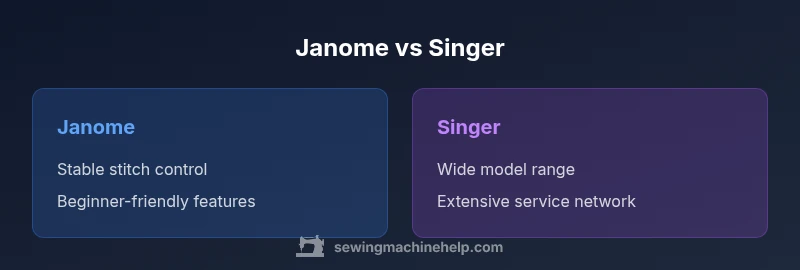
According to Sewing Machine Help, answering whether is janome sewing machine better than singer depends on what you sew and how you work. Janome generally emphasizes stable stitch control, quiet operation, and beginner-friendly setup, while Singer offers broader model variety and a wide service network. The best choice depends on your budget and projects.
Is janome sewing machine better than singer? Key Differences
According to Sewing Machine Help, is janome sewing machine better than singer is a nuanced question. The phrase is janome sewing machine better than singer appears in many consumer discussions, but practical guidance shows that the answer hinges on your typical projects, space, and budget. In practice, Janome tends to deliver consistent stitches, quiet operation, and a gentle learning curve that helps beginners gain confidence quickly. Singer, on the other hand, shines with model variety and a broad service network that makes it easier to find parts and support. The takeaway from expert analysis is simple: your choice should align with your most common fabrics, the pace of your projects, and how much you value maintenance ease and access to accessories.
Core Criteria for Comparing Brands
When weighing Janome vs Singer, focus on core criteria that translate to real-world use. Key factors include stitch quality and consistency, ease of use and threading, maintenance costs and parts availability, model variety across beginner to advanced tiers, warranty terms, and the availability of service centers in your area. For beginners, intuitive interfaces, automatic tension, and clear guides matter most. For more advanced sewists, consider features such as speed control, foot compatibility, and the breadth of the built-in stitch catalog. Remember, the best choice balances initial cost with long-term ownership costs, including accessories and routine servicing.
Brand Positioning and Ecosystems
Janome positions itself around reliable stitch control and a cohesive ecosystem of compatible feet and accessories, often emphasizing a straightforward learning curve for beginners. The brand tends to favor models that maintain consistent performance across a range of fabrics. Singer markets a broad ladder of models with extensive accessory options and a large service footprint, which can be a significant advantage in regions with robust retail networks. The ecosystem matters because owning a machine is not just about the core unit; it’s about feet, bobbins, needles, and available repairs. In practice, you may find Janome’s lineup better suited to steady, predictable projects, while Singer may offer broader choices for those who want a wide feature set and easy access to parts.
Performance, Reliability, and Craftsmanship
In day-to-day sewing, performance is measured by how smoothly a machine handles a variety of fabrics, from delicate knits to sturdy denim. Janome models are frequently praised for consistent stitch quality and smooth feeding, with thoughtful design elements that reduce friction during threading and fabric feeding. Singer models are often lauded for their versatility and wide array of built-in stitches, which can be advantageous for decorative sewing and quick garment construction. Reliability for both brands sits on maintenance habits: regular cleaning, oiling where required, and timely servicing. The practical takeaway is simple—choose a model whose performance aligns with your most-used fabrics and your maintenance routine, rather than chasing the most features.
Price, Ownership Costs, and Value
Price remains a central consideration. Janome mid-range machines often prioritize build quality and durability, which can translate into lower long-term maintenance costs per project. Singer tends to offer more budget-friendly options with a broad feature set that can deliver compelling value at a lower upfront price. Ownership costs extend beyond sticker price and include replacement feet, bobbins, needles, and service visits. Regional availability and local service networks can sway total cost of ownership more than the advertised price. If your projects are simple and you value cost-effective upgrades, a budget Singer may provide excellent value; if you expect frequent use and long-term dependability, a Janome setup could prove more economical over time.
Practical Decision Framework for Beginners
For newcomers, a practical, repeatable framework makes choosing easier. First, list your top three projects and identify which features matter most for those tasks. Second, test machines side-by-side—spin handles, test tension, and assess how intuitive the threading path feels. Third, verify the availability of compatible feet and accessories, and confirm service options in your region. Fourth, estimate annual maintenance costs and accessory purchases, then compare to the purchase price. Finally, seek in-store demonstrations and read user reviews to gain real-world insight. The goal is to minimize friction in your daily sewing routine while staying within budget.
Common Myths and Misconceptions
Several myths persist about these brands. One common myth is that a higher stitch count automatically yields better results; in reality, stitch quality depends on calibration, tension, and fabric handling. Another misconception is that brand-name guarantees lower maintenance costs; while some brands offer proven reliability, replacement feet, bobbins, and parts are often model-dependent. A further myth is that service networks guarantee universal support; while coverage is strong in many regions, local technicians’ familiarity with specific models varies. Debunking these myths helps you focus on actual usage needs, long-term costs, and how well a machine integrates into your routine.
In-Store Testing Checklist
When evaluating models in store, use a practical checklist. Start with threading and tension tests on your usual fabrics. Check feed stability, noise level, vibration, and how smoothly the presser foot lifts. Test speed control and the ease of changing feet. Verify the availability of essential accessories and the ease of obtaining parts. Finally, compare warranty terms and what is covered. A hands-on approach is the best way to gauge whether a machine feels right for your hands and your projects.
Real-World Scenario Guides
Think through practical scenarios to inform your choice. If most of your work involves lightweight fabrics and you prefer a compact, quiet machine, Janome can be compelling. If you regularly tackle a wide range of stitches for creative garments and decorative projects, Singer’s broader model range may offer better value. For sewists who travel or move between locations, the breadth of service networks matters. A pragmatic strategy is to compare two to three models from each brand in the same price tier and assess how each feels during long sessions. Your final decision should hinge on daily usability and long-term support rather than a single feature.
Comparison
| Feature | Janome | Singer |
|---|---|---|
| Target user | Beginner-friendly, dependable performance | Budget-conscious buyers with broad model choices |
| Stitch options | Strong core stitches and stable control | Extensive built-in stitches in many price tiers |
| Ease of maintenance/parts | Good parts availability, reputable service | Wide service network and parts availability |
| Price range | Mid-to-upper range emphasis | Wide spectrum from budget to premium |
| Best for | Projects requiring consistent results | Users seeking variety and value across models |
Strengths
- Strong stitch control and reliable presser-foot action
- Solid build quality across a broad price range
- Extensive service networks support long-term ownership
- Good availability of compatible accessories and feet
Negatives
- Price bands vary by region, complicating comparisons
- Model-specific features may not translate across brands
- Some advanced features appear only on higher-end models
Neither brand is universally better; choose based on your projects, budget, and preferred support.
For beginners who value ease and consistent results, Janome is a strong fit. If you need broad model variety and a wide service footprint, Singer may offer better overall value. The best path is hands-on testing and comparing models within your budget.
Your Questions Answered
Is Janome generally easier for beginners than Singer?
In many cases, yes. Janome models are designed with intuitive interfaces and reliable basic performance, which helps beginners gain confidence quickly. However, Singer also offers beginner-friendly options across its model range. Your experience will depend on the specific model and how you approach learning.
Yes—many beginners find Janome easier to start with, but choose a model that matches your comfort level and projects.
Do Janome machines have better stitch quality than Singer?
Stitch quality is model-dependent rather than brand-wide. Both brands offer reliable stitching; the difference often comes down to setup, maintenance, and how you handle fabrics. Test stitching on your typical fabrics to see which meets your needs.
Stitch quality depends on the model and setup, not just the brand.
Which brand has better service networks?
Singer generally has a broad global service footprint, which can make repairs easier in many regions. Janome also offers solid service in many markets, but availability varies by country. Check local dealer support and service accessibility when choosing a model.
Service networks matter—check local availability before buying.
Are there big price differences between Janome and Singer models?
Prices vary widely within each brand, depending on features, build quality, and included accessories. In general, Singer covers a broader price range, while Janome emphasizes durability in its mid-to-upscale lines. Always compare similar feature sets side-by-side.
Prices vary by model; compare like-for-like features across brands.
Should a beginner buy Janome or Singer for quilting?
Both brands offer quilting-capable models, but Janome’s quilting-focused options often emphasize stable stitch quality and easy setup, which can be advantageous for beginners exploring quilting. If you want a broader range of stitches and accessories, Singer’s options could be appealing. Test the specific quilting features you’ll use most.
For quilting, try models specifically marketed for quilting from either brand and test their quilt-focused features.
How do I test a Janome vs Singer in-store?
Visit a local dealer, bring a sample of your common fabrics, and test threading, tension, and stitch quality across several fabrics. Check ease of changing feet, switching stitches, and the availability of service and warranty terms. Take notes on which machine feels most natural to operate over a 20–30 minute session.
Test threading, tension, and fabric handling side-by-side; note which machine feels most comfortable to use.
The Essentials
- Test models side-by-side to reveal real differences
- Prioritize service networks as a major decision factor
- Balance upfront cost with long-term maintenance costs
- Focus on projects you actually do and required features
- Choose a model that fits your daily workflow, not marketing claims