Oldest Sewing Machine Brand: A Historical Overview
Explore the oldest sewing machine brand and its early history. This overview traces Singer’s 1851 founding and compares Pfaff (1862) and Bernina (1893), highlighting how founding dates shape brand legacies.


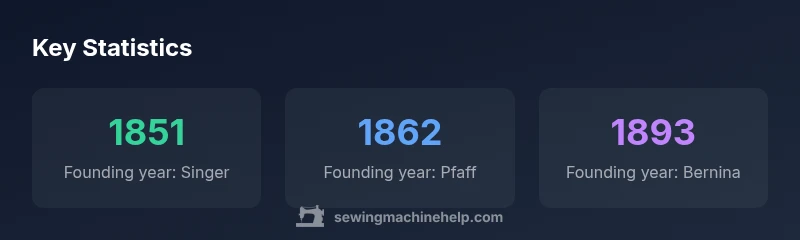
The oldest sewing machine brand still widely recognized is Singer, founded in 1851. Singer quickly grew into a global name and remains a dominant historic brand, with Pfaff (1862) and Bernina (1893) following in the early years. This article examines founding dates and the historical context to explain why 'oldest' is often debated but Singer is typically cited.
Historical context of the oldest sewing machine brand
The phrase 'oldest sewing machine brand' often centers on founding dates in the 19th century. While the earliest patents date to the 1840s, the emergence of enduring brands begins with Singer, established in 1851. Singer's early factory production and licensing helped spread sewing machines worldwide, cementing its place in history. Other early brands such as Pfaff (founded 1862 in Germany) and Bernina (founded 1893 in Switzerland) followed, shaping how households and small businesses adopted sewing technology. The distinction between 'oldest' and 'oldest surviving brand' matters because some early entities merged, renamed, or vanished, while the brands that persisted launched generations of models and innovations. For home sewists, understanding this lineage provides context for evaluating modern machines from brands with long legacies.
Founders and early milestones
Elias Howe's 1846 patent set the stage, but the branding era truly opened with Isaac Singer's 1851 company. The move from individual inventor to mass-producing company allowed consumer access, setting a pattern for international distribution. By the late 1850s and 1860s, Pfaff and other European firms introduced more precise mechanisms, and by the end of the century, several brands had established global networks. These milestones are essential to appreciate because they explain why 'oldest' is often measured by founding date, product line breadth, and the ability to endure through changing ownership structures. The result is a landscape where early brands either survived by adaptation or faded as markets consolidated.
How 'oldest' is defined in practice
In historical discussions, 'oldest' can refer to different benchmarks: the earliest patent, the oldest company formation, or the longest continuously operating brand. Some sources emphasize the patent date (1846 for Howe); others stress the founding year (1851 for Singer). Yet continuity matters too: a brand that persisted through mergers, name changes, or licensing agreements may still be considered 'oldest' in terms of lineage. For researchers and enthusiasts, clarifying the chosen benchmark helps avoid confusion when comparing brands across regions and generations.
The leading candidates from the 19th century
Among the earliest brands, Singer stands out for its 1851 founding and subsequent scale-up, which helped standardize domestic sewing in homes and factories. Pfaff, founded in 1862 in Germany, became renowned for precision mechanisms and durable construction. Bernina, established in 1893 in Switzerland, carved a niche in reliable domestic machines with innovative features. Together, these brands illustrate how the 19th century produced a trio of names that many collectors and historians use as reference points when discussing the 'oldest' sewing machine brand and its legacy. Each brand influenced design language and repair practices well into the 20th century.
Brand evolution through mergers and acquisitions
The 20th century saw many sewing machine brands absorbed by larger groups, rebranded, or licensed to different manufacturers. These corporate shifts complicate claims about 'oldest' status, since the original company may no longer exist in its early form even as the brand survives. For home sewists, this means focusing on artifacts, model lines, and serial-number provenance rather than the corporate umbrella alone. A brand with deep archival catalogs and widely available parts often remains a reliable reference point for vintage machines, regardless of ownership changes.
Regional trajectories: Europe vs United States
In the United States, mass production and a rapid expansion of distribution helped Singer set the standard early on, with many regional brands eventually merging into larger corporations. In Europe, Pfaff and Bernina cultivated specialized workshops, emphasizing craftsmanship and long-term serviceability. These regional trajectories shaped how households and small shops adopted sewing technology, and they continue to influence modern restoration markets. For hobbyists, recognizing these regional patterns can guide gear selection, restoration priorities, and parts sourcing when dealing with machines that claim a long lineage.
Collecting, restoration, and verifying authenticity
Authenticating a machine's age involves comparing serial numbers, model catalogs, and factory marks, rather than relying solely on branding claims. Deep catalogs from Singer, Pfaff, and Bernina provide reference points for dating models; however, parts availability and machine condition often play a larger role in restoration success. Collectors should also consider the machine's provenance, such as documented repair history or historical advertisements. By following best practices in restoration, hobbyists can preserve the legacy of these early brands while maintaining functional machines for modern use.
Practical guidance for hobbyists seeking legacy brands
If your goal is to connect with the 'oldest sewing machine brand' lineage, start with a model known for long production runs and strong parts availability. Check the serial number against brand catalogs, verify gear train design, and assess the availability of replacement bobbins and oiling points. Consider attending a local antique sewing machine show or joining a collector group to learn model-specific cues. Finally, balance age with practicality: some 19th-century designs are charming but may require more maintenance than late-20th-century successors.
Wrap-up and notes for readers
The history of the oldest sewing machine brand is a story of innovation, globalization, and corporate evolution. Singer's 1851 founding remains a pivotal reference point, with Pfaff and Bernina following in the decades that shaped early domestic and industrial sewing. By understanding these founding years and brand legacies, home sewists can better appreciate the machines they encounter, whether restoring a vintage model or evaluating a modern option from a brand with a centuries-long lineage.
Founding years and origins of early sewing machine brands
| Brand | Founding Year | Country of Origin | Notable Early Role |
|---|---|---|---|
| Singer | 1851 | USA | Pioneered mass production and accessibility |
| Pfaff | 1862 | Germany | Early high-precision machines |
| Bernina | 1893 | Switzerland | Early luxury domestic machines |
Your Questions Answered
Which brand is considered the oldest sewing machine brand?
Most sources cite Singer as the oldest surviving sewing machine brand, founded in 1851, though the claim can vary by how one defines 'oldest' (patent vs. company).
Singer is commonly cited as the oldest surviving sewing machine brand, with other early names like Pfaff and Bernina following soon after.
Were there sewing machine brands older than Singer?
There were earlier patents (e.g., Howe in 1846), but Singer is typically referenced as the oldest surviving brand due to sustained operation and broad production.
There were earlier patents, but Singer is usually the first enduring brand.
What defines 'oldest' in sewing machine history?
Oldest can mean earliest patent, earliest company formation, or longest continuous operation; different definitions yield different brands as the oldest.
Oldest depends on whether you count patents, company formation, or continuous operation.
Which brands from the 19th century still operate today?
Today, Singer, Pfaff, and Bernina remain active brands, though under different corporate structures and ownership.
Yes—Singer, Pfaff, and Bernina are among brands still active today, though owned by different groups.
“Founding dates illuminate how the sewing machine industry shifted from individual invention to global brands that endured through decades of change.”
The Essentials
- Identify oldest brand using founding-year context
- Singer's 1851 founding marks a pivotal era
- Pfaff and Bernina followed in the 19th century
- Brand longevity depends on continuity and archives