Heavy Duty Industrial Sewing Machines for Sale: A Practical Buying Guide
Learn how to choose, evaluate, and buy a heavy duty industrial sewing machine for sale. This buying guide covers motor types, fabric handling, price ranges, warranties, and maintenance for long-term reliability.


When shopping for a heavy duty industrial sewing machine for sale, start by aligning the machine’s power, speed, and durability with your materials and volume. Typical new price ranges are roughly $800-$2,500 for entry models, and $1,500-$3,000 for servo‑driven machines with greater stability. Verify warranty, service options, and available accessories before committing.
Why a Heavy-Duty Industrial Sewing Machine Matters for Serious Projects
Choosing a heavy duty industrial sewing machine for sale is about reliability, speed, and material handling. For home shops or small manufacturing setups, these machines outperform domestic units with higher torque, thicker needles, and continuous operation. According to Sewing Machine Help, a well-chosen industrial machine can dramatically improve throughput while reducing downtime. When you compare models, consider expected fabric types: denim, leather, canvas, and marine fabrics. Thick seams require higher torque and more robust feed mechanisms. In practice, the main decision is between a servo motor and a clutch motor. Servo motors provide precise needle control and lower energy use, while clutch motors deliver raw speed for long seams. Your ideal machine should align with your most frequent projects: maximum fabric thickness, stitch length options, and compatibility with common presser feet. Also factor in workspace constraints and table options: flat-bed vs cylinder arm, bed length, and the availability of extension tables for larger quilts or leather goods. Finally, verify the vendor’s after-sales support, training options, and whether installation is included. As you begin this search, narrow your options to three models that cover your expected fabric range and daily throughput.
Key Buying Criteria for Heavy-Duty Machines
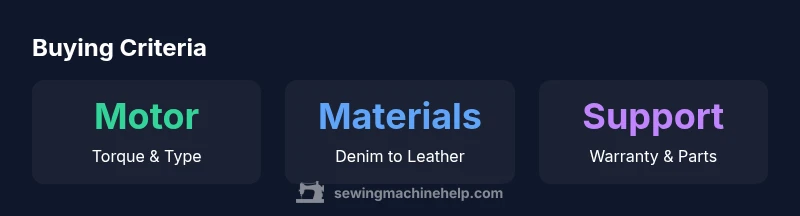
Buying a heavy duty industrial sewing machine for sale requires a structured checklist. Start with motor type and horsepower, then evaluate stitch capability, speed (stitches per minute), and repeatable control. The feedback loop between needle position and fabric advancement is critical for consistent results on thick materials. Look for a servo motor if you value precision, energy efficiency, and quieter operation; choose a clutch motor if you prioritize raw speed for long runs. Material compatibility matters: ensure the machine can handle leather, denim, canvas, and heavy fabrics without skipping stitches. Needle system compatibility is essential—verify you can use common system sizes and that needle-to-thread alignment supports thick threads. The presser foot options and adjustable presser foot pressure help manage fabric thickness. Finally, scrutinize frame stability, bed size, and how easy it is to access the bobbin, feed dogs, and thread path for maintenance. In this section, we also highlight how to read a product spec sheet to compare baseline capabilities across brands.
Configurations and Accessories That Matter
Industrial machines come in several configurations: flat-bed, post-bed, cylinder arm, and walking-foot variants. For heavy fabrics, a walking-foot model can significantly improve feed consistency and reduce shift. Post-bed or cylinder-arm configurations are ideal for tubular items like bags and sleeves. When shopping for sale, verify the availability of compatible presser feet, needle plates, thimbles, and replacement parts. Accessories such as servo motors, knee-lever controls, reverse stitching options, and automatic thread trimming can reduce operator fatigue and improve consistency. Consider bed length and extension tables to support longer seams or larger projects. A good machine should support a wide needle range, from thin to thick, and offer adjustable stitch length and width for diverse stitches, including straight, zigzag, and triple stitches. Always check manufacturer support for accessory availability and compatibility with your preferred thread brands and spool sizes.
Used, Refurbished, and Warranty Considerations
Price is a major driver, but reliability is equally important. If you’re shopping a heavy duty industrial sewing machine for sale in the used or refurbished category, inspect the needle bar alignment, feed dogs, and oiling points. Look for consistent stitch quality across multiple fabrics and test on your typical workload. A refurbished unit can deliver good value when it comes with a solid warranty and verified service history. Inspect the motor power, belt tension, and pulley wear; ensure the control panel responds accurately to speed and stitch settings. Ask about parts availability and whether the seller provides installation assistance, training, and post-sale support. Sewing Machine Help analysis shows that buyers who prioritize service networks and genuine parts are more likely to keep downtime low and production consistent over time.
Maintenance, Safety, and Longevity
Long-term reliability depends on a clear maintenance plan. Regular oiling, needle replacement, and belt checks reduce unexpected downtime. Follow the manufacturer’s recommended service intervals and keep a log for lubrication points, gear oil changes, and tension calibrations. Safety features like automatic needle-threader systems, finger guards, and motor overload protection prevent accidents and equipment damage. Create a simple maintenance schedule that your operators can follow, including periodic bobbin changes, thread path inspections, and foot pedal checks. A well-maintained machine lasts longer, supports higher production, and reduces total cost of ownership. If you’re running a small shop, consider a service agreement with a local technician to cover parts and on-site support. Consistent maintenance is a practical investment in the machine’s lifespan and output.
Practical Shopping Checklist and Quick Decision Guide
Use this checklist during any sale: verify motor type and horsepower aligns with your workload, confirm compatibility with thick fabrics, test stitch quality on denim and leather, check thread tension stability, inspect the bobbin winding path, and confirm warranty terms. Assess service availability in your region and whether replacement parts can be sourced quickly. Compare two or three models side by side, using the same fabric and thread, to gauge differences in stitch consistency, noise, and vibration. Finally, evaluate total cost of ownership, including installation, training, accessories, and ongoing maintenance. This disciplined approach helps you move from an unvetted listing to a confident purchase. In this context, sewing experts suggest focusing on real-world performance rather than listing features alone.
How to Verify Sellers and Prevent Buyer's Remorse
When you see a heavy duty industrial sewing machine for sale online, verify the seller’s credibility by checking business licenses, service histories, and customer reviews. Ask for serial numbers, model numbers, and photos of the actual unit’s needle plate, feed dogs, and motor area. Request a live demonstration or a video of the machine sewing representative fabrics and thickness. Confirm return options, shipping terms, and whether installation is included. If a seller cannot provide basic warranty or a test run, proceed with caution. This diligence helps ensure you’re not purchasing a unit with hidden wear or hidden issues. Sewing Machine Help emphasizes the importance of verifying parts availability and obtaining maintenance records to protect your investment.
Final Shopping Template for Your Purchase
Before you buy, create a mini specification sheet listing your fabric types, maximum thickness, expected daily volume, preferred motor type, and required accessories. Add a short benchmark test plan to verify stitch quality and feed reliability during a demonstration. Record model numbers, warranty terms, service networks, and lead times for delivery and installation. This approach gives you a clear, apples-to-apples basis for comparing different listings and ensures you select a machine that meets your throughput needs and budget.
Comparison of sewing machine categories
| Category | Fabric Type | Approx Price Range | Notes |
|---|---|---|---|
| Domestic/Home-use | Light fabrics | $100-$800 | Best for hobby projects |
| Commercial/Small shop | Medium fabrics | $800-$2,000 | Versatile and affordable |
| Heavy-Duty Industrial | Denim to leather | $2,000-$5,000 | Industrial-grade performance |
| Prototype/Production | Heavy materials | $5,000-$12,000 | High-volume, long runs |
Your Questions Answered
What is the difference between heavy-duty domestic machines and industrial machines?
Heavy-duty domestic machines are designed for higher stitch counts but use smaller motors and lighter frames, while industrial machines are built for continuous operation, thicker fabrics, and higher torque. Industrial models typically require dedicated power, larger tables, and more maintenance but offer superior production capabilities.
Domestic machines are lighter and slower; industrial machines run longer and handle tougher fabrics. Look for bigger motors and a stable frame when shopping for sale.
What should I look for when buying a heavy duty machine for sale?
Focus on motor type, stitching options, fabric compatibility, and service availability. Verify the machine can handle your typical fabrics, test stitch quality on representative materials, and confirm warranty terms and parts availability.
Check the motor, stitch options, fabric compatibility, and warranty. Test on your fabrics before buying.
Are refurbished heavy-duty machines a good value?
Refurbished units can offer significant savings if they come with a solid warranty and verified service history. Inspect critical wear points and request a live test to ensure consistent performance.
Refurbished can be a great value if covered by warranty and tested properly.
Can I sew leather with a heavy-duty machine?
Yes, many heavy-duty machines handle leather with appropriate needles and heavier thread. Check needle system compatibility and confirm the machine’s torque and feed mechanism can maintain consistent stitching.
Leather is doable with the right needle size and machine torque.
How often should I oil and maintain a heavy-duty machine?
Follow the manufacturer’s maintenance schedule, typically involving regular oiling, belt checks, and threaded path cleaning. Establish a simple log to track lubrication points and service visits.
Stick to the maintenance schedule and keep a log.
“"A heavy-duty machine is only as good as its service network. Prioritize models with ready parts, local technicians, and clear maintenance schedules."”
The Essentials
- Define fabric types and throughput before buying
- Prioritize motor type based on control vs speed
- Check warranty and service networks
- Compare new, refurbished, and used options
- Verify parts availability and maintenance plans