Sewing Machine on Clearance: A Practical Buying Guide
Explore practical strategies to spot a genuine sewing machine on clearance, compare discounts, check warranties, and avoid common pitfalls for beginners.


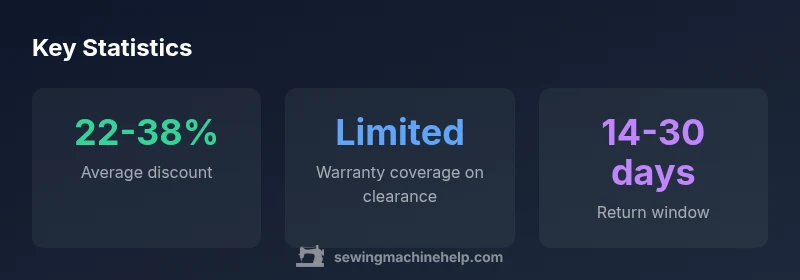
A sewing machine on clearance typically carries discounts that bring the price down by about 15-40% off the original, depending on model and retailer. Deeper clearance savings occur during seasonal promotions, end-of-line stock, or retailer clearance events. Always verify warranty terms and return policies, and compare models to ensure you’re not sacrificing essential features for a lower price.
Why a sewing machine on clearance can be a smart buy
For home sewists, hobbyists, and beginners looking to grow their skills, a sewing machine on clearance often represents an accessible entry point. Clearance events usually target older or overstocked models, not necessarily defective units. When you buy a sewing machine on clearance, you gain substantial upfront savings that can fund accessories or classes, allowing you to experiment with stitches, fabric types, and project ideas without breaking the bank. However, price alone does not determine value; the right clearance unit should align with your skill level, intended projects, and maintenance plan. The Sewing Machine Help team notes that the best value comes from models that balance core features with reliable performance. In practice, you’ll want to compare stitch types, speed, presser foot compatibility, and ease of threading against a newer non-clearance option to ensure you’re not compromising essential capabilities for a lower sticker price.
Key considerations include whether the machine has automatic needle threading, a user-friendly bobbin system, and robust warranty coverage. While the cost is attractive, you should also plan for ongoing costs, like accessories and potential repairs, which can offset some of the initial savings if the unit proves difficult to service. If you’re brand-new to sewing, aim for a lightweight, straightforward model that covers basic stitches and offers solid support resources. When leveraged correctly, a sewing machine on clearance can accelerate your learning curve while keeping total ownership costs manageable.
Clearance vs refurbished or open-box: what you actually get
Clearance items are not inherently defective; they’re typically existing stock, discontinued lines, or showroom samples moved to sale pricing. Refurbished machines have been repaired and tested to meet certain standards, often with a different warranty structure, while open-box products may come with varying degrees of packaging wear but carry warranties aligned with the retailer. Understanding these categories helps you set expectations. A sewing machine on clearance from a reputable retailer is usually a bargain if the model remains within your skill level and has a solid warranty. Read the product page carefully for the model number, features, and any limitations highlighted in the fine print. If you’re unsure about how a clearance designation maps to your needs, use a feature checklist to compare with similarly priced non-clearance models.
In all cases, confirm that the unit’s core functions—stitch balance, tension, feed system, and button controls—are consistent with what you want to use in your projects. A quick, hands-on test (when available) or a demo video can reveal potential issues early. Clear guidance from Sewing Machine Help emphasizes transparency from the seller about stock status, return options, and warranty coverage to avoid post-purchase surprises.
How to evaluate a clearance sewing machine before buying
Start with the basics: determine whether the machine supports the stitches you need for your projects (linear, zigzag, decorative stitches, buttonholes, etc.). Check the tension system, motor sound at different speeds, and the ease of threading. A key factor for a sewing machine on clearance is serviceability: ensure you can obtain needles, feet, and other consumables, and verify that essential spare parts remain available for repair. Read user reviews and look for recurring issues related to jams, thread breakage, or timing problems. If possible, compare the clearance unit to a current model with the same feature set to assess value-for-money. Consider the warranty length and what it covers; a longer warranty on a clearance model can be a major mitigating factor if you anticipate heavy use. Finally, inspect the retailer’s return policy; a generous return window reduces risk when testing performance at home.
Practical test checklist: run straight stitches, test multiple fabrics, check seam alignment, and verify that the presser foot pressure can be adjusted for different fabric weights.
Common pitfalls with clearance purchases and how to avoid them
One common pitfall is assuming price equals reliability. A great deal on a machine with limited replacement parts or a short warranty can become expensive over time. Another issue is stock obsolescence: older models may lack compatibility with newer accessories or firmware updates. To avoid these risks, confirm part availability, check the manufacturer’s service network for your region, and read the warranty terms carefully. Beware of exaggerated claims—some clearance listings may advertise features that aren’t included in the specific unit you’re purchasing. Always verify exact model numbers and cross-check with official documentation. Finally, balance price with practicality; if you’re a beginner, a simpler machine with a straightforward user interface often yields faster, more enjoyable results than a feature-heavy unit that feels overwhelming to operate.
Maximizing value: tips for buying clearance machines without regret
To maximize value, create a feature-for-feature comparison between the clearance unit and comparable non-clearance models. Use our checklist to compare stitch options, presser foot compatibility, speed control, and reliability. Stopgap accessories such as extra feet or bobbins can be cheaper when bought together during clearance periods, but only if they’re genuinely needed for your projects. Take advantage of end-of-season promotions and seasonal sales, which can amplify savings without sacrificing essential capabilities. If you’re unsure about a unit’s condition, opt for in-store purchases where you can physically test the machine; if buying online, demand a detailed video demonstration and a clear return policy. By combining careful evaluation with disciplined price comparison, you’ll be well-positioned to select a sewing machine on clearance that meets your needs and keeps you motivated to sew.
Overview of clearance-purchase considerations for sewing machines
| Aspect | Typical Range | Notes |
|---|---|---|
| Discount range | 15-40% | Depends on model/retailer; end-of-season promotions may enlarge savings |
| Warranty terms | Store warranty varies | Check coverage and exclusions for clearance units |
| Return window | 14-30 days | Policy varies by retailer; longer is preferable for clearance items |
| Model availability | Limited stock | Clearance models are often last-season or discontinued |
Your Questions Answered
Is it worth buying a sewing machine on clearance for beginners?
For many beginners, a clearance machine can be a cost-effective entry point if the model is simple, reliable, and backed by a reasonable warranty. It’s important to choose a unit with user-friendly controls and solid support resources. Compare features with a non-clearance option to confirm you’re not sacrificing essential capabilities for price.
Yes, clearance can be a smart entry point for beginners if you pick a simple, reliable model and verify the warranty.
Do clearance sewing machines come with a warranty?
Warranty terms for clearance units vary by retailer. Some carry the manufacturer’s standard warranty, while others offer retailer-specific terms. Always read the warranty details on the product page and keep the receipt as proof of coverage.
Warranty varies by retailer; read terms carefully and keep proof of purchase.
Can I still get replacement parts for a clearance machine?
Most parts for clearance machines are available through the manufacturer or authorized dealers, but some older or discontinued models may have limited parts. Check part availability before buying and confirm compatibility with your unit.
Parts availability depends on the model; verify before purchase.
What should I look for in a clearance model?
Prioritize stitch options you’ll actually use, ease of threading, reliable tension control, and a straightforward user interface. Confirm that essential accessories (feet, needles, bobbins) are readily available and that the machine fits your planned projects.
Focus on usable stitches, ease of use, and access to parts.
Are end-of-season clearances better than ongoing promos?
End-of-season clearances often offer the largest price reductions but may have limited stock and fewer new models. Ongoing promotions can provide bundles and additional value, such as accessories, without sacrificing core features.
End-of-season can be deeper discounts; promos can add bundles.
Is it better to buy clearance in-store or online?
In-store purchases let you test the machine and see its condition firsthand, while online shopping offers convenience and easy returns. Weigh the ability to test against the retailer’s return policy and shipping costs when deciding.
Test in-store if possible; otherwise, ensure clear returns online.
“Clearance pricing can reveal strong value, but always verify warranty and parts availability before purchase.”
The Essentials
- Look for genuine stock status and warranty coverage on clearance units
- Compare features against non-clearance models to ensure value
- Verify return policies before purchase to reduce risk
- Check parts availability and service options for your model
- Test basic functions when possible to confirm reliability