Sewing Machine Without Foot Pedal: A Practical Guide
Learn safe, hands-free sewing with a machine lacking a foot pedal. This guide covers speed control, alternative pedal-free options, and practical steps for beginners.


Goal: Learn to sew with a sewing machine without a foot pedal. This quick guide covers safe power-on methods, alternate speed controls, and practical setups for hands-free operation. By the end you’ll know when to use a knee lift, hand control, or external speed controller and how to adjust stitch speed safely.
What pedal-free sewing means and who it helps
Sewing machine without a foot pedal refers to machines operated without the traditional pedal under the foot. Instead, you control speed with a start/stop button, a speed dial, or an external controller. This setup is popular for accessibility, beginners who prefer top-down control, and crafters who need steady, repeatable stitch speeds. According to Sewing Machine Help, pedal-free configurations can simplify learning curves and reduce fatigue during long sewing sessions. In this section you’ll learn the basic concepts, typical limitations, and how to assess whether pedal-free sewing fits your projects and workspace. Expect to find practical guidance, safety reminders, and real-world scenarios that illustrate when pedal-free sewing shines and when it may be less convenient.
Core alternatives to pedal operation and speed control
Most pedal-free workflows rely on one or more of these mechanisms: a start/stop button to power the machine on or off, a speed controller or electronic interface that sets a maximum stitch rate, and a knee lift or hand-operated lever to keep both hands on fabric. The important part is consistency: choose a control method you can operate without looking away from the needle. Based on Sewing Machine Help analysis, many hobbyists find a dedicated start/stop switch plus a reliable speed dial offers the most predictable results for beginner-friendly projects. Keep in mind that some fabrics require slower, steadier feeds, which means practice and controlled hand guidance are essential even with pedal-free systems.
Comfort and safety when you don’t use a foot pedal
Without a foot pedal, machine handling relies on proactive safety habits. Always test new speed settings on scrap fabric before tackling a project. Ensure your work surface is stable, with ample lighting and a non-slip mat to prevent shifting. If you use a knee lift, position your leg naturally so you can switch between fabric guiding and speed control without overreaching. Avoid sudden speed changes that can cause skipped stitches or fabric jams. The goal is predictable, repeatable results that you can reproduce block by block.
Step-by-step: setting up pedal-free operation for a project
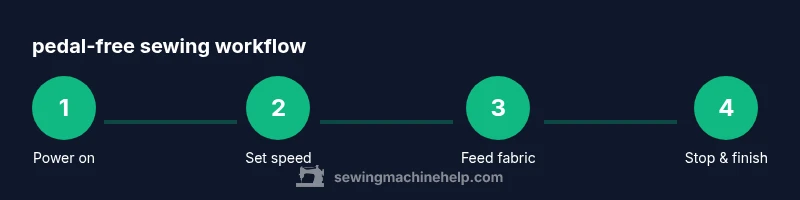
- Power on the machine using the start/stop switch and select a conservative speed. This gives you immediate control without needing to reach for a pedal. 2) Attach the fabric, lower the presser foot, and align your stitch length with the project requirements. 3) Practice a few straight stitches on scrap fabric to gauge how quickly the machine responds to speed controls. 4) Transition to the actual sewing, maintaining steady fabric guidance with both hands. 5) If you need to stop, use the dedicated stop mechanism before lifting the needle or changing direction. 6) When finished, power down and perform a quick maintenance check.
Safety tips and common mistakes to avoid
- Pro-tip: Always test at slow speeds on scrap fabric first, especially with new materials. - Warning: Do not reach under the needle while the needle is moving; use the stop button to halt operation. - Note: Keep fingers well away from the feed dogs while feeding fabric, and never override speed controls with force.
Maintenance and care for pedal-free setups
Pedal-free machines still require regular maintenance—clean lint from under the presser foot, oil according to the manual, and verify that the knee lift or alternate control is functioning smoothly. Periodically check the wire connections for the start/stop switch and the speed controller to prevent intermittent operation. A clean, well-lubricated machine resists jams and produces more consistent stitches, which is especially important when you are relying on non-traditional controls.
Troubleshooting pedal-free operation
If the machine starts too fast or hesitates when you press the start button, first verify that your speed control is set to a safe maximum. Check the knee lift and any levers to ensure they return smoothly to neutral. If you notice inconsistent stitch length, recheck the needle, thread path, and bobbin rotation. When in doubt, perform a factory reset if your model supports it, and consult the service manual for model-specific guidance.
Tools & Materials
- Sewing machine with start/stop capability(Must be operable without a foot pedal (start/stop button or speed toggle))
- External speed controller or electronic interface(Use if your machine supports pedal-free speed regulation)
- Knee lift or knee-control lever(Helps keep hands on fabric; check compatibility with your machine)
- Sewing-machine manual(Reference for your model’s safety and setup steps)
- Scrap fabric for test stitches(Use inexpensive fabric to test speed changes)
- Thread, bobbins, and needles(Carry a small supply for quick swaps)
- Non-slip mat or stable work surface(Improves stability during pedal-free sewing)
Steps
Estimated time: 25-40 minutes
- 1
Power on and select initial speed
Use the start/stop button to power the machine. Set an intentionally slow starting speed to gauge response. The goal is to have repeatable control without sudden acceleration as you begin stitching.
Tip: Choose a conservative speed to build familiarity before handling delicate fabrics. - 2
Prepare fabric and insert needle
Place fabric under the presser foot, align with guide lines, and insert the needle at the correct angle. Lower the presser foot to secure the fabric before feeding it forward.
Tip: Ensure fabric lies flat to prevent snags when speed changes occur. - 3
Practice straight stitches on scrap
Run a few inches of straight stitches on scrap, adjusting speed using the controller to feel how quickly the machine reacts.
Tip: If the stitch wobbles, slow down and recheck thread path and needle size. - 4
Shift to a real project
Begin your project with controlled, even feeds. Keep both hands on the fabric while guiding it and use the knee lift to reposition as needed.
Tip: Avoid sudden direction changes; plan your seam line ahead of time. - 5
Pause and inspect
Stop the machine with the control, lift the presser foot, and inspect the seam. Confirm stitch length and tension before continuing.
Tip: Pause often on new fabrics to catch issues early. - 6
Finish and power down
Complete your final seam, power off, and perform a quick post-sewing check (clean lint, rethread needle, store supplies).
Tip: Document any adjustments that worked well for future projects.
Your Questions Answered
Is a foot pedal ever required for basic sewing tasks?
No for many beginner projects. Pedal-free machines can handle straight stitches and simple seams with alternative speed controls. Some advanced tasks may still benefit from a pedal for micro-adjustment.
Pedal-free options work for many basic tasks; if you need ultra-fine control, you might use other methods instead of a pedal.
Can I use a knee lift with any sewing machine?
Knee lifts require specific mounting points or compatible accessories. Check your model’s manual or consult the manufacturer’s site to confirm compatibility before purchasing.
Not every machine supports a knee lift—check your model first.
What should I do if the machine starts at full speed unexpectedly?
Stop the machine using the stop control, reset speed to a low setting, and re-test on scrap fabric. Inspect the speed controller and wiring for any faults.
If it suddenly speeds up, stop, reset, and test on scrap fabric.
How do I thread the machine for pedal-free operation?
Threading is the same as usual, but ensure the thread path is smooth and consistent to prevent tangling at higher speeds.
Threading is the same; just keep paths clean and tensions correct.
Are there safety risks with pedal-free sewing?
Yes, risks include unintended starts or rapid speed changes. Always use shielded controls, keep hands clear of the needle, and never leave the machine unattended when powered.
There are safety concerns—always use controlled start/stop and keep hands away from moving parts.
Watch Video
The Essentials
- Master pedal-free control with a start/stop method
- Use knee lift to keep hands free and control speed
- Practice on scrap fabric before tackling a real project
- Maintain safety by testing and pausing regularly