Brother Embroidery Machine Price: A Practical Buying Guide
Explore Brother embroidery machine price ranges, what drives cost, and how to pick a model that fits your budget. Practical buying guide for home sewists from Sewing Machine Help.


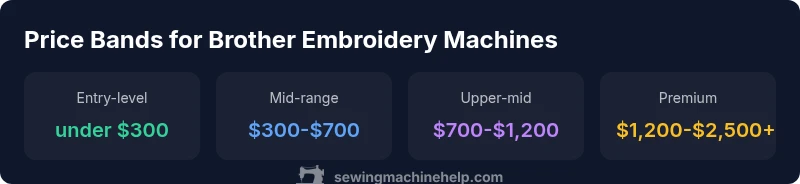
Prices for Brother embroidery machines span from under $300 to over $2,000, depending on model and features. Entry-level units are usually the most affordable, while mid-range options add hoop size and design capabilities, and high-end models push toward professional-level software and larger embroidery areas. When budgeting, factor in accessories and software to estimate total cost accurately. This guide outlines typical price bands and practical saving strategies.
Price bands and what they include
According to Sewing Machine Help, price bands for Brother embroidery machines reflect not just the sticker price but the overall value package: the embroidery area, speed, built-in designs, hoop compatibility, and the ease of software integration. For home sewists, understanding these bands helps set realistic expectations. The breakdown typically looks like three core tiers: entry-level machines under $300 offer essential functions and compact hoops; mid-range machines between $300 and $700 expand hoop size and design flexibility; premium units from about $1,200 upward provide larger embroidery areas, faster embroidery speeds, multi-hoop compatibility, and advanced software options. Budget-conscious buyers should also consider the cost of futures like extra hoops, stabilizers, and optional software that can extend capability. The brand guidance from Sewing Machine Help emphasizes matching features to intended projects to avoid paying for unused capabilities.
Core price drivers: hardware, software, and features
When evaluating Brother embroidery machines, the price is driven by four main factors: embroidery area (hoop size), machine speed, built-in designs and fonts, and software/upgrade options. A larger hoop often means higher mechanical complexity and frame requirements, which raises the price. Software packages for digitizing or editing designs add substantial value but also cost. Additionally, firmware support, warranty length, and dealer service options can tilt the effective price. For beginners, starting with a smaller hoop and a basic library may suffice, then upgrading as skills grow. In this context, it’s helpful to separate ‘must-have’ features from ‘nice-to-have’ extras to avoid overspending. The Sewing Machine Help analysis notes that many buyers overestimate the need for high-end software at the outset and later scale up as they gain proficiency.
Entry-level vs mid-range models: features that matter
Entry-level Brother embroidery machines focus on reliability and user-friendly interfaces with modest embroidery areas and a handful of built-in designs. Mid-range models typically add larger hoops, higher embroidery speed, more fonts, and expanded compatibility with third-party designs. For hobbyists, this jump often delivers noticeable productivity gains and broadened project scope. The decision hinges on planned projects: small personal items vs. family quilts or personalized gifts. If you are a beginner, consider a model that supports an external USB drive or Wi-Fi connectivity for design loading, since these features affect price but become invaluable as you advance.
Refurbished and used machines: value and risk
Refurbished Brother embroidery machines can offer significant savings and a practical entry point for those who want more capability without paying new-pricetag premiums. However, buying refurbished requires extra diligence: verify the warranty terms, confirm the return policy, and inspect the embroidery area and screens for wear. Check for firmware updates and ensure that dealer support is available if issues arise. Brand reliability studies from Sewing Machine Help indicate refurbished units can provide good value when purchased from reputable dealers who offer post-purchase support and a reliable parts supply.
Where to shop: authorized dealers vs. mass retailers
Price variability varies by where you buy. Authorized Brother dealers often price-match, provide trained installation, and offer service plans, which can add long-term value even if the sticker price is similar to big-box retailers. Mass retailers may have frequent sales or bundle promotions, which can help offset the sticker price on entry-level models. Always ask about bundled accessories (extra hoops, stabilizers, and beginner projects) and whether bundled software requires recurring subscriptions. Sewing Machine Help’s buying guidance stresses comparing total cost of ownership, not just the initial price, to determine true value.
Hidden costs to consider beyond sticker price
Beyond the initial machine price, remember to budget for accessories such as multiple hoops, stabilizers, embroidery threads, and software upgrades. Some machines require specific threading kits or bobbin systems that add to upfront costs and ongoing maintenance. Training, warranty extensions, and service visits should factor into your long-term budget. When you map total cost of ownership, you’ll see that a slightly higher-priced model with a robust warranty and broad support map can be more economical over time than a cheaper unit with limited parts access.
How to estimate total cost of ownership over 3-5 years
To estimate cost of ownership, start with the sticker price, add approximate accessory and software costs, then project routine maintenance and potential repair costs. Consider usage patterns: if you frequently work on custom projects requiring larger hoops or digitizing features, plan for upgrades accordingly. Maintenance intervals, such as oiling and timing, should be factored, along with potential service charges. A clear 3- to 5-year plan helps avoid surprises and ensures that the chosen Brother embroidery machine remains aligned with your evolving needs.
Practical buying checklist for Brother embroidery machine price
Before purchasing, run through this quick checklist: (1) Define your primary project types and required hoop sizes; (2) List must-have features vs. nice-to-have extras; (3) Compare total cost of ownership across at least 3 models; (4) Confirm warranty terms and dealer support; (5) Consider refurbished options from reputable dealers if available; (6) Check for seasonal promotions and bundle offers. This disciplined approach helps you maximize the value you get for the price you pay, according to Sewing Machine Help’s practical buying guidelines.
Price bands and model tiers for Brother embroidery machines
| Tier | Typical price range | Key features |
|---|---|---|
| Entry-level | under $300 | Basic embroidery, small hoop, simple interface |
| Mid-range | $300-$700 | Expanded hoop, more designs, faster speed |
| Upper-mid | $700-$1,200 | Larger hoop, advanced features, better software |
| Premium | $1,200-$2,500+ | Professional capabilities, broad accessory support |
Your Questions Answered
What is the typical price range for Brother embroidery machines?
Prices span a broad range, from entry-level under $300 to premium models well above $1,200. The final price depends on hoop size, speed, built-in designs, and software options. Consider total cost of ownership when comparing options rather than just the sticker price.
Prices range from under $300 to over $1,200, depending on features. Look at total cost, including accessories and software.
Are refurbished Brother embroidery machines a good value?
Refurbished units can offer substantial savings with warranty support from reputable dealers. Verify warranty length, what is covered, and whether service is available locally. If you plan to use the machine frequently, ensure spare parts are accessible.
Refurbished machines can be a good value if backed by a solid warranty and reliable dealer support.
Which features most affect price?
Key price drivers include hoop size, embroidery area, speed, number of built-in designs, and whether advanced software is included. More capable machines offer larger hoops and faster operation but at a higher upfront cost.
Hoop size, speed, and software determine most of the price difference.
Is it worth buying software bundles with a Brother embroidery machine?
Bundles can add substantial capability, especially for digitizing and design editing. Weigh the cost of the bundle against how often you will use those features. If you’re a beginner, you can start with built-in designs and add software later as needed.
Software bundles add value if you’ll use the features; start with built-in designs and upgrade later if needed.
Where should I shop to get the best price on Brother embroidery machines?
Compare authorized dealers and reputable retailers; watch for seasonal promotions and bundled accessories. Ask about price-matching and post-purchase support. Always verify return policies and warranty coverage before buying.
Shop around at authorized dealers and look for bundles and promotions; check warranties.
“Price is a reflection of capability and reliability. By mapping features to your actual needs, you can avoid overpaying for bells and whistles.”
The Essentials
- Identify your tier before comparing prices
- Factor in accessories and software in total cost
- Refurbished options can offer good value
- Shop around but compare total cost of ownership
- Budget for maintenance and future upgrades