Juki vs Usha Sewing Machine: A Comprehensive Comparison
Compare Juki and Usha sewing machines for home use with an analytical, evidence-based approach. Learn about build quality, performance, usability, price ranges, and how to choose the right model for your projects.


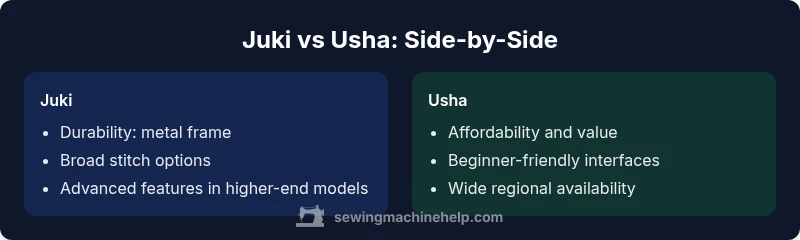
For home sewists, Juki generally offers stronger durability and precise stitch quality, while Usha delivers better value and beginner-friendly appeal. If you need a robust machine for frequent, varied projects, Juki is often the safer long-term bet; if upfront cost and broad accessibility matter most, consider Usha. The best choice depends on your typical projects, space, and budget.
Juki vs Usha: The Big Picture for Home Sewists
When evaluating juki vs usha sewing machine options for a home workshop, you quickly notice two different strengths. Juki models are frequently associated with durability, precise stitch quality, and a hands-on feel that appeals to serious hobbyists. Usha machines, by contrast, emphasize accessibility, ease of use, and strong value for beginners or budget-conscious projects. This frame sets the tone for a careful comparison: both brands deliver reliable performance, but they target slightly different needs and price tiers. This distinction matters because the right choice hinges on how often you sew, what fabrics you tackle, and how much room you have for maintenance. According to Sewing Machine Help, the long-term reliability of metal-frame construction tends to favor Juki, while immediate affordability and broad regional availability make Usha compelling in many markets. For readers who plan to sew regularly on a range of fabrics—from lightweight sheers to denim—the question becomes not which brand is universally better, but which model best aligns with your typical projects, space, and learning curve. The juki vs usha sewing machine landscape is not a single answer; it is a spectrum shaped by model lineage, regional support networks, and the kind of projects you like to tackle. In this guide we lay out the core differences, compare common features head-to-head, and offer practical criteria to help you decide with confidence.
Core Differences at a Glance
When you first compare juki vs usha sewing machine options, several dimensions stand out. Budget, build approach, and model availability shape the decision more than any single spec. Here is a concise map of the most impactful differences you should consider:
- Price sensitivity: Usha often offers affordable entrance models, while Juki tends to position higher-end, longer-term value.
- Build philosophy: Juki emphasizes stiffness and durability with metal frames in many lines; Usha prioritizes lightweight, user-friendly designs.
- Market accessibility: Usha has broad distribution in certain regions, with easy access to common spare parts; Juki's network is robust in many professional and enthusiast markets but can be region-dependent.
- Warranty and service: Warranty length and service coverage can vary by model and region; both brands offer dealer support, but coverage quality depends on local networks.
- Feature depth: Juki models frequently pack advanced features and heavy-duty presser feet; Usha models deliver essential functions well and are often easier for beginners to master.
- Model variety: Juki offers a wide range of machines for quilting, garment construction, and semi-industrial use; Usha provides a broad spectrum focused on home sewing and practical projects. Knowing what you plan to sew helps align features with your needs.
Build Quality and Longevity: Metal Frames vs Plastic Bodies
Durability is a core axis along which juki vs usha sewing machine options diverge. Juki models—especially higher-end home and semi-industrial lines—tend to use more metal components and reinforced frames that resist flex under heavy fabrics and long sewing sessions. This robust construction translates into steadier stitching when you push for speed or tackle thick materials like denim or canvas. Usha machines, on the other hand, often prioritize lighter weight and cost efficiency. They frequently employ plastic housings and simpler internal assemblies to keep prices accessible and to reduce overall machine weight for portability. For most hobbyists who sew occasionally, either brand can deliver reliable results on common fabrics, but the long-term feel and fatigue resistance typically favor Juki in the same price tier. Sewing Machine Help notes that metal-frame designs generally sustain performance over more hours of use, contributing to better longevity with heavy workloads. The trade-off is weight and the possibility of higher upfront costs, particularly for models aimed at heavy-duty garments or quilting projects. When choosing, consider your typical project load, whether you need portability, and how much you value a tactile sense of sturdiness during needlework precision tasks.
Stitching Performance, Speed, and Fabric Versatility
Stitch quality and range are central to comparing juki vs usha sewing machine models. Juki machines often deliver consistent stitch density across a wide speed spectrum, which helps when transitioning from garment construction to more technical tasks like quilting or leather detailing. They frequently offer longer stitch catalogs, with options that support industrial-feel presser feet and heavier fabrics, making them a strong choice for users who want versatility and room to grow. Usha machines typically cover the essentials with reliable stitches for everyday sewing, garment repairs, and light crafting. The stitch library may be narrower on budget models but remains adequate for beginners and casual sewers. In practice, you’ll notice Juki models retain thread tension stability at higher speeds and maintain stitch balance across varied fabric thickness. Usha’s strengths lie in intuitive controls and straightforward threading that supports quick project turnarounds. When selecting, map your regular fabrics (cotton, jersey, denim, leather) to the stitch options and consider whether you need decorative options or quilting stitches for creative projects.
Usability, Features, and Learning Curve
Ease of use is a practical deciding factor when comparing juki vs usha sewing machine lines. Usha’s mid- and entry-level models tend to emphasize straightforward operation: simple threading paths, automatic bobbin loading on some models, and clearly labeled presets that help beginners avoid tension missteps. This accessibility lowers the barrier to starting new projects, making Usha appealing for hobbyists who want quick results with minimal setup. Juki offers a broader feature set in many of its home and semi-industrial machines, including more advanced tension control, multiple presser feet options, and sometimes computerized interfaces. While these features empower experienced sewists to dial in highly precise outcomes, they can introduce a steeper learning curve for newcomers. The key is to align the feature depth with your skill level and the complexity of your projects. If you anticipate growing into frequent, varied sewing tasks, a Juki model may serve you well already; if you expect to focus on foundational projects and value speed-to-sew, Usha can be both empowering and economical.
Maintenance, Spare Parts Availability, and Service Networks
Maintenance considerations are essential when weighing juki vs usha sewing machine options. Spare parts availability varies by region and model. Juki typically maintains strong dealer networks in many markets, offering a broader choice of replacement parts and accessories for the higher-end lines. In some regions, you may encounter longer lead times for specific Juki components, particularly if you’re outside major urban centers. Usha’s broad distribution in several countries, notably in South Asia, often results in easier access to common spares and scheduled servicing. Both brands rely on authorized service centers and trained technicians; the difference tends to be how swiftly you can find a technician familiar with your model and how readily you can source genuine components. Regular maintenance, such as cleaning, oiling where applicable, and timely servicing, will extend any machine’s life. Sewing Machine Help analysis shows that building a routine around parts availability and service access is as important as initial price when planning long-term use.
Price, Warranty, and Total Cost of Ownership
Price considerations for juki vs usha sewing machines reflect the brands’ positioning and market dynamics. Usha generally offers a broader spectrum of affordable models suitable for beginners and casual crafters, while Juki often targets the mid-to-upper price tier with more durable construction and advanced features. Warranty terms vary by model and region, but both brands typically provide standard warranties through authorized dealers, with longer durations on higher-end machines. When evaluating total cost of ownership, consider not only the sticker price but also the cost and availability of spare parts, servicing frequency, and the expected lifespan of the machine in your work routine. If you sew professionally or regularly push your machine through heavy fabrics, a Juki investment may pay off through reduced downtime and fewer repairs. For hobbyists prioritizing upfront affordability and a broad local support network, Usha models can offer compelling value without compromising essential performance.
How to Decide Based on Your Projects and Skill Level
The best way to choose between juki vs usha sewing machine options is to map your typical projects to the machine’s strengths. If your sewing includes frequent garment construction, quilting, or denim work and you value long-term durability, favor a Juki model with the features you need. If you primarily sew lightweight fabrics, make simple repairs, and want a machine that’s easy to learn and affordable, an Usha model may be the smarter starting point. Consider your space and workflow: if you have a dedicated sewing area and can handle a heavier unit, Juki’s stability plus upgraded features become more attractive; if you need portability and a quick setup for occasional projects, Usha’s lighter designs may suit you better. Finally, test-compare in person where possible, focusing on needle threading, fabric feeding, stitch registration, and audible noise. Your final choice should balance practicality, budget, and the likelihood of ongoing satisfaction over time.
Hands-on Evaluation Checklist for Juki and Usha Models
Before purchasing, use this practical checklist to compare models in your market. Check wiring and power draw (if mentioned in specs), test with fabrics you routinely sew, and evaluate the ease of threading and bobbin changes. Review the ease of stitch selection, tension adjustment, and foot compatibility. Ask sellers about service availability, spare parts lead times, and warranty terms. Finally, request a side-by-side demonstration of the two brands on similar projects to visualize how they perform in your real-world setting.
Comparison
| Feature | Juki | Usha |
|---|---|---|
| Build Quality | Typically metal-frame, sturdy feel | Often lighter, plastic-bodied, value-focused |
| Stitch Variety | Broad range including quilting/decorative options | Essential stitches with solid basic set |
| Performance at Speed | Consistent, stable at higher speeds | Reliable at steady speeds, may slow with very thick fabrics |
| Ease of Use | More advanced features in higher-end models | Generally beginner-friendly with simple interfaces |
| Parts Availability | Strong dealer networks in many regions; parts widely available in supported markets | Broad distribution in several regions; easy access to common spares |
| Warranty & Service | Often longer warranties on premium lines; robust service networks | Competitive warranties; extensive local dealer reception |
| Price Range | Mid-to-high for quality, feature-rich home machines | Low-to-mid for entry-level models and value seekers |
| Best For | Pro-style projects, quilting, heavy fabrics | Beginners, budget-conscious projects, simple repairs |
Strengths
- Strong value for money in Usha models
- Juki models excel in durability and precision
- Wide availability of spare parts and dealer support
- Good after-sales service networks in many regions
Negatives
- Higher upfront cost for some Juki models
- Spare parts accessibility can vary by region for certain Juki lines
- More features on some Juki models may require a learning curve
- Usha models sometimes have fewer advanced features at budget levels
Juki generally offers higher durability and advanced features; Usha provides better initial value and beginner-friendly options
Choose Juki if you prioritize longevity and expansion potential. Choose Usha if upfront cost and quick, easy results matter most, especially for beginners.
Your Questions Answered
Which brand offers better durability for home use: Juki or Usha?
In general, Juki models are built with durability and stability in mind, often featuring metal frames in higher-end lines. Usha provides reliable performance on budget-friendly models, but long-term durability may vary by model and care. Consider your workload and fabrics to decide which aligns with your expectations.
Juki usually edges out on durability in tougher sewing tasks, while Usha gives solid reliability at a friendlier price. Pick based on how often you sew and the fabrics you use.
Are spare parts and service widely available for Juki vs Usha models?
Spare parts and service depend on your region. Juki has strong dealer networks in many markets, but availability can vary. Usha generally provides broad access in several regions where the brand is popular, making parts easier to source locally.
Parts availability varies by region; check your local dealers for both brands before buying.
Which is better for beginners, Juki or Usha?
Usha often wins for beginners due to simpler controls, lighter machines, and generally lower entry costs. Juki offers more advanced features that can benefit growing skill levels, but they may require more time to learn. If you’re starting out, consider a mid-range Usha model first.
For beginners, start with Usha for ease and value, then consider a Juki as your skills grow.
Do both brands offer computerized models, and are they worth it?
Both brands offer computerized or computer-assisted options in select lines. Computerized models provide convenience and precision but add cost and complexity. If you value presets and automation, explore the higher-end Juki lines or Usha’s more feature-rich options.
Yes, both offer computerized options in some models; weigh the cost against your need for presets and automation.
What should I expect in warranty terms for Juki vs Usha?
Warranty length and coverage vary by model and region. Both brands typically offer standard warranties through authorized dealers, with longer coverage on higher-end models. Always confirm what’s included (parts, labor, and service) before purchase.
Warranty varies by model; verify coverage details with your seller before buying.
Which brand is better for heavy fabrics or quilting projects?
Juki models designed for home or semi-industrial use generally perform well with heavier fabrics and quilting due to sturdier construction and consistent stitch delivery at higher speeds. Usha can handle these tasks in higher-end or specialized models, but purer heavy-duty performance is often stronger with Juki.
For heavy fabrics or quilting, Juki typically offers stronger, more reliable performance.
The Essentials
- Prioritize your project mix when choosing
- Juki suits durability and pro-level work
- Usha excels in beginner-friendly value
- Spare parts and service access matter
- Test models in-person if possible