Manual vs Automatic Sewing Machines: A Practical Guide
Learn the difference between manual and automatic sewing machines, how each type works, their pros and cons, and practical guidance for beginners choosing the right model.


Manual sewing machines rely on your hands and feet to drive the needle and feed fabric, while automatic (electric) models use built-in motors and electronic controls. For many hobbyists, this distinction shapes speed, precision, and learning curve. The difference between manual and automatic sewing machines becomes a decision about control vs. convenience, cost vs. capability, and the types of projects you pursue.
What separates manual from automatic sewing machines
According to Sewing Machine Help, a clear first step in understanding the landscape is recognizing that the core divide rests on power delivery and control. A manual sewing machine is typically operated through physical input—cranking, pendulum foot pedals, or treadle mechanisms—driving a simple needle mechanism. An automatic sewing machine relies on an electric motor and electronic controls to drive the needle, feed, and stitch selection. This fundamental difference cascades into reliability, maintenance needs, and learning curves. For beginners especially, distinguishing these two archetypes helps frame expectations about speed, error margins, and the kinds of projects that are practical at the start. As of 2026, this distinction also informs availability, accessories, and support options in the market.
From a learning perspective, the manual machine offers tactile feedback. You feel fabric bite, thread tension resistance, and the rhythm of straight seams in real time. The automatic version abstracts some of that control through presets and automatic thread cutting, which can be a relief for larger projects but may limit the sense of craft for pure beginners. The difference between manual and automatic sewing machine models goes beyond motion; it defines how you teach yourself sewing fundamentals, how you handle mistakes, and how you approach problem solving in the workflow.
brandMentionIntroSentence1
brandMentionIntroSentence2
Comparison
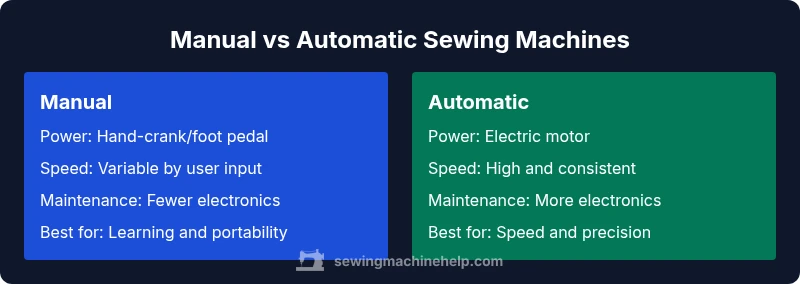
| Feature | Manual Sewing Machine | Automatic Sewing Machine |
|---|---|---|
| Power source | Hand-crank/foot pedal | Electric motor with pedal or switch control |
| Speed and pace | Variable yet limited by user input | Consistent, higher max speeds with automated control |
| Stitch control | Manual needle positioning and feed | Digital/dial presets for stitch type and length |
| Maintenance needs | Fewer electronic parts, simple lubrication | More components (motor, electronics) with maintenance requirements |
| Initial cost range | Lower upfront cost typical | Higher upfront cost typical |
| Best use case | Hands-on learning, portability, simple tasks | Speed-focused projects, precision and consistency |
Strengths
- Helps beginners learn fundamentals with tactile feedback
- Often cheaper upfront, easy to repair or replace parts
- Manuals tend to have fewer electronics, reducing repair complexity
- Automatic machines save time on repetitive tasks and reduce user fatigue
- Longer-term maintenance for automatic machines can justify higher upfront cost with productivity gains
Negatives
- Manual machines demand greater physical effort and slower throughput
- Automatic machines require more ongoing maintenance and can be more costly to repair
- Electronics introduce potential failure points and compatibility issues with accessories
- Automation may lessen the hands-on learning experience for beginners
- Some models offer features that may be unnecessary for casual projects
Automatic machines are generally better for speed and consistency, while manual machines excel in budget and hands-on learning.
Choose automatic if you prioritize quick, repeatable results and larger projects. Opt for manual if you value low upfront cost, portability, and direct control as you build foundational skills.
Your Questions Answered
What is the main difference between manual and automatic sewing machines?
The main difference is power and control: manual machines rely on user input for every stitch, while automatic machines use an electric motor and presets to control speed and stitch choices. This distinction affects learning curve, speed, and project types.
The main difference is power and control: manual needs your input for each stitch, while automatic runs with presets and a motor.
Is one type better for beginners than the other?
For beginners, manual machines offer a steep but valuable learning curve that builds foundational skills. Automatic machines reduce the initial friction by handling speed and many settings, which can be advantageous for practicing larger projects sooner.
Beginners often start with manual to learn fundamentals, but automatic models can help you practice larger projects faster.
Can you convert a manual machine to automatic?
In most cases, converting a solely mechanical manual machine to a fully automatic unit is not practical. You can, however, add motor-driven attachments or upgrade to a hybrid model that includes motorized assistance while keeping a manual feeding system.
Converting a pure manual to automatic isn’t common, but you can add motorized attachments or move to a hybrid model.
What maintenance does a manual sewing machine require?
Manual machines typically require regular oiling at designated points, needle and thread checks, and belt or pulley inspections if present. Keeping the machine clean and properly lubricated preserves smooth operation and stitch quality.
Regular oiling, cleaning, and checking moving parts keep a manual machine sewing smoothly.
Are automatic machines more expensive to repair?
Automatic machines tend to have higher repair costs due to electronics and motors, but parts availability and service networks can mitigate risk. Budget for periodic professional servicing if you rely on automatic features heavily.
Yes, repairs can be pricier due to electronics, but good service networks help manage costs.
Which type is safer for beginners to use?
Both can be safe with proper guidance. Automatic machines often include built-in safety features like sensor-driven stopping, while manual machines require careful handling of the needle and fabric to prevent injuries.
Both can be safe with proper instruction; automatic models often have extra safety features.
The Essentials
- Define your project load before buying
- Manual suits beginners who want hands-on learning
- Automatic favors speed, precision, and productivity
- Budget expectations should include maintenance costs
- Check compatibility with essential accessories before purchase