How to Stitch with a Machine: A Beginner's Guide
Master machine stitching: threading, needle choices, tension control, and basic seams. A practical, beginner-friendly guide from Sewing Machine Help.


In this guide, you’ll learn how to stitch with a sewing machine to create clean, durable seams. You’ll need a basic sewing machine, the appropriate needle and thread, and a simple fabric project. We’ll cover threading, starting, sewing straight and curved seams, and troubleshooting common issues. This quick answer helps you decide if you should practice on scrap fabric first, and highlights essential safety steps.
Your Stitching Toolbox: What you need to begin\n\nBefore you stitch, set up a clean workspace, and gather a few basics. A reliable machine, a suitable needle, all-purpose thread, quality fabric, and a few accessories will make lessons smoother. This section outlines the essential equipment and a practical setup checklist to help you start with confidence. Remember, a well-lit, stable surface reduces mistakes and fatigue.
Choosing the Right Needle, Thread, and Fabric\n\nBegin with fabrics that are easy to manage—cotton, lightweight canvas, or quilting cotton are forgiving for beginners. Match the needle size to the fabric: lighter fabrics need finer needles (for example, a small gauge), while medium to heavy fabrics require sturdier needles. Use all-purpose polyester thread for most projects, which provides balanced strength and stretch. Always test a seam on a scrap piece to confirm your choice before stitching your actual project. Also, keep a small pair of shears and fabric chalk handy for clean cuts and accurate hems.
Threading and Bobbin Basics\n\nThreading your machine correctly is essential for consistent stitches. Start by placing the spool on the holder, guide the thread through the thread guides, and then thread the take-up lever. Ensure the thread is properly seated in the thread path and through the needle from front to back. Wind and insert the bobbin according to your machine’s manual, ensuring the thread unwinds in the correct direction. Pause to test a short stitch on scrap fabric to confirm proper tension and smooth feeding.
Setting Tension for Clean Seams\n\nTension determines how the top thread and bobbin thread meet at the fabric surface. If your stitches pull to the top or the bottom, adjust tension in small increments and re-test on a scrap piece. Begin with a mid-range setting and only tweak one factor at a time—for example, increase top tension if your bottom thread loops are visible, then re-test. Proper tension makes stitches lie flat and seams join firmly without puckering.
Basic Machine Stitches: Straight, Zigzag, and Backstitch\n\nA basic kit of stitches includes straight, zigzag, and backstitch. The straight stitch is ideal for seams and topstitching; the zigzag helps finish raw edges and accommodate stretch fabrics; backstitch locks each seam to prevent unraveling. Set your stitch length to about 2.5–3.0 mm for standard seams, and adjust to 1.5–2.0 mm for topstitching. Practice on scrap fabric to memorize how each stitch feels and sounds.
Seams and Finishes: Seams with Precision\n\nConsistency comes from maintaining a straight edge and consistent fabric feeding. Use a ruler or guide foot for alignments, and pin or clip fabric to prevent shifting. For beginners, a 1/4 inch seam allowance is a reliable starting point. Finish edges with a zigzag or overlock stitch to prevent fraying. Press seams gently after stitching to set them in place and achieve a professional look.
Handling Curves, Corners, and Edges\n\nCurves require a lighter touch and smaller adjustments to the fabric. Reduce speed as you approach corners, pivot the fabric with the needle down, and use a gentle hand to guide the edge. When turning corners, sew slowly and take small stitches to maintain smooth, even curves. For edge finishing, align the edge with the presser foot and avoid pulling to prevent fabric distortion.
Practice Projects to Build Confidence\n\nStart with small, simple projects like a tote bag liner, a fabric coaster, or a lined pillow cover. These projects allow you to practice straight seams, topstitching, and finishing techniques without overwhelming complexity. Use scrap fabric to experiment with different stitch types and tensions. Each completed project gives you tangible confidence and a clear skill progression.
Maintenance, Safety, and Common Mistakes to Avoid\n\nKeep your machine clean by removing lint and dust from feed dogs and bobbin areas. Always unplug before changing needles or threading, and never force fabric through the machine. Common beginner mistakes include pulling fabric, using the wrong needle for the fabric type, and neglecting to test stitches on scrap. A simple routine—clean, oil lightly as recommended, and test—keeps your machine performing reliably.
Tools & Materials
- Sewing machine(Ensure it is threaded and serviced if needed.)
- Assorted needles(Begin with small sizes for light fabrics, larger for denim.)
- All-purpose sewing thread(Choose a color that matches your fabric.)
- Bobbin wound with thread(Keep spares on hand.)
- Fabric scissors(Sharp blades for clean cuts.)
- Pins and pincushion(Fine pins to avoid fabric snagging.)
- Seam ripper(Use gently to avoid damaged fabric.)
- Fabric chalk or marker(Mark seam lines and hems.)
- Measuring tape(For accurate seam allowances.)
- Iron and ironing board(Press seams after stitching.)
- Scrap fabric for practice(A few small pieces work well.)
Steps
Estimated time: 25-30 minutes
- 1
Set up your workspace
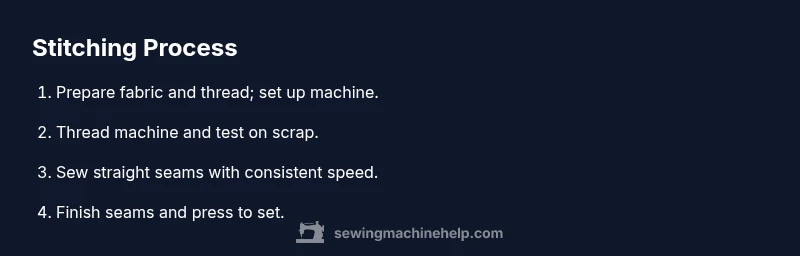
Clear the table, plug in the machine, and wind a bobbin. Thread the machine following the path shown in your manual. Align fabric under the presser foot with the edge you’ll sew parallel to the guide. Test a short stitch on scrap fabric before starting the real project to verify tension and feed.
Tip: Have good lighting and a comfortable height to reduce mistakes. - 2
Thread the machine properly
Place the spool on the spindle, guide the thread through all guides, and thread the take-up lever. Bring the thread down to the needle from front to back and ensure it’s securely seated. Re-thread if the stitch quality is poor.
Tip: Take your time; a correctly threaded machine makes all the difference. - 3
Prepare fabric and needle
Lay fabric flat and align the edge with a straight line on the throat plate. Place pins to hold fabric in place, then insert the correct needle for your fabric. Use a test scrap to confirm your needle choice.
Tip: Keep the needle straight and avoid bending it during setup. - 4
Lower presser foot and start sewing
Lower the presser foot, hold the fabric lightly, and start at a short mark on scrap fabric. Keep a steady pace and guide the fabric with your non-dominant hand, letting the machine feed the fabric. Stop with a backstitch to secure the seam.
Tip: Never rush; a calm, even pace improves stitch consistency. - 5
Sew a straight seam
Align the fabric edge with the guide and sew a straight seam. If your stitches deviate, adjust your hand position and re-test on scrap. Backstitch at the start and end to lock stitches in place.
Tip: Use a straight stitch length of about 2.5–3.0 mm for general seams. - 6
Finish seam and backstitch
After completing the seam, backstitch for a few stitches to secure. Trim threads, press the seam to set it, and inspect for evenness. Practice on a scrap to improve control before moving to a final project.
Tip: Pressing after stitching makes seams look neater and lie flat.
Your Questions Answered
What is the correct needle size for beginner fabrics?
For lightweight fabrics, start with a finer needle (e.g., small gauge like 70/10 to 75/11). For medium fabrics, use 80/12 to 90/14. For heavy fabrics like denim, use 100/16 to 110/18. Always test on scrap first.
For light fabrics, start with a small needle; for heavier fabrics, use a larger needle and test on scrap first.
How do I fix thread bunching under the fabric?
Thread bunching usually means tension or threading issues. Re-thread the machine, check that the bobbin is wound correctly, and test on scrap. Adjust the top tension gradually until stitches sit evenly on both sides.
Re-thread and test on scrap; adjust the top tension gradually until the stitches look balanced.
Can I stitch with thick fabrics like denim on a basic machine?
Yes, but use a heavier needle, slower stitching speed, and a reinforced seam. Consider using a longer stitch and a walking foot if your machine supports it.
Yes, but use a heavier needle and slower speed; a walking foot helps with thick fabrics.
How often should I service or oil my machine?
Follow the manufacturer’s guidelines, typically after a certain number of hours or projects. Light oiling at indicated points helps maintain performance and longevity.
Oil at the points your manual indicates and follow the schedule for maintenance.
Why is my machine skipping stitches?
Skipping stitches can result from a bent needle, improper threading, or fabric too thick for the needle. Replace the needle, re-thread correctly, and test on scrap.
Check the needle, re-thread, and test on scrap to identify the issue.
Watch Video
The Essentials
- Master threading to prevent tangles.
- Choose the right needle and thread for fabric type.
- Practice on scraps before real projects.
- Understand tension to achieve clean seams.
- Sew with steady speed and backstitch to secure.