What Sewing Machine Settings for Stretchy Fabric: A Practical Guide
Learn exact sewing machine settings for stretchy fabrics like knits and jerseys. This guide covers stitch types, tension, needles, feet, and testing swatches to prevent puckering and curling.


With the right sewing machine settings, stretchy fabrics like jerseys, knits, and spandex can form smooth, durable seams. This guide shows exact stitch types, lengths, and tension ranges, plus tips on needles, feet, and testing swatches. By the end, you’ll know how to dial in settings for common knits and prevent curling, skipped stitches, or puckering.
Why stretchy fabrics require different settings
Stretch fabrics such as cotton jersey, interlock, lycra, and spandex blends behave differently than woven fabrics. Their loops and fibers stretch under tension, so a straight stitch can easily break the fabric’s yarns or cause edges to curl. The reader should understand that what sewing machine settings for stretchy fabric really means is choosing stitch options, foot choices, and feed controls that accommodate the fabric’s elasticity while keeping seams flat and secure. According to Sewing Machine Help, knits often require gentler handling and a stitch that gives a little without creating gaps. This section also introduces common terms you’ll see later, such as ballpoint needles, zigzag stitches, walking feet, and differential feed.
When you practice on scraps, you’ll notice that even slight changes in fabric weight or lycra content change how the fabric feeds, how the stitch lies, and how the seam behaves after washing. The goal is to balance movement (fabric feed) with hold (stitch formation) so you don’t over-stretch the material and create puckers. In short: stretch fabrics reward deliberate, tested settings more than any other material. This is a core idea that guides every subsequent recommendation in this guide.
The reader will walk away with a practical approach to testing and dialing in the machine, ensuring a secure, flexible seam on a variety of knit materials.
The core settings: stitch type, stitch length, and tension
When you tackle stretchy fabrics, three levers matter most: stitch type, stitch length, and thread tension. For knits, a stretch stitch or a wide zigzag stitch provides the necessary give without breaking the yarns. The needle type is critical too: use a ballpoint needle in the appropriate size for your fabric weight to glide between fibers rather than cut them. Start with a mid-range stitch length (for many knits around 2.5–3.0 mm) and a light tension. If you notice the fabric puckering, reduce tension slightly and test again; if you see loose stitches, increase tension or shorten the stitch length by a small increment. Finally, ensure the stitch width accommodates the fabric’s stretch without creating a seam that feels tight when worn.
In practice, begin with a zigzag stitch (or a dedicated stretch stitch) and a length of 2.5–3.0 mm for lighter knits, adjusting as you test on a scrap. If your machine offers a “stretch” needle or a special zigzag pattern, that can produce the most forgiving seam. The key is to test your settings on swatches that mimic your final garment: a sleeve cap, a hem, and a body panel.
Presser feet and needles for knits
Knits love the right needle and foot. Use a ballpoint needle (size 70/10 to 90/14) to minimize snags. This needle splits the loops instead of piercing them, reducing skipped stitches and runs. Attach a walking foot if your fabric tends to shift or stretch unevenly—especially with longer seams or heavier knits. For extremely stretchy or bulky fabrics, consider a twin needle for hems (with compatible machine capability) to maintain a professional look on topstitches while the needle spaces create two parallel lines.
If you don’t have a walking foot, try a narrow zigzag with slightly shorter stitch length and gentle pressure on the presser foot. A straight stitch can work on very stable knits, but most stretch fabrics benefit from a foot that helps feed multiple layers evenly. Always test your needle choice on swatches to confirm no skipped stitches or fabric damage before sewing the final piece.
Differential feed and walking feet to control curl and stability
Differential feed is a powerful tool for knits. When used correctly, it helps control fabric feeding on both the top and bottom layers, preventing waves and puckering. If your machine has a differential feed, start around 0.8–1.0 for lightweight knits and adjust upward for thinner fabrics or as you see edge curl. For heavier fabrics, a setting closer to 1.1–1.3 can help prevent the fabric from being pushed forward too aggressively, which can cause stretching or tunneling along seams. When you don’t have adjustable differential feed, you can simulate the effect by gentle guiding and using a walking foot to stabilize the feed.
A walking foot interacts with the fabric more evenly, reducing the chance of notch curves and misaligned seams. If your fabric shifts or stretches as you sew, pause to re-align the layers and test the seam again on a swatch. This section emphasizes the link between feed mechanics and knit stability—the difference between a comfortable seam and a loose or wavy edge.
Test swatches: how to dial in settings for your fabric
Testing on fabric scraps is non-negotiable. Cut several small swatches (about 4x4 inches) in your intended fabric, ideally from the same bolt. Sew a few seam samples with varying stitch types (stretch stitch vs zigzag), stitch lengths (2.0–3.5 mm), and tension settings (low to medium). Evaluate the seams for stretch recovery, puckering, and the integrity of the fabric fibers near the seam. Mark your favorite combination on the swatch and then apply it to a full test garment piece that reproduces the seam lines you’ll actually use.
Documenting the settings that work best for your fabric weight saves time across future projects. If you are experimenting across different knits, you may need to keep a small notebook or swatch card for each fabric type (cotton jersey, interlock, or spandex blends). This practice reduces guesswork and speeds up your workflow when switching fabrics.
Common issues and quick fixes
Stretch fabrics are notorious for a few recurring issues: edge curling, fabric shifting, skipped stitches, and puckering along seams. Curling is often caused by overly tight tension or feed issues; loosen tension slightly and test again. Shifting is mitigated with a walking foot and proper needle choice; verify your fabric lies flat before starting and use a longer seam allowance to secure the layer. Skipped stitches can happen if the needle hits a fold or if the needle size is too small for the fabric; switch to a larger ballpoint needle and re-test. Puckering usually signals tension needs adjustment or an undersize stitch length—try a bit more length and a touch less tension.
Remember: always use scrap fabric to test before risking the final garment. If you encounter persistent issues, check your machine’s manual for recommended settings by fabric type and consider stabilizers for very light knits to maintain seam shape during stitching.
Sewing with different stretch fabrics: cotton jersey, lycra, scuba, rib knit
Not all knits behave the same way, and different stretch fabrics demand small changes in approach. Cotton jersey is forgiving and often sews well with a medium zigzag and a ballpoint needle. Lycra or heavy spandex blends require slightly longer stitches and a buffer of stabilization—stitch length around 2.5–3.0 mm with a gentle tension. Scuba fabrics can be bulky; use a walking foot and a narrow zigzag to minimize bulk in the seam. Rib knits and terry require stronger stabilizers and careful handling to avoid stretching the fabric at the edges. In every case, test swatches that mimic your final garment’s weight and stretch properties to dial in settings.
Finishing: seams, finishing stitches, and debonding
Once you’ve established the best stitch and tension, consider finishing options that keep knits strong and flexible. A narrow zigzag or a small stretch stitch provides a durable seam with some give. If you prefer a cleaner topstitch, a twin needle hem can produce a professional look on light to mid-weight knits, provided your machine supports it. Finish edges with a serger or an overedge stitch if you have access to one; otherwise, use a zigzag over the edge and press properly to prevent fraying. Proper pressing during finishing helps seal the seam and keep the fabric feeling smooth against the skin.
Maintenance and longevity tips for stretchy sewing
Stretch sewing places different demands on your machine. Regularly clean lint from the feed dogs and check the needle for any burrs or wear. Oil changes aren’t fabric-specific, but keeping the machine well maintained reduces the chance of skipped stitches. Store knits away from heat and humidity to preserve fiber elasticity. Finally, keep a small kit of spare needles, replacement walking feet, and stabilizers—these small accessories make quick fabric swaps easier and help you maintain consistent results across projects. By following a routine, you’ll extend the life of your machine and keep your knit sewing consistent.
Tools & Materials
- Ballpoint needle (size 70/10 to 90/14)(Choose based on fabric weight; use specifically for knits to avoid snagging.)
- Stretch or zigzag foot(Helps fabric feed with less resistance and preserves stretch.)
- Walking foot(Useful for slippery or multi-layer knits to prevent shifting.)
- Stabilizer or tissue paper(Optional for very light knits or tricky edges to control stretch.)
- Test swatches (fabric scraps)(Cut from same fabric and weight as final project.)
- Polyester or cotton-poly thread(Choose a thread with some give; forms a balanced seam on knits.)
- Sharp fabric shears(Keep blades clean; cut multiple fabrics cleanly.)
- Sewing machine manual(Reference for machine-specific stitch options and feet.)
Steps
Estimated time: 30-45 minutes
- 1
Assess fabric and choose stitch
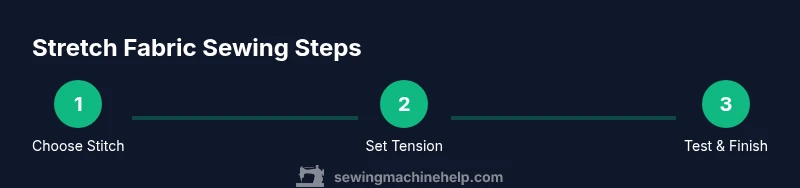
Identify your knit type and choose a stitch that accommodates stretch (stretch stitch or zigzag). Use a ballpoint needle. Test on a scrap to validate how the stitch interacts with the fabric’s loops and edges.
Tip: Begin with a mid-range stitch length and light tension; adjust after a scrap test. - 2
Install the correct needle
Replace the needle with a ballpoint needle sized for your fabric weight. Ensure the needle is fully inserted and straight to avoid skipped stitches or fabric snags.
Tip: Check for bent needles before sewing; a bent needle causes damage and skipped stitches. - 3
Set stitch length and tension
Start with a stitch length around 2.5–3.0 mm for lightweight knits and adjust toward 2.0–2.5 mm for bulkier fabrics. Use a light tension and test again on scraps.
Tip: If you see puckering, loosen tension slightly or increase stitch length by 0.5 mm. - 4
Attach presser feet
Mount a walking foot if your fabric shifts. If not available, use a zigzag foot with a slight pressure setting and steady hands to guide layers.
Tip: Avoid pushing the fabric; let the machine feed it evenly. - 5
Test seam and adjust differential feed
Sew a test seam with various feed settings to observe edge behavior. If your machine has a differential feed, start around 0.8–1.0 for lighter knits.
Tip: Wait for the fabric to relax before measuring seam integrity. - 6
Finish seam and press
Finish the seam with a suitable edge finish (narrow zigzag or twin needle for hems). Press with steam to set the seam and reduce bulk for a clean look.
Tip: Press from the seam allowance side to avoid distorting the fabric.
Your Questions Answered
What stitch is best for stretch fabrics?
A stretch stitch or a wide zigzag is typically best for knits; pair it with a ballpoint needle and light tension. Test on scraps to confirm how the stitch behaves on your fabric.
A stretch stitch or wide zigzag is usually best for knits; test on scraps to confirm.
Should I use a walking foot for knits?
Yes, a walking foot helps feed the fabric evenly and reduces shifting on layers, especially for medium to heavy knits. If you don’t have one, stabilize with a zigzag foot and careful guiding.
Yes, a walking foot helps feed knits evenly.
How can I prevent puckering on stretch fabrics?
Loosen tension slightly, test different stitch lengths, and consider using stabilizers for very lightweight knits. Also ensure a secure seam allowance and a steady feeding technique.
Loosen tension a bit and test different lengths; stabilizers can help with light knits.
Can I use a twin needle on stretch fabrics?
Twin needles can give two parallel lines on hems and topsides, but ensure your machine supports it and choose appropriate stitch settings to avoid skipped stitches.
Twin needles are good for hems if your machine supports them.
What is a good starting differential feed setting?
Start around 0.8–1.0 for lightweight knits and adjust based on edge curling or fabric wave. If your machine lacks this feature, use walking foot stability instead.
Start with 0.8 to 1.0, adjust as needed for curl or waves.
Do I need special stabilizers for knit fabrics?
Stabilizers help with very light knits or sheer fabrics; use tissue paper or lightweight stabilizers under the fabric to prevent stretching during stitching.
Stabilizers help keep light knits from stretching while you sew.
Watch Video
The Essentials
- Dial in stitch type for knit-friendly seams
- Test swatches before sewing a final piece
- Use ballpoint needles to protect fabric fibers
- Walking feet stabilize slippery knits
- Fine-tune tension and stitch length for each knit