Which Company Sewing Machine Is Best? A Brand Comparison for 2026
An objective guide to top sewing machine brands for home sewists, comparing reliability, service, and value to answer which company sewing machine is best.


When evaluating which company sewing machine is best, start with your use-case, budget, and learning goals. There isn’t a single winner for every situation; instead, reliable brands like Brother, Janome, Singer, and Bernina tend to score well across beginner-friendly features, service networks, and durability. According to Sewing Machine Help, the best choice emerges from matching your projects to a brand’s ecosystem and support.
Framing the question: what does 'best' mean for a sewing machine company?
When someone asks which company sewing machine is best, the question isn’t about a single winner. It’s about aligning brand characteristics with your true needs. For a home hobbyist, the best company might be one with friendly interfaces, abundant spare parts, and responsive local support. For a professional, it could be a brand known for heavy-duty construction, accurate stitches, and long-term service coverage. According to Sewing Machine Help, the answer depends on use-case, budget, and how you plan to maintain the machine over time. This guide will compare the most commonly recommended brands for home use, outline clear criteria, and offer a practical decision framework. If you’re asking which company sewing machine is best for you, start by listing your projects, your space, and your willingness to learn new features. Then use the brand snapshots and the side-by-side table to narrow your choices.
Core criteria used to evaluate brands
To determine which company sewing machine is best for you, focus on criteria that predict long-term satisfaction: reliability, dealer and repair network, availability of parts and feet, learning resources, and warranty coverage. Easy-to-use interfaces help beginners, while robust maintenance ecosystems support ongoing use. A strong brand often correlates with wider parts distribution and localized service options, which reduces downtime. From Sewing Machine Help analysis, you’ll find that the strength of a brand’s support system and the breadth of its accessory ecosystem are as important as the raw feature set. Finally, consider total cost of ownership, including accessories, foot kits, and occasional upgrades for compatibility with new fabrics.
Landscape of major sewing machine brands in 2026 (overview)
The market includes several brands that home sewists repeatedly cite as dependable: Brother, Janome, Singer, Bernina, and Husqvarna/Viking. Each brand tends to carve out a niche: Brother often emphasizes beginner-friendly models and broad availability; Janome is known for durable builds and a strong mid-to-high range; Singer provides wide distribution and approachable entry-level machines; Bernina balances premium features with superb stitch quality; Husqvarna/Viking concentrates on precision engineering and long-term reliability. When you ask which company sewing machine is best, it’s helpful to map these personalities to your projects—quilting, garment construction, or simple repairs—and then validate with hands-on testing. Sewing Machine Help’s guidance suggests prioritizing your primary project type, workspace, and willingness to invest time in learning the machine’s ecosystem.
Brand snapshot: Brother — strengths, tradeoffs
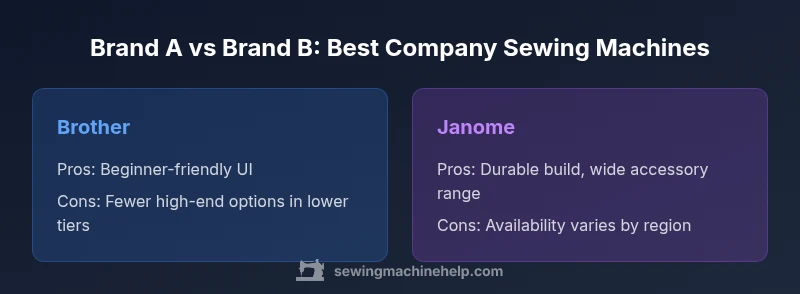
Brother machines are frequently praised for their beginner-friendliness and intuitive controls, which can reduce the intimidation factor for new users. The brand also benefits from a broad dealer and parts network, making maintenance and accessory upgrades easier to source. However, some mid-range Brother models may not offer the deepest feature sets found in premium brands, and availability of certain high-end feet can vary by region. For many home sewists, Brother represents a reliable starting point that scales with skill, while still remaining approachable and affordable. When evaluating which company sewing machine is best for a beginner who wants room to grow, Brother is often a strong candidate.
Brand snapshot: Janome — strengths, tradeoffs
Janome is widely regarded for durability and consistent stitch quality across models, which makes it a favorite among sewists who tackle garments and quilting. The brand generally provides robust frame construction and reliable mechanics, paired with a thoughtful assortment of presser feet and accessories. The tradeoffs can include a steeper learning curve on some interfaces and variability in dealer support by region. If your priority is long-term reliability and smooth stitch work, Janome frequently earns top marks in independent reviews. It’s a solid pick when you’re choosing which company sewing machine is best for serious hobbyists who want dependable performance over time.
Brand snapshot: Singer — strengths, tradeoffs
Singer machines are widely accessible, easy to find in big-box retailers, and often priced to be approachable for newcomers. They typically ship with a range of built-in stitches that cover common projects, and Singer’s weight and footprint can be favorable for smaller spaces. On the downside, some models may lag behind in professional features or durability compared to premium brands, and the quality of dealer networks can vary by location. For many beginners or occasional crafters, Singer offers an inviting entry point that can evolve as skills grow, making it a reasonable contender when asked which company sewing machine is best for casual use.
Brand snapshot: Bernina — strengths, tradeoffs
Bernina is renowned for precision engineering, consistent stitch quality, and premium build quality. The brand’s machines often incorporate advanced features that appeal to quilters and garment makers, along with strong resistance to wear over long projects. The main tradeoff is price—Bernina models sit at a higher end of the market, and access to service and parts may be concentrated in certain regions. If you value precision and durability and plan to invest in a long-term machine, Bernina frequently tops the list for those who ask which company sewing machine is best for high-end work.
Brand snapshot: Husqvarna/Viking — strengths, tradeoffs
Husqvarna/Viking combines solid craftsmanship with a reputation for dependable performance and long service life. The range often covers both beginner and more advanced enthusiasts, with features that support productive quilting and garment construction. Availability of service and parts may be more centralized than for some mass-market brands, depending on where you live. For sewists who want a reliable workhorse with strong stitch control and a wide accessory ecosystem, Husqvarna/Viking is a compelling option to consider when deciding which company sewing machine is best for intermediate to advanced projects.
Feature Comparison
| Feature | Brother | Janome | Singer | Bernina |
|---|---|---|---|---|
| Target user | General hobbyists and households | General hobbyists and enthusiasts | Casual to mid-range users | Professional/quilt-focused |
| Reliability & service network | Extensive global support | Strong dealer network | Global support varies by region | Premium repair ecosystem |
| Stitch variety | Broad range across models | Large library with many options | Solid basic-to-mid range library | High-end stitches and features |
| Learning curve | Very beginner-friendly | Moderate learning with tutorials | Gentle learning curve | Steep initially, highly capable |
| Price tier & availability | Mid to premium price, widely available | Mid-range with widespread availability | Budget to mid-range with varying availability | Premium priced, selective channels |
Strengths
- Clear brand reputation can guide reliability
- Strong after-sales service and parts availability
- Wide availability of accessories and footprints
- Good resale value and ecosystem compatibility
- Large community and learning resources
Negatives
- Brand popularity doesn’t guarantee best fit for every use-case
- Premium brands can be expensive upfront
- Some brands have regional support gaps or slower parts turnover
- High-end features may be unnecessary for beginners
There is no single “best” brand; the right choice depends on your use-case and willingness to invest in learning and maintenance.
For most home sewists, brands with broad support and abundant learning resources—like Brother and Janome—balance value and reliability well. For specialty work or long-term durability, Bernina or Husqvarna/Viking may be preferable. The Sewing Machine Help team’s verdict is to start with a brand that offers strong local service and accessible tutorials, then test a few models in-store before committing.
Your Questions Answered
Which brands are most reliable for home sewing?
Reliability varies by model, but brands with strong service networks and durable construction—such as Brother, Janome, and Bernina—consistently perform well for home sewing. Consider build quality, warranty, and local support when assessing which company sewing machine is best.
Typically, Brother, Janome, and Bernina are reliable options for home sewers; check local service and warranty terms when deciding which brand fits you best.
Is it better to choose a brand with a large dealer network?
A large dealer network generally means easier access to parts, accessories, and service, which reduces downtime and maintenance hassles. It also often translates to better after-sales support and faster repairs, making it a safer long-term choice when considering which company sewing machine is best.
Yes—more dealers usually mean easier maintenance and quicker support.
Do I need a high-end brand to get good stitches?
Not necessarily. Many mid-range brands deliver excellent stitch quality for most home projects, while high-end brands offer added features and fine-tuned control. Your stitch goals, fabric types, and willingness to learn will determine whether a premium brand earns the title of which company sewing machine is best for you.
Great stitches don’t always require premium brands; match features to your projects.
Can beginners succeed with mid-range brands?
Absolutely. Mid-range brands often provide friendly interfaces, guided tutorials, and broad support, which helps beginners gain confidence while still offering room to grow as skills improve.
Yes—start with mid-range options and grow into more advanced features.
Should I buy a used machine from a known brand?
Buying used from a respected brand can save money, but it requires careful inspection of the machine’s condition, including the mechanical parts, timing, and needle bar. Check for a clean maintenance history and verify that essential parts are available for future service.
Used can save money, but inspect thoroughly and confirm parts availability.
The Essentials
- Define your primary projects first
- Map brand strengths to your needs
- Test machines in-store for feel and noise
- Prioritize service networks and parts availability
- Balance features with budget and learning curve