Are Industrial Sewing Machines Better? A Practical Comparison for Home Sewists
Explore whether industrial sewing machines outperform domestic models for home projects, with practical criteria, cost ranges, maintenance needs, and setup guidance for home sewists.


Are industrial sewing machines better? In general, they excel in speed, durability, and continuous production, but they’re not automatically the right choice for every home project. For hobbyists, domestic models with robust features often meet needs at a lower price, while industrial machines suit heavy fabrics and long sessions. According to Sewing Machine Help, this guide breaks down when each type is preferable.
Why the question matters for home sewists
The question of whether are industrial sewing.machines better resurfaces in many hobbyist forums and shopping guides. The short answer depends on how you define “better”—is it speed, durability, or cost? Industrial machines are designed for long runs and heavy materials, so they can complete projects faster and with consistent results. They require a larger work surface, heavier stands, more powerful motors, and sometimes specialized parts. Domestic machines, by contrast, prioritize versatility, lighter weight, quieter operation, and easier maintenance, which appeals to home sewers who juggle fabrics such as cotton, knit, denim, and synthetic blends. According to Sewing Machine Help, the practical test of “better” is whether the machine saves you time without introducing excessive setup, space, or maintenance burdens. For many home projects, a high-quality domestic model will handle most tasks with fewer headaches; for production-like work, an industrial unit can provide tangible efficiency gains, albeit at a higher upfront and ongoing cost. The key is aligning capacity with the typical workload you expect.
If you’re evaluating options, consider whether you’re asking, in effect, are industrial sewing.machines better for you. Sewing Machine Help notes that space, noise, maintenance commitment, and input costs should drive the decision as much as raw speed.
-1 start
Comparison
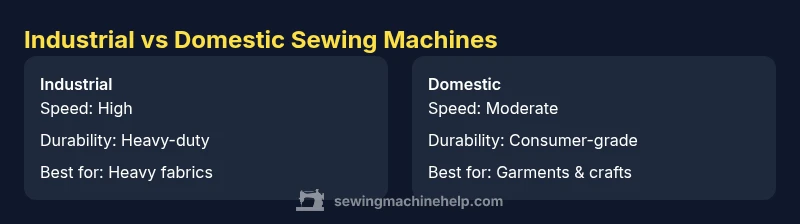
| Feature | Industrial Sewing Machine | Domestic Sewing Machine |
|---|---|---|
| Speed/Throughput | Very high, designed for continuous operation | Moderate; optimized for versatility and garment work |
| Durability/Build | Heavy-duty metal frame; industrial components | Light-to-mid-weight frame; consumer-grade components |
| Fabric Handling | Handles heavy fabrics (leather, canvas) and multi-layer stacks | Excels with lighter to medium fabrics and garments |
| Maintenance | Frequent professional servicing; precise timing checks | User-friendly maintenance; easier DIY servicing |
| Footprint/Space | Larger footprint; requires sturdy stand | Compact to mid-sized footprint; more portable |
| Noise/Vibration | Generally louder; suited for workshop environments | Quieter; suitable for home environments |
| Price | Higher upfront; potential lower cost per stitch with volume | Lower upfront; higher long-term cost with frequent replacements |
| Best For | High-volume production; heavy fabrics | General garment sewing; hobbyist projects |
Strengths
- Great for high-volume, heavy-duty tasks
- Potentially lower cost per finished unit with heavy use
- Long machine lifespan under proper maintenance
- Extensive parts and service networks for common models
Negatives
- Higher upfront purchase price
- Larger space and power requirements
- More intensive maintenance and skilled servicing
- Can be intimidating for beginners
Industrial machines offer clear advantages for heavy, frequent workloads; domestic machines win for versatility and value in typical home sewing.
Choose industrial when your projects demand speed and durability at volume. Opt for domestic when you prioritize flexibility, size, and lower initial costs. Sewing Machine Help’s perspective emphasizes matching capability to workload and workspace.
Your Questions Answered
What defines an industrial sewing machine?
Industrial sewing machines are built for heavy-duty, long-running use with a robust frame, powerful motor, and components designed for reliability under constant operation. They’re typically faster and aimed at production environments, with fewer decorative options than consumer models.
Industrial machines are designed for heavy, continuous work with sturdy builds and high performance. They’re built for speed and durability in professional settings.
Are industrial sewing machines better for beginners?
Generally not. Industrial machines are powerful and require more space, maintenance, and setup knowledge. Beginners usually benefit from a capable domestic model that offers guides, accessories, and easier thread management.
They’re usually not ideal for beginners because of their power and setup needs; start with a good domestic model instead.
Can I upgrade a domestic machine to handle heavier fabrics?
Some domestic machines handle heavier fabrics with the right needles, thread, and tension adjustments, but you’ll reach a limit on speed and continuous use. For frequent thick-material sewing, an industrial machine is often more efficient.
You can push a domestic machine with the right accessories, but it won’t replace the durability of an industrial setup for heavy use.
What fabrics are best for industrial machines?
Industrial machines excel with heavy fabrics like denim, canvas, leather, and multiple layers. They’re designed to feed tough materials steadily and minimize skipped stitches or thread breaks when used correctly.
Denim, leather, and heavy canvas are ideal for industrial machines due to their power and feeding ability.
What space considerations matter?
Industrial machines require a stable, vibration-damping workspace, enough clearance around the machine, and a solid bench. Domestic machines fit in smaller spaces and often benefit from movable carts for flexibility.
Make sure you have room for a bigger unit and a stable surface with good lighting.
How should I evaluate total cost of ownership?
Include upfront price, installation, maintenance, parts availability, and energy use. Industrial machines may be pricier upfront but can be cheaper per finished item if you work high volumes; domestic machines usually cost less to buy and maintain but may require more frequent replacement if you push fabrics hard.
Think beyond the price tag—maintenance, parts, and energy add up over time.
The Essentials
- Assess your weekly hours and fabrics to choose wisely
- Measure and dedicate space for the machine that fits your workflow
- Prioritize total cost of ownership over sticker price
- Test feed quality and fabric handling before buying
- Don’t overlook maintenance needs and service availability