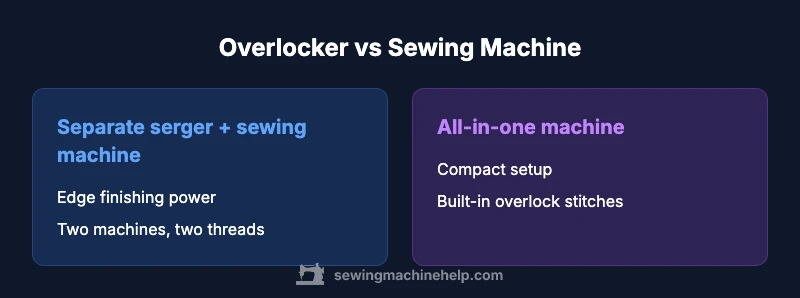
Do You Need an Overlocker and a Sewing Machine? A Practical Comparison
Analytical guide for home sewers: comparing separate serger and sewing machine setups vs all-in-one machines with built-in overlock options. Learn when to choose each path, plus tips for beginners.


If you do a lot of finishing on woven fabrics and want speed, a separate serger plus a standard sewing machine offers the most versatility. For hobbyists with limited space or budget, an all-in-one sewing machine with built-in overlock stitches can cover the essentials. Do you need an overlocker and a sewing machine? In practice, many home sewers balance one reliable machine with occasional serging for clean edges.
Do you need an overlocker and a sewing machine? Context for beginners
The question do you need an overlocker and a sewing machine often comes up in home sewing forums and shopping guides. An overlocker, commonly called a serger, excels at finishing raw fabric edges, trimming seam allowances, and stitching with multiple threads for a crisp, professional look. A standard sewing machine handles a broad range of stitches, buttonholes, zippers, and garment assembly. For many hobbyists, the answer is not a simple yes or no but a planning decision: should you invest in both pieces of equipment, or focus on one machine that can cover the essentials with built-in finishing options? According to Sewing Machine Help, the right setup hinges on how you use fabrics, how often you sew, and the space you have available.
This opening block establishes the core context and uses the keyword phrase in a natural way. The goal is to frame the topic for readers who may be deciding between a dedicated serger and a versatile sewing machine. It also sets the stage for deeper analysis of how each path aligns with common project types, budgets, and learning curves. Expect subsequent sections to break down real-world scenarios and practical tests that help you decide the best route for your needs.
Comparison
| Feature | Separate serger + sewing machine | All-in-one sewing machine with built-in overlock stitches |
|---|---|---|
| Cost / upfront investment | Higher upfront investment due to two machines and potential maintenance | Lower upfront investment with a single machine that offers overlock stitches |
| Space requirements | Two machines require more dedicated workspace and organizational solutions | One compact footprint with combined capabilities |
| Stitch variety & finishing options | Professional finishing with multiple threads, adjustable edge trimming, and edge finishing versatility | Built-in overlock stitches suitable for common seams but limited specialty options |
| Learning curve | Requires learning two interfaces, threading paths, and maintenance routines | Simpler setup and intuitive operation with one machine |
| Maintenance burden | Double maintenance: serger timing, blade care, tensions on two machines | Single maintenance routine with a multi-function device |
| Best use case | Heavy fabrics, high-volume finishing, professional aesthetics | Casual sewing, quick projects, beginners starting out |
Strengths
- Versatility: dedicated serger yields clean, professional edges on many fabrics
- Speed: serger finishes seams quickly, reducing overall project time
- Quality: separate machines can optimize stitch control and fabric handling
- Flexibility: upgrade paths for each device as skills grow
- Redundancy: if one machine fails, the other can keep you sewing
Negatives
- Higher cost overall when buying two machines
- More space and setup complexity
- Maintenance and threading can be intimidating for beginners
- Learning curves multiply when juggling two devices
For most home sewers, a single all-in-one sewing machine with built-in overlock stitches is the best balance; opt for separate machines if you frequently finish many edges or work with heavy fabrics.
Choose the all-in-one option when space and budget are priorities or when you primarily sew standard garments. Consider a separate serger if your projects demand near-professional edge finishes and you regularly handle fabrics that fray easily.
Your Questions Answered
Do you need an overlocker if you already own a sewing machine?
Not always. If your projects involve basic seams and hems, a sewing machine with built-in overlock stitches can suffice. A serger adds edges finishing speed and durability for fraying fabrics.
If your projects are simple, a serger isn't required. For fray-prone fabrics and faster edge finishing, a serger is worth considering.
What is an overlocker, and what does it do?
An overlocker or serger uses multiple threads to trim, stitch, and finish raw edges in one pass. It produces clean, professional edges and can enable fast construction of seams.
A serger trims and finishes fabric edges quickly with multiple threads for a neat look.
Can domestic sewing machines perform overlocking?
Many modern domestic machines include overlock or overedge stitches. They can mimic serging for basic finishes, but the results and speed may vary compared with a dedicated serger.
Some sewing machines have overlock stitches, but they may not match a serger for speed and durability.
Is it cheaper to buy a serger or a machine with built-in overlock stitches?
Prices depend on models and features, but generally a dedicated serger plus a sewing machine costs more than a single multi-function machine. Consider long-term use and maintenance when deciding.
Typically, two devices cost more upfront, but you gain flexibility and finishing power.
What fabrics benefit most from serging?
Fabrics that fray easily, like woven cottons, linens, and synthetics, benefit from serging. Knits may also benefit when a clean edge is desired, particularly for garments.
If your fabrics fray or curl, a serger can help you finish edges neatly.
What should I test before buying a setup?
Test stitching on similar fabric weights, check threading ease, and evaluate foot pedal ergonomics. Consider future projects and whether you need a wide variety of stitches.
Test on fabrics like yours and see how each machine handles the finishes you use most.
The Essentials
- Prioritize your space and budget first
- Consider built-in overlock options if you want simplicity
- Separate serger shines with edge finishing and speed
- Balance durability with maintenance needs
- Test stitching on similar fabrics before buying