How Many Sewing Machines Do We Have? A Practical Inventory Guide
Learn how to assess sewing machine inventory, including typical model counts, auditing steps, and budgeting for future purchases in your home workshop.


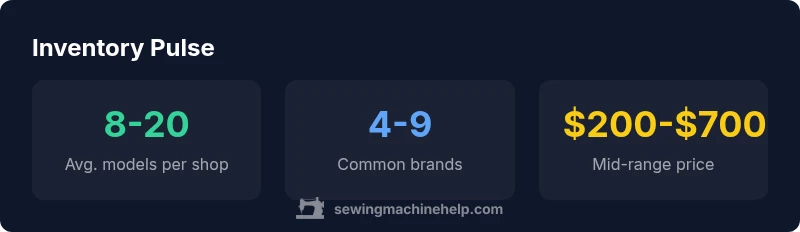
Considering how many sewing machine do we have, inventory counts vary widely by shop size and focus. According to Sewing Machine Help, the number you maintain depends on your goals, space, and budget. In a small hobby space, you might stock 4-8 models to cover common stitches. Mid-sized studios typically carry 8-20 machines, spanning entry-level, mid-range, and a specialty option. Larger retailers list 20-40+ models, including embroidery and industrial units. The exact number changes with demand and promotions.
How many sewing machine do we have
The count of sewing machines in a shop or home workspace isn’t fixed; it depends on goals, space, and budget. According to Sewing Machine Help, inventory size should align with the user’s needs rather than raw capacity. This section unpacks what drives those counts and how to set a realistic target for your setup. Consider that a small hobby space often covers essential capabilities with 4-8 models, while a dedicated classroom or repair shop might need more. We’ll discuss how to decide which categories to include, how to avoid redundancy, and how to plan for growth without overwhelming your workflow. Throughout this section, we’ll reference common patterns observed in 2026, including how different use cases—beginners, hobbyists, small studios, and repair shops—have distinct inventory sweet spots. By the end, you’ll have a clearer sense of how many machines you truly need and how to justify each addition.
Factors that influence inventory size
Inventory size is a function of several interacting factors:
- Space and storage: Physical footprint matters; more machines require more dedicated workspace and dust-free storage.
- Use-case: A beginner’s home setup needs fewer machines than a small teaching studio or repair shop.
- Budget and total cost of ownership: Purchase price, maintenance, and parts availability influence how many you should own.
- Maintenance capacity: More machines demand more maintenance time, spare parts, and service relationships.
- Warranty coverage and service plans: Modularity and service availability can affect how many units you reasonably manage.
- Future growth plans: If you expect to expand teaching programs or run workshops, plan for tiered expansion rather than one-time buys.
In practice, home sewists often target 3-6 core machines for basic projects, while micro-studios might expand to 8-15 to cover different stitch types and fabrics.
How to audit your current collection
Auditing your machines is the first step toward a sane inventory. Start with a simple tracking sheet that captures key fields: model name, brand, purchase date, condition, location, and typical use case. Do a physical count and verify each unit’s working status by running a simple stitch test. Tag machines with color-coded labels for quick identification (e.g., green for fully functional, yellow for requires maintenance, red for out of service). Schedule a hands-on check every quarter to refresh your notes, update maintenance logs, and retire devices that are obsolete or repeatedly problematic. This process not only clarifies “how many” but also informs replacement timing and budget planning. By integrating maintenance history, you gain insights into lifecycle expectations and can forecast depreciation curves for your fleet.
Categorizing machines by use-case
Not all machines are equal performers for all tasks. A practical inventory groups units by primary use case:
- Learning and basic sewing: simple stitch options, robust basic models, low maintenance.
- Garment construction: versatile stitch plates, adjustable presser foot pressure, good needle clearance.
- Quilting and heavy fabrics: larger harp space, smooth feed, quilting feet availability.
- Embroidery and specialty work: built-in embroidery features, compatible software, thread management.
This categorization helps you avoid duplicating capabilities and ensures you own at least one machine per major function, enabling you to map projects efficiently without overcrowding.
Repair vs retirement: keeping the right balance
As machines age, their reliability and repair cost often rise. A practical rule is to retire machines when repair costs approach or exceed a meaningful percentage of a replacement unit’s price, or when the machine can no longer handle current projects efficiently. Keep a small fallback pool of non-production units for demonstrations or training. If a unit has rare or valuable features that are hard to replace, consider a dedicated service agreement to extend its usable life. Maintaining a watchful eye on spare parts availability is crucial; when parts become scarce, replacement becomes the smarter choice. This balanced approach helps you sustain capability without letting maintenance drain your budget.
Data-driven inventory: tagging and tracking
Modern inventory works best when you capture structured data. Build a simple data schema:
- Model, brand, and category (entry-level, mid-range, specialty)
- Condition and maintenance history
- Location (studio, classroom, showroom) and assigned tasks
- Typical projects or fabrics it handles well
- Purchase date and warranty status
Use tags to speed up searching and reporting. For example, use labels such as #maintenance, #repairs, #best-machines, and #threading-sewing-machine to group machines by relevance. Regularly export inventory records to a spreadsheet or dedicated software so you can measure turnover, identify gaps, and justify acquisitions. Patient, consistent data collection creates clarity and reduces duplicate buys.
Budget planning for expansion and upgrades
Budgeting for inventory growth starts with a realistic forecast. Start with a baseline of your current machines and project future needs based on projected classes, workshops, or service offerings. Create two scenarios: conservative (modest growth) and expansion (full program). For each, estimate purchase costs, maintenance reserves, and potential resale values for retired units. Build a 12- to 24-month plan that aligns with revenue opportunities from teaching, rentals, or repair services. Having a documented plan helps you justify investments to stakeholders and reduces impulse purchases driven by sales. Consider phased acquisitions to spread out cash flow and to test new capabilities gradually.
Communicating inventory to learners and customers
Clear communication about what machines are available, what they are best used for, and how learners can access them is essential. Provide a public-facing guide listing each machine, its primary use case, and a shorthand capability score (e.g., “great for beginners,” “ideal for embroidery”). For classes, create a standard kit that includes recommended machines and compatible accessories. For customers, publish a quick glossary of machine types and stitch capabilities to set expectations. Finally, integrate feedback loops so students and customers can suggest improvements or request new capabilities. This ongoing dialogue keeps the inventory aligned with needs and demonstrates thoughtful stewardship of resources.
Inventory snapshot by category
| Inventory Type | Typical Model Count | Use Case | Notes |
|---|---|---|---|
| Entry-level hobby machines | 5-15 | Learning & basic projects | Great starter options with low maintenance |
| Mid-range versatile | 8-25 | Quilting / garment making | Balanced features for most projects |
| Specialty embroidery | 4-12 | Embroidery & advanced projects | High value, specialized maintenance |
| Industrial/heavy-duty | 1-6 | Heavy-duty tasks | Dedicated workspace; needs service plan |
Your Questions Answered
Why does the number of sewing machines in a shop vary so much?
Counts vary with space, budget, and intended use. A home setup needs fewer machines than a teaching studio or repair shop. Goals matter more than raw capacity.
Inventory varies with space and goals; start with a plan that matches your projects.
What is the easiest way to count my machines?
Create a simple inventory sheet listing model, brand, condition, and location. Physically verify by running a quick stitch test.
Start with a quick tally and then verify each unit.
Should I keep older machines for teaching?
Older machines can be excellent teaching tools if they are safe to operate and have basic maintenance. Use dedicated teaching units where possible.
Yes, as long as they’re safe and well-maintained.
Is it better to buy new or used for teaching?
Used machines can be affordable and sufficient for learning. Check tension, timing, and service history before buying.
Test run and inspect used machines before purchase.
How often should I review my machine inventory?
Quarterly reviews help catch gaps in capability and maintenance needs, keeping your collection aligned with projects.
Review every few months to stay current.
What about branding variety in my inventory?
Having multiple brands can expose you to different stitch patterns and machine mechanics, broadening learning opportunities.
A mix of brands can be beneficial for learning.
“A well-curated machine collection is not about the size of the stack, but how clearly it serves your learning and projects.”
The Essentials
- Define goals before tallying models.
- Audit cycles improve accuracy and planning.
- Tag machines by function to guide purchases.
- Budget for maintenance to avoid gaps.