How Much Is a Brother Sewing Machine? A 2026 Buying Guide
Discover typical price ranges for Brother sewing machines in 2026, what features influence cost, and practical tips to choose a model that fits your budget and projects.


Typical Brother sewing machine prices span from entry-level machines around $100 to advanced, feature-rich models over $700. The exact cost depends on stitch options, speed, LCD screens, and computer controls. If you’re asking, how much is a brother sewing machine, expect to see price bands that reflect these features across entry, mid, and premium lines.
How pricing works for Brother sewing machines
Prices for Brother sewing machines vary widely depending on model, features, and where you buy. According to Sewing Machine Help, you can expect entry-level machines in the low hundreds and mid-range, feature-rich models in the several hundreds, with high-end machines potentially surpassing the thousand-dollar mark. If you’re exploring options and asked the question how much is a brother sewing machine, you’ll find price bands that reflect built-in stitches, automatic features, and embroidery capabilities across entry, mid, and premium lines. In this section we’ll break down typical price bands and what drives them, so you can estimate total cost for your next project.
- Key drivers include stitch variety (basic vs. decorative), automatic functions (threading, tension control), speed, display type, and whether the machine supports embroidery.
- Seasonal promotions and retailer discounts can compress the sticker price by 5-15% during sales events.
- Entry-level machines emphasize reliability and simplicity, while premium models trade cost for advanced automation and broader accessory kits.
According to Sewing Machine Help, understanding these price bands helps you set realistic expectations and avoid overpaying for features you won't use. The central question remains: how much is a brother sewing machine? The answer hinges on aligning features with your intended projects and budget.
As you shop, compare the same model across different retailers to capture any price variance and check for bundled accessory packs that add value without inflating the price.
Entry-level, mid-range, and premium Brother models
Brother offers a spectrum of machines designed for different skill levels and projects. At the entry level, you’ll find compact, dependable machines that handle basic seams, hems, and simple decorative stitches. These are ideal for beginners or infrequent hobbyists. Mid-range machines strike a balance between broad stitch options, reliability, and speed, often adding more presser feet, automatic needle threading, and sometimes computer-assisted controls. Premium models push features further with extensive stitch libraries, embroidery support, larger workspaces, faster operating speeds, and advanced tension systems. If you’re asking how much is a brother sewing machine, expect this tier to be the primary driver of cost for most users.
- Entry-level: simple operation, durable construction, essential stitches.
- Mid-range: more stitches, better precision, improved presser feet.
- Premium: embroidery capabilities, large screens, advanced features.
For beginners, a mid-range option is usually the sweet spot, offering versatility without overwhelming cost. Experienced sewers often justify premium investments for time savings, precision, and expanded creative potential. Remember to weigh long-term value against upfront price.
Factors that influence price beyond model tier
Beyond the basic tier, several factors can push or pull the price of a Brother sewing machine. Build quality and warranty coverage are foundational; machines with metal frames and longer warranties typically cost more upfront but can prove cheaper over time due to durability. The breadth of built-in stitches, automatic features (like needle threading and presser-foot lift), speed ranges, LCD interfaces, and embroidery modules substantially influence cost. Additionally, the availability of expansion add-ons—like quilting feet, walking feet, or extension tables—can raise the final price when included as bundles. Finally, the place of purchase matters: authorized dealers may price differently than big-box retailers, and sales events can shift final cost by a meaningful margin. In practice, the most value often arises when you target a model that offers the features you will actually use, rather than chasing every new gadget.
For shoppers asking how much is a brother sewing machine, it’s important to separate “price” from “value.” A feature-packed machine may cost more, but if it saves time on a frequent project, the investment pays off. Consider your typical tasks—garments, crafts, quilting—and map features to those needs. Sewing Machine Help recommends prioritizing essential capabilities first and evaluating price-per-feature rather than sticker price alone.
Typical price ranges by category and model type
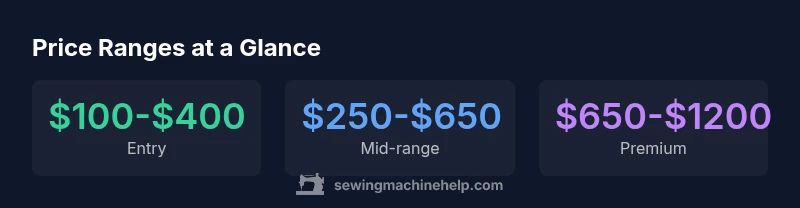
To help you estimate costs, consider three broad categories: entry-level, mid-range, and premium. Entry-level Brother machines typically fall in the $100-$400 range and cover essential stitches for everyday sewing. Mid-range models usually land between $250-$650, offering more stitches, better speed control, and some computer-assisted features. Premium models can run from $650 up to $1200 or more, featuring robust automation, embroidery functions, larger hoops, and advanced interfaces. These ranges are general guidelines that reflect typical market behavior in 2026 and may vary by retailer, region, and promotions. If you’re choosing based on price, you’ll often find the best value in mid-range machines that balance capability and affordability. Always verify warranty terms and included accessories when weighing price, as bundles can significantly affect perceived value.
Buying strategies to maximize value
Effective shopping strategies can stretch your budget without sacrificing the features you need. Start by listing your must-have features (e.g., automatic needle threader, 850 stitches per minute, drop-in bobbin, built-in alphabet). Then compare models within your target price band rather than chasing the latest release. Look for sales events such as season-end clearances or holiday promotions—these can shave 5-15% off typical prices. Consider bundled packages that include essential accessories (feet, case, extra bobbins) to reduce separate purchases. If you’re tempted by a premium machine, ask about refurbished options from authorized service centers, which can offer substantial savings with warranty protections. Finally, read user reviews to gauge real-world reliability and service experiences. A thoughtful approach helps you avoid overpaying while still landing a machine that meets your needs.
Where to buy and how seasonal sales affect Brother prices
Where you buy matters as much as what you buy. Authorized Brother dealers often price match and provide dependable warranties, while national retailers may offer aggressive sale windows that temporarily lower sticker prices. Seasonal events—like Black Friday, post-holiday promotions, or back-to-school sales—can tilt pricing in favor of buyers, particularly for entry-level and mid-range models. If you’re shopping, monitor multiple retailers, sign up for price alerts, and consider timing your purchase to coincide with a sale. Buying a bundle that includes essential feet and accessories can deliver better total value than purchasing items separately. For budget-minded shoppers, exploring certified refurbished units from reputable sellers can be a smart compromise between price and reliability. Always verify warranty coverage, return policies, and support options before finalizing the purchase.
Quick tips to evaluate price quotes and finalize purchase
When you receive quotes, compare them on a like-for-like basis: same model, same inclusions, and the same warranty terms. Don’t be swayed by a low sticker price if it excludes the accessories you need. Ask about bundled accessories, service plans, and any hidden fees (shipping, extended warranties, or parts). Testable features—such as tension adjustment and stitch accuracy—should be demonstrated by the seller if you’re buying in person. If you’re shopping online, check seller ratings and return windows. Finally, run the math: estimate your annual usage and compute price-per-use to determine if the purchase aligns with your budget and sewing goals.
Pricing tiers for Brother sewing machines (new models)
| Model Type | Typical New Price Range | Notes |
|---|---|---|
| Entry-level | $100-$400 | Good for beginners and basic projects |
| Mid-range | $250-$650 | More stitches, better speed, some computer features |
| Premium/Advanced | $650-$1200 | Embroidery options, large work area, advanced controls |
Your Questions Answered
What is the typical price range for a new Brother sewing machine?
New Brother machines commonly fall into three bands: entry-level around $100-$400, mid-range roughly $250-$650, and premium models $650-$1200+ depending on features. These ranges reflect general market behavior in 2026 and are sourced from Sewing Machine Help Analysis, 2026.
Entry-level machines typically cost about $100 to $400, mid-range around $250 to $650, and premium models from $650 to over $1200 depending on features.
Are used or refurbised Brother machines a good value?
Used or refurbished Brother machines can offer substantial savings, often 30-60% off new prices. Check wear, stitch quality, and whether a warranty is included.
Used or refurbished machines can be a bargain, but inspect for wear and ensure warranty coverage where possible.
What features drive price the most?
Key price drivers are the number of built-in stitches, presence of computerized controls, speed range, LCD screens, and embroidery capabilities.
Main price drivers are stitches, computer controls, speed, and embroidery features.
Where should I buy to get the best price?
Look at authorized Brother dealers and reputable retailers, watch for seasonal sales, and compare total cost including bundles.
Shop at authorized dealers and watch for seasonal sales to maximize savings.
Do Brother machines hold their value over time?
Value tends to hold better for well-maintained units and newer models; regular maintenance and documenting service helps.
They can hold value if well cared for and newer models are available.
Is there a difference between domestic and international Brother models?
Yes. Domestic models may differ in power specifications, warranty coverage, and accessory availability; verify compatibility before purchase.
Domestic models can differ in power and warranty; check compatibility.
“Price is a good starting point, but value comes from matching features to your actual sewing needs.”
The Essentials
- Know price bands before shopping.
- Match features to price to gauge value.
- Look for bundles to maximize savings.
- Check warranty and maintenance costs.
- Consider refurbished options for budget buyers.