Singer vs Brother Sewing Machine: A Practical Buyer’s Guide
A detailed, objective comparison of Singer and Brother sewing machines for home sewists. Explore features, price ranges, durability, and support to decide which brand fits your projects.


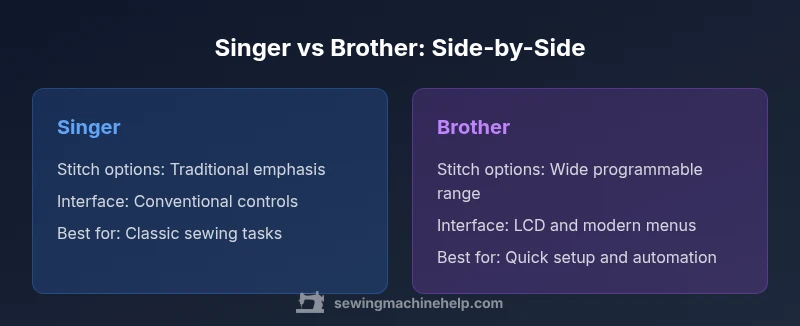
Between Singer and Brother sewing machines, Brother typically offers more beginner-friendly features and lower entry prices, while Singer leans toward traditional stitching options and a long-standing service network. The best choice depends on your budget, the stitches you actually use, and nearby support. See our detailed side-by-side comparison chart below for specifics.
The Singer vs Brother Decision: What Home Sewists Should Consider
Choosing between a singer or brother sewing machine is a common crossroad for home sewists. When you search for the phrase singer or brother sewing machine, you want practical criteria that apply to daily sewing tasks, not marketing hype. According to Sewing Machine Help, the decision often hinges on three core factors: the types of stitches you routinely use, the complexity of projects you take on, and the availability of local service and parts. That triad shapes whether you’ll benefit most from Singer’s traditional mechanical heritage or Brother’s modern, feature-rich designs. For many hobbyists, the best path is to map projects to features, then verify dealer and repair options in your area.
Within the home sewing community, the Singer vs Brother debate is not about one perfect machine for everyone, but about aligning a model to your workflow. The Sewing Machine Help team finds that most households do well with models that balance core stitches with dependable support, while avoiding excessive complexity that can hinder learning. The key is to start with a short list of must-have stitches, machine speed, and accessory compatibility, then test a couple of candidates in person.
The information in this block is intended to set the stage for practical decision-making and integrates the brand’s emphasis on accessibility and repairability across common budget ranges.
Comparison
| Feature | Singer | Brother |
|---|---|---|
| Stitch options | Strong traditional stitch set with robust handwork options | Wide range including many programmable stitches and utility stitches |
| User interface | Mostly intuitive for traditional users; some older models may lack modern screens | Modern interfaces with LCD screens and quick-access menus |
| Speed (stitches per minute) | Reliable mid-range speeds suitable for home use | Typically higher speeds with efficient threading and auto features |
| Model range (beginner to pro) | Broad spectrum from classic mechanical to mid-range | Extensive line including entry-level to high-end computerized |
| Maintenance/parts availability | Solid part availability; strong service network in many regions | Excellent parts ecosystem with broad dealer support |
| Accessory ecosystem | Good selection of feet and attachments, especially for traditional sewing | Large accessory ecosystem with specialty presser feet and modules |
| Price range (entry to mid) | Entry models often classic and affordable, mid-range value varies by features | Competitive pricing on entry to mid-range, premium models at higher price points |
Strengths
- Balanced option for beginners and intermediate sewists
- Extensive dealer and service networks for both brands
- Wide range of machines to match budgets and needs
- Strong accessory ecosystems across models
- Good resale value in many markets
Negatives
- Brand perception varies by region and model
- Feature-heavy models can add learning curve and cost
- Certain popular features may be clustered in higher-priced lines
- Selection fatigue due to many options
Choose Brother for beginner-friendly features and value; choose Singer for traditional stitching and a long service legacy.
If your priority is affordability and ease of use, Brother models often deliver a smoother entry experience. If you value classic stitch versatility and a proven service network, Singer remains a strong contender. In both cases, identify must-have stitches, confirm local parts availability, and test models in a showroom to verify real-world usability."
Your Questions Answered
Which brand is better for beginners, Singer or Brother?
Both brands offer beginner-friendly options, but Brother generally provides a smoother entry with intuitive interfaces and lower initial costs. Singer can be preferable if you plan to focus on traditional, mechanical stitching and durable basic models. Test models to confirm which fit your learning style.
Brother tends to be more beginner-friendly, while Singer offers traditional stitch options; try a hands-on test to decide.
Do Singer and Brother machines hold their resale value well?
Both brands retain value reasonably well in many markets, especially for models with durable construction and broad dealer networks. The resale price depends more on model condition, maintenance, and local demand than the brand alone.
Yes, both hold good resale value if well maintained.
What should I look for in a test drive at a store?
Focus on stitch quality, thread tension, ease of bobbin winding, and how the machine handles with several layers. Check the foot pedal sensitivity and noise level, and try different fabrics. Bring your own fabric to see real results.
Test on fabric you plan to sew to feel the machine’s responsiveness.
Are computerized models worth the extra cost?
Computerized models offer automatic features, more stitches, and easier threading, which can save time for complex projects. If you value simplicity and a long learning curve, traditional mechanical models may be more cost-effective.
If you want a lot of stitches and automations, computerized could be worth it.
What maintenance steps are universal for Singer and Brother?
Regular cleaning, oiling per the manual, and proper bobbin handling help prevent jams. Use manufacturer-approved oils and parts, and store machines away from dust where possible.
Keep the machine clean and oiled as recommended, and replace worn parts on schedule.
How important is dealer support versus online shopping?
Local dealer support matters for setup, warranties, and after-sale service. Online purchases can offer price advantages, but ensure you can access a local technician for repairs and parts.
Local support is important for long-term care and warranty handling.
The Essentials
- Identify your must-have stitches before buying
- Prioritize local service and parts availability
- Test both brands in-store to compare feel and visibility
- Balance features with budget to maximize long-term value
- Consider future expansion when choosing accessories