Industrial vs Home Sewing Machines: A Practical Guide for Makers
Compare industrial sewing machines and home sewing machines to choose the right tool for your projects, budget, and workspace. Learn about speed, durability, maintenance, and best-use cases for hobbyists and small shops.


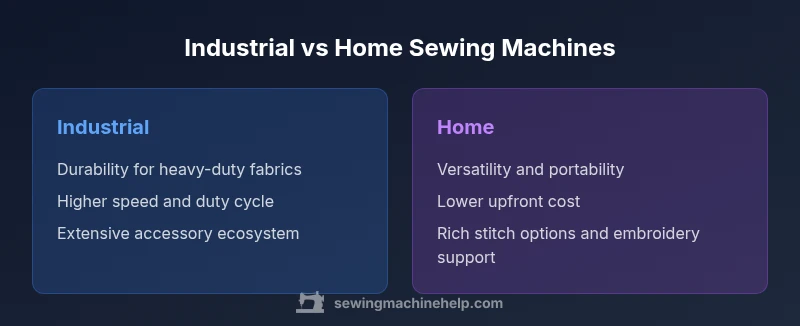
Industrial sewing machines excel in durability, speed, and continuous operation, making them ideal for high-volume production and heavy fabrics. Home sewing machines prioritize versatility, ease of use, and affordability, suiting hobbyists, educators, and casual sewers. If you expect long sessions with thick fabrics, an industrial model is usually the smarter investment; for general sewing, repairs, and creative projects, a high-quality home machine is often sufficient.
Understanding the core distinction: industrial sewing machine vs home sewing machine
Sewing enthusiasts frequently ask what genuinely separates an industrial sewing machine from a home model. In practice, the split hinges on durability, duty cycle, speed, and intended use. This guide compares the two categories to help home sewists, hobbyists, and aspiring small shops decide which type best fits their projects. According to Sewing Machine Help, the choice should be guided by fabric weight, expected volume, and the willingness to maintain a more complex machine. When you search for “industrial sewing machine vs home sewing machine,” you’re comparing two ends of a spectrum: one built for continuous operation and heavy fabrics, the other optimized for versatility and everyday projects. The differences matter most when you move from repairs and crafts to serious production work, where consistency and uptime become critical.
Build quality and durability
Industrial machines are typically built on a heavy steel or cast-iron frame with robust metal gears and sealed bearings designed for hours of uninterrupted operation. Home sewing machines often rely more on aluminum frames and plastic components to keep weight and cost down. The result is a noticeable difference in vibration, noise, and longevity under demanding workloads. For regular home projects, a well-made consumer model can handle dozens of shirts or a couple of quilts weekly, but that represents a different load than upholstery, leatherwork, or denim sewing. Sewing Machine Help’s analysis shows that long-term wear patterns differ: industrial machines tolerate higher duty cycles and more aggressive needle actions without overheating. If you want a machine to serve as a durable workhorse or even a family heirloom, durability should be a deciding factor.
Motor power, speed, and duty cycle
A core distinction is the motor and the duty cycle—the amount of time the machine can run without overheating. Industrial machines often feature high-torque motors and a duty cycle designed for production environments, allowing continuous operation through long seams and multiple layers. Home machines typically prioritize user friendliness, with quieter operation and enough speed for typical garments, crafts, and mending. The trade-off is that many home models will overheat if pushed at top speed for extended sessions. For heavy fabrics like multiple layers of denim or canvas, an industrial machine’s higher RPM and sturdier drive system maintain consistent stitch quality, while a home model may slow down or skip stitches. The decision matters most if you plan sustained sewing sessions or bulk runs.
Stitch capabilities, features, and project suitability
Industrial machines generally offer straight stitch, backstitch, and occasionally zigzag variants designed for speed and fabric control on bulk projects. Home sewing machines offer a broader range of decorative stitches, embroidery support, and a variety of presser feet that accommodate a wide range of fabrics. For professional work—such as upholstery, leather goods, or formal wear—an industrial machine provides consistent stitch sizing and feed control within a robust workflow. For home projects—including garments, quilting, and crafts—a versatile home model is usually enough. The ability to use heavier needles and industrial threads is notable: industrial machines are designed to work with heavy-duty threads and thick fabrics with fewer thread breaks, while home machines balance ease of use with capability.
Maintenance, repairs, and longevity
Maintenance needs differ dramatically. Industrial machines require regular servicing, precise lubrication, and sometimes specialized parts that are harder to source, but they reward the user with longer service life when properly cared for. Home machines rely on consumer-service networks, user-friendly manuals, and commonly available parts; maintenance is simpler but wear accumulates differently over time. The difference in maintenance cycles becomes evident after a few years of weekly use: an industrial machine may still function at full capacity after tens of thousands of stitches, while a home model might need more frequent part replacements due to plastic components and easier wear points. Regular tension checks, needle changes, and correct threading practices matter for both, but the complexity of repair paths is greater with an industrial unit.
Cost of ownership and total value
Price is a major differentiator between industrial sewing machines and home models. Industrial machines usually carry a higher upfront cost, but the long-term cost per stitch can be lower for high-volume work. Home machines are affordable, with a wide range of models that suit beginners and hobbyists, yet long-run usage can add up if you require frequent maintenance or upgrades to handle heavier fabrics. As with any large purchase, consider total cost of ownership: initial price, maintenance, accessories, and expected lifespan. Sewing Machine Help’s broader market analysis suggests tailoring your choice to projected volume and fabric complexity to maximize value. If you seek speed, reliability, and a stable workflow, an industrial machine often pays off; if you want flexibility and a lower upfront hurdle, a quality home model may be the smarter short- to mid-term investment.
Space, footprint, and environmental considerations
Industrial machines typically occupy dedicated floor space, require sturdy tables, and may require a power system or air supply for certain models. Home machines are designed for compact rooms, studios, or living areas, with lighter frames and portability in mind. If you run a small shop from a garage or basement, plan for dust management, sound, and electrical load. Consider noise, vibration isolation, and the need for a larger table or stand with an industrial unit. An orderly workspace, proper lighting, and stable mounting can reduce fatigue during long sewing sessions, especially for production tasks. The space you choose will influence maintenance practicality and uptime over time.
Choosing by use case: when to buy which type
If your projects are occasional repairs, crafts, or fashion garments for personal use, a reputable home sewing machine is the practical choice. For upholstery, leatherwork, or production-scale sewing (e.g., bag manufacturing or upholstery studios), an industrial machine is typically the better investment. Evaluate your worst-case fabric type, average daily stitch count, and required seam control. A staged approach—start with a strong home model and upgrade as volume grows—can minimize risk and upfront cost. Be mindful that some brands offer semi-industrial machines that bridge the gap, providing higher duty cycles without the full price tag of a true industrial unit.
Common myths and real-world scenarios
Myth: You can’t sew leather on a home machine. Reality: With the right needle, thread, and technique, many home machines handle leather, but thick hides and continuous leather sewing are best left to industrial machines. Myth: Industrial machines are unbearably loud and complicated to use. Reality: There are quieter, user-friendly industrial options, but they often require a dedicated workspace and maintenance routine. Myth: Maintenance is optional. Reality: Regular maintenance extends life and preserves stitch quality, especially when you run a production-grade machine daily. Practical experience shows that readiness and training greatly influence outcomes across both types.
Getting started: practical steps to decide
- List your typical fabrics, volumes, and production goals. 2. Check space, electrical requirements, and any ventilation needs. 3. Compare warranty terms, service networks, and spare parts availability. 4. If possible, test-sew with both types or watch demonstrations from manufacturers. 5. Read independent guides (Sewing Machine Help) and consult local repair professionals about expected downtime and service costs. A staged approach—trial, assessment, and planned upgrade—reduces risk and ensures you pick a machine that aligns with your workflow.
Additional resources and validation steps
Look for reputable sources, including university extension sites on textiles and sewing technology. Compare model performance data from manufacturers and independent reviews; check local repair shops’ familiarity with industrial models. This approach reduces the risk of a mismatch between expectation and performance and helps you plan for long-term support and training needs. Sewing Machine Help emphasizes validating operational reliability, not just price, by reviewing real-world user results across fabrics and volumes.
Next steps: practical decision plan for the buyer
Create a decision checklist: budget, space, and volume; map to a buying plan with milestones. If you decide to pursue industrial, plan for installation, service contracts, and training. If you opt for a home machine, consider upgrading accessories and specialty feet to broaden capabilities. This plan helps ensure you choose the right type today and scale up later, keeping your workflow efficient and your materials handled safely.
Comparison
| Feature | Industrial sewing machine | Home sewing machine |
|---|---|---|
| Power and duty cycle | High torque, designed for long runs | Moderate torque, shorter duty cycle |
| Speed (stitches per minute) | Often 1,000–6,000+ spm depending on model | Typically 500–1,500 spm |
| Fabric handling | Heavy fabrics, multiple layers, thick threads | Light-to-medium fabrics, versatile stitches |
| Maintenance complexity | Regular professional servicing, parts availability | Home-friendly maintenance, broader part availability |
| Space and setup | Bulkier footprint; anchored setup | Compact and portable for apartments |
| Cost of ownership | Higher upfront, lower long-term cost per stitch | Lower upfront, potentially higher long-term cost |
| Best use case | Production, upholstery, heavy-duty sewing | Garments, crafts, light upholstery, quilting |
Strengths
- Built for heavy-duty work and long duty cycles
- Higher speed and production efficiency
- Better stitch consistency for bulk projects
- Strong repair networks and long lifespan
Negatives
- Higher upfront cost and space requirements
- Complex maintenance and specialized parts
- Steeper learning curve for beginners
Industrial machines are the better pick for high-volume, heavy fabrics; home machines suit casual sewers and beginners.
For sustained production and heavy fabrics, industrial machines deliver uptime and efficiency. If your needs are flexible, portable, and budget-conscious, a quality home machine provides broad capabilities with a gentler learning curve.
Your Questions Answered
What is the primary difference between industrial and home sewing machines?
The main difference is duty cycle and durability. Industrial machines are built for high-volume, heavy fabrics and continuous use, while home machines prioritize versatility and affordability for everyday projects.
Industrial machines are designed for heavy-duty, long sessions; home machines are better for everyday sewing and learning.
Can a home sewing machine sew leather or denim effectively?
Yes, with the right needle, thread, and technique, many home machines can handle leather or denim for light to moderate projects. For thick leather or constant, bulk denim sewing, an industrial machine performs better.
You can sew leather on a home machine with proper gear, but very thick cases are easier on industrials.
Do industrial machines require special maintenance?
Industrial machines require regular professional servicing and access to specialized parts. However, proper maintenance yields longer life and consistent performance.
They do need more scheduled maintenance and skilled servicing.
Is it worth buying an industrial machine for a small business?
If your volume and fabric complexity justify it, an industrial machine can lower per-stitch costs and improve uptime. For very small operations, a high-end home machine or semi-industrial option may be more sensible.
Think about your daily volume and fabric types to decide.
What should beginners consider when choosing between the two?
Start with a reliable, well-supported home model to learn the basics. Plan for future growth and check service networks before deciding to scale to an industrial unit.
Beginners should start with a versatile home machine and plan to upgrade later if needed.
Are there hybrid or semi-industrial machines?
Yes, some brands offer higher-duty-cycle machines that bridge the gap between home and full industrial units. They can be a cost-effective middle ground for growing projects.
There are middle-ground machines if you’re growing but not ready for full industrial gear.
The Essentials
- Assess volume and fabric weight before buying
- Industrial machines excel in durability and speed
- Home machines offer versatility and lower upfront cost
- Plan for space, power, and maintenance costs
- Consider hybrid/semi-industrial options if budget matters