Why Use a Serger Instead of a Sewing Machine: A Practical Guide
Sewing Machine Help analyzes when a serger outperforms a regular sewing machine for edge finishing, speed, and durable seams, with practical guidance for home sewers.


If you’re wondering why use a serger instead of a sewing machine, the quick answer is that sergers excel at fast edge finishing, trimming, and creating neat, durable seams on lightweight fabrics. A traditional sewing machine handles the broad range of construction stitches and more complex garments. For most home sewers, the best setup is a complementary pairing: a serger for finishing and a sewing machine for assembly.
Why Use a Serger Instead of a Sewing Machine: Core Differences
The question of why use a serger instead of a sewing machine often boils down to two pillars: edge finishing and production speed. A serger performs trimming, overcasting, and seam finishing in one pass, dramatically reducing handling time on many woven and knit fabrics. By contrast, a traditional sewing machine specializes in a wider range of stitch types and construction tasks, from topstitching to buttonholes and zippers. For hobbyists and beginners, this distinction is essential because it shapes which tools belong in a starter kit. In the Sewing Machine Help analysis, most home sewers benefit from understanding both capabilities and how they complement each other over the lifetime of projects. The core message, especially for those asking why use a serger instead of a sewing machine, is that you don’t have to choose one tool for every task—your best results often come from using both in concert.
wordCountCountedInBodyFirstBlock":null},{
Edge Finishing: What a Serger Brings That a Sewing Machine Typically Lacks
Edge finishing is where a serger shines. It trims fabric edges while applying an overlock stitch that prevents fraying. This results in clean, resilient edges on knits and delicate fabrics that would fray with ordinary straight stitches. The serger’s blade and loopers operate in harmony to close and finish the edge in a single motion, making it particularly popular for garment seams and lingerie where a smooth interior finish matters. However, this strength comes with trade-offs: a serger generally does not replace the need for traditional topstitching and may struggle with bulky fibers. The practical takeaway for the reader exploring why use a serger instead of a sewing machine is that sergers excel at finishing, while sewing machines excel at construction. This nuanced distinction is something the Sewing Machine Help team emphasizes for hobbyist workflows.
wordCount":210} ,{
Stitch Types and Construction: Capabilities of Each Tool
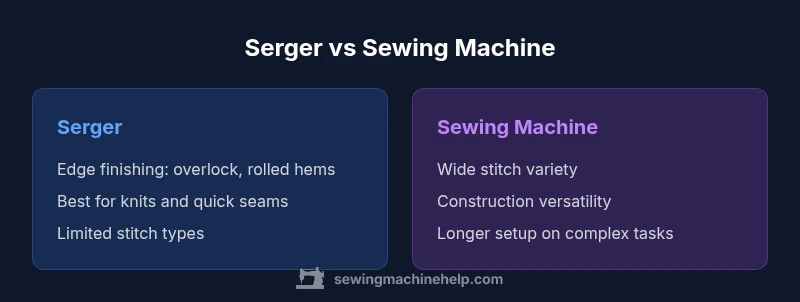
A serger offers overlock stitches, rolled hems, and narrow edge finishes, which are ideal for lightweight fabrics and ready-to-wear-like seams. It typically lacks the variety of stitch types found on modern sewing machines, such as zigzag, satin, and visible decorative stitches, or specialized stitches for buttonholes and topstitching. A sewing machine, meanwhile, provides a broader gamut of stitch options that enable complex construction and precise control over fabric behavior. The key here is to design a workflow that uses the serger for finishing the edges and a sewing machine for assembly and specialized stitching. When you evaluate why use a serger instead of a sewing machine, the practical answer is: reserve the serger for edge finishing and use the sewing machine for versatile stitching and structural work. Since many home projects involve both finishing and construction, this combined approach yields stronger results and a cleaner look, which Sewing Machine Help consistently advocates.
wordCount":190} ,{
Fabric Handling and Project Suitability
Fabric handling capabilities define whether a serger or a sewing machine should take the lead. Sergers are superb with knits and fabrics that tend to stretch, drape, or fray at the edges. They handle raw edges quickly, reduce bulk with narrow hems, and create highly professional-looking seam finishes in a fraction of the time. For woven fabrics, sergers still perform well for edge finishing, but you’ll typically rely on the sewing machine for the final construction and assembly details. The “why use a serger instead of a sewing machine” decision rests on matching fabric type to tool strengths: sergers excel where edges, speed, and durability matter most, while sewing machines excel where stitch variety and structural control are required.
wordCount":198} ,{
Speed, Throughput, and Production Mindset
One of the most tangible advantages of a serger is speed. A serger completes edge finishing and seam formation rapidly, which is especially valuable for recurring projects like garment production or home decor where time matters. That speed comes with a caveat: setup and threading can be more complex, and changing thread tensions across multiple threads takes practice. In contrast, a typical sewing machine offers quick setup for many tasks, and construction can be faster with familiarity and proper feet. For those asking why use a serger instead of a sewing machine, the takeaway is that sergers maximize throughput for finishing tasks, while sewing machines provide flexibility for diverse stitch needs and more elaborate seams.
wordCount":170} ,{
Maintenance, Durability, and Cost Considerations
Maintenance is a practical factor when weighing serger versus sewing machine use. Sergers require regular cleaning, oiling, and periodic belt or blade checks, particularly in higher-end models; threading must be managed carefully to prevent bird-nesting and tension issues. Sewing machines generally require less frequent upkeep and have a broader range of compatible parts and support networks. In terms of cost, sergers can represent a larger upfront investment, but they may save time on finishing tasks and extend the life of garments by reducing stress on seams. The central question of why use a serger instead of a sewing machine often comes down to whether your projects justify the additional maintenance and upfront costs for edge finishing.
wordCount":190} ,{
Real-World Scenarios: When a Serger Is Essential
Consider a typical home sewing project—knits, T-shirts, activewear, or baby bedding—where edges need a clean finish and the project benefits from a streamlined seam. A serger’s efficiency reduces bulk and improves edge stability, which is particularly beneficial for knits that tend to curl or stretch. On the other hand, quilting, garment sewing with complex topstitching, and projects requiring precise buttonholes or pucker-free seams lean on the sewing machine’s broader stitch repertoire. If you’re asking why use a serger instead of a sewing machine, a practical rule of thumb is this: for finishing-heavy tasks on fabrics prone to fraying, the serger is often the best choice; for construction-heavy tasks that require multiple stitch types, the sewing machine takes the lead. Sewing Machine Help has found that the optimal setup for most hobbyists is a deliberate balance between both tools, not a binary choice.
wordCount":205} ,{
Workflow Integration: How to Use Both Effectively
A modern workflow stacks the serger and sewing machine to their strengths rather than treating them as interchangeable. Start with pattern layout and cutting, then assemble with the sewing machine for major seams and precise details. Transition to the serger for edge finishing and seam allowance trimming. Finally, finish with topstitching or decorative stitches on the sewing machine if needed. Practice serial steps in your workspace until you reach a rhythm that minimizes thread changes and repositioning. The overall goal is to reduce rework and ensure durable, neat seams. In short, the serger handles edges; the sewing machine handles construction—this combination aligns with why use a serger instead of a sewing machine for many projects, and it’s a strategy Sewing Machine Help recommends for new hobbyists seeking efficiency without sacrificing quality.
wordCount":190} ,{
Buying Guide: What to Look For in a Serger vs Sewing Machine
When shopping, prioritize task-specific features. For sergers, consider the number of threads, differential feed, thread path clarity, and compatibility with common fabrics. For sewing machines, focus on stitch variety, presser foot options, needle system, and ease of use. A balanced decision hinges on anticipated projects and budget. If you’re asking why use a serger instead of a sewing machine, the answer is that you can often optimize for edge finishing and speed with a serger while retaining broad construction capabilities with a sewing machine. For beginners, a mid-range serger with guided threading and a robust support network is a practical start—paired with a capable, entry-level sewing machine.
wordCount":210} ,{
Common Mistakes and How to Avoid Them
Common mistakes include trying to use a serger for everything, neglecting proper tension, and skipping practice swatches. Avoid rushing thread changes and ensure you are using the correct blade tension for your fabric. For those learning why use a serger instead of a sewing machine, a wise approach is to build a small library of sample fabrics and test stitches from both machines to understand how each tool performs under consistent conditions. With patience and deliberate practice, your finishing quality will improve without sacrificing the accuracy of your constructions.
wordCount":180} ,{
Authority Sources and Further Reading
For readers who want to explore the broader context of sergers and sewing machines, we recommend consulting established, credible sources and practitioner guides. While specific brand comparisons vary, the fundamental principles of edge finishing, stitch construction, and fabric handling are well-documented in textile education resources and extension program materials. Sewing Machine Help advises treating these sources as a starting point for hands-on experimentation and local class guidance. Remember, practical experience remains the most reliable teacher when evaluating why use a serger instead of a sewing machine for your personal projects.
wordCount":170} ],
Comparison
| Feature | serger | sewing machine |
|---|---|---|
| Edge finishing / seam types | Overlock edges, rolled hems, narrow hems | Wide range: straight, zigzag, decorative stitches, buttonholes |
| Stitch options | Overlock-focused stitches (3-5 thread options) | Extensive stitches including straight, zigzag, satin, decorative |
| Fabric handling | Excellent for knits; trims bulk; helps prevent curling | Versatile across fabrics; depends on presser foot and feed dogs |
| Speed / throughput | Very fast finishing; efficient for repetitive tasks | High overall speed; best for varied construction tasks |
| Setup / learning curve | Higher learning curve; threading and tension management | Easier threading on common models; broader immediate use |
| Maintenance / reliability | Regular cleaning and oiling; thread management crucial | Routine maintenance; wider service network for parts |
| Cost / value | Higher upfront cost; long-term efficiency pays off | Lower upfront cost; broader compatibility across projects |
| Best for | Edge finishing, knits, and rapid garment prep | General sewing, quilting, and complex constructions |
Strengths
- Faster edge finishing and durable hems on lightweight fabrics
- Cleaner seams with minimal snagging on edges
- Improved production efficiency for finishing-heavy projects
- Compact setups that complement a regular sewing machine
Negatives
- Higher upfront cost and ongoing maintenance requirements
- Learning curve for threading and tension setup
- Limited stitch variety compared to a full-featured sewing machine
- Reliance on proper fabric selection to maximize benefit
A serger is a specialized finishing tool that complements a sewing machine, not a full replacement.
For most home sewists, the best path is to own both: a serger for fast edge finishing and a sewing machine for versatile construction. This dual-tool setup offers the strongest balance of speed, durability, and stitch capability, enabling efficient workflows across a wide range of projects.
Your Questions Answered
Is a serger necessary if I only sew simple hems?
For simple hems, a serger is not strictly necessary, but it can speed up finishing and create professional-looking edges. If you only sew occasional hems, a serger may feel excessive, but for regular garment finishing it’s a valuable asset.
If you mostly do basic hems, you can start with a sewing machine and pick up a serger later if finishing time becomes a bottleneck.
Can a serger replace a sewing machine for garment construction?
A serger cannot fully replace a sewing machine for most garment construction due to limited stitch variety and lack of certain construction features. It’s best used in combination with a standard sewing machine.
A serger handles finishing, while a sewing machine handles construction—together they cover most garment needs.
Do sergers handle denim and leather well?
Serge quality on denim or leather depends on the model and needles used. Heavy fabrics can be managed, but often require a specialized setup or a sewing machine for certain steps.
Denim and leather can be tricky for sergers; expect some limitations and consider heavy-duty machines for those fabrics.
What maintenance does a serger require?
Serger maintenance includes regular cleaning, oiling moving parts, and periodic tension checks. Proper threading and blade care help prevent performance issues.
Keep it clean, oiled, and threaded correctly to avoid tension problems.
What is the best starter setup for beginners?
A balanced starter setup includes a mid-range serger with guided threading and a basic, reliable sewing machine. This pairing covers finishing and construction without overwhelming a new user.
Start with a solid sewing machine and a user-friendly serger to learn both tools gradually.
How do thread tensions differ between the two tools?
Serger tensions are critical because multiple threads interact; improper tension can cause loops or missed stitches. Sewing machines have tension for each stitch type and are often easier to adjust for beginners.
Tension is more finicky on a serger; take time to test on scraps before sewing ready fabric.
The Essentials
- Balance finishing and construction by using both tools
- Prioritize serger use for edges and knits
- Choose a capable sewing machine for stitches and precision
- Expect a learning curve with threading and tension
- Plan maintenance and budget for both tools