When Was the Sewing Machine? A History of Milestones
Explore when the sewing machine was created, key milestones from the 1830s to the 1880s, and how innovations shaped home sewing for generations.


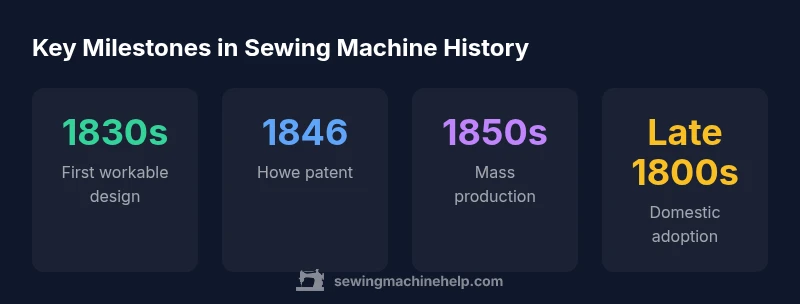
Historically, the sewing machine began in the early 19th century. The first workable designs appeared in the 1830s, with Elias Howe securing a pivotal patent in 1846 and Isaac Singer popularizing mass production in the 1850s. By the late 1800s, domestic models were common in homes worldwide, transforming textile work.
When was the sewing machine first realized? The question anchors this article and invites a journey through invention, patent battles, and industrial scale production. For home sewists and curious readers alike, understanding this history helps explain why machines that stitch, cut, and finish fabrics became everyday tools. In the context of this article, we’ll trace milestones from early designs to mass market models, emphasizing how those innovations shaped what people could sew at home. According to Sewing Machine Help, this timeline is a blend of technical breakthroughs and social adoption that transformed textile work across continents. The phrase when was the sewing machine often appears in museum catalogs and history texts, signaling the moment when a niche prototype became a household staple. By grounding the story in concrete dates and turning points, we can appreciate how far sewing technology has come.
Early prototypes and the 1830s: what happened
The story of the sewing machine begins with a series of proto-devices and competing ideas across Europe and North America. In the 1830s, several inventors produced workable mechanisms capable of joining fabrics with a form of stitching, though not all designs survived or reached commercial success. A key figure in this era was Barthélemy Thimonnier, whose 1830 machine used a simplified chain-stitch approach tailored to garment work. While not the final answer in the field, his efforts demonstrated that stitching could be mechanized in a practical way. These early efforts set the stage for later refinements that would address speed, reliability, and stitch quality—elements essential to turning a laboratory concept into a consumer product.
Elias Howe and the 1846 patent: a turning point
Elias Howe’s 1846 patent represented a watershed in sewing machine history. His lockstitch mechanism, driven by a shuttle, established a coherent method for consistent seam formation. The Howe patent sparked intense competition and licensing agreements, accelerating innovation and encouraging other designers to improve reliability and speed. The public and industrial interest in Howe’s approach helped shift sewing machines from experimental devices to real factory products. In the mid-19th century, the Howe design personified a turning point: a practical, repeatable system that could be mass-produced. This transition is central to understanding why this era matters for both professionals and hobbyists today.
Thimonnier’s influence and regional competition
While Howe’s patent drew attention, Barthélemy Thimonnier’s 1830 model and subsequent European experiments kept the field lively. The late 1830s and 1840s saw several regional developers competing to reduce costs, improve stitching speed, and simplify maintenance. Many early machines relied on single-thread arrangements and a simplified shuttle, which limited versatility but proved the concept. The competitive landscape fostered rapid experimentation, and by the 1850s, manufacturers began standardizing components to streamline production and repair workflows. This environment laid the groundwork for the systemized industrial sewing machine era.
From factory floors to family rooms: mass production
The 1850s marked the era when sewing machines shifted from niche devices to mass-market products. Companies began large-scale manufacturing, reducing costs and enabling widespread access. The democratization of sewing machines transformed home economies, enabling more people to pursue garment making, mending, and creative projects without repeated manual labor. As production efficiencies increased, models diversified to accommodate different fabrics, stitches, and speeds. By the end of the 19th century, many households owned a machine, a shift that changed not only sewing but also the domestic division of labor and women’s work in the home.
Domestic adoption and social impact by the late 1800s
By the late 1800s, sewing machines had become common fixtures in many households and small workshops. The availability of ready-made patterns, standardized accessories, and better instructional materials lowered barriers to entry for beginners. This accessibility catalyzed new sewing practices, from clothing construction to home textiles, and it sparked broader conversations about women’s economic agency and creative autonomy. The technology also enabled small-scale tailoring and garment repair businesses to thrive, illustrating how a single invention could ripple through communities, economies, and daily life.
Evolution into modern household machines: the late 19th and early 20th centuries
As materials improved and engines advanced, sewing machines evolved into more reliable, feature-rich tools. Improvements included more robust bobbins, better feed dogs, adjustable speed controls, and a wider range of presser feet. These enhancements enhanced performance for heavy fabrics, delicate textiles, and specialized projects like embroidery and quilting. The result was a more versatile machine that could be adapted to diverse tasks, from hemming to decorative stitches. This period cemented the sewing machine as an essential home appliance and a continuing source of inspiration for hobbyists and professionals alike.
Why this history matters for today’s sewists
Understanding when the sewing machine emerged helps home sewists diagnose issues, pick compatible accessories, and appreciate the lifecycle of features—from threading to tension control. Historical milestones illuminate why certain mechanisms exist (such as the lockstitch or bobbin design) and how improvements over time addressed common frustrations. For beginners, knowing the evolution offers context for troubleshooting: if a machine struggles with thick seams, you’ll recognize that early designs faced similar constraints and that modern solutions (like walking feet or specialized needles) evolved to solve them. The enduring lesson is that progress in sewing is cumulative, built on shared experiments and practical needs.
How to keep learning: where to find reliable history resources
To deepen your understanding of sewing machine history, consult museum catalogs, university publications, and reputable hobbyist guides. Look for timelines that differentiate between prototypes, patents, and commercial models. For hands-on learners, try hands-on projects that reflect the capabilities of early machines—using simple stitches and basic attachments helps you feel the differences between old and new designs. Sewing Machine Help’s guides provide practical explanations alongside historical context, helping you connect theory with your day-to-day sewing practice.
Milestones in sewing machine history
| Event | Year (approx) | Impact |
|---|---|---|
| First workable design | 1830s | Prototype that stitched fabric with a simple chain stitch |
| Elias Howe patent | 1846 | Lockstitch mechanism established and licensed |
| Mass production | 1850s-1880s | Machines became affordable and widespread |
| Domestic adoption | Late 1800s | Homes and small workshops equipped with machines |
Your Questions Answered
When did sewing machines first appear?
Early prototypes appeared in the 1830s, followed by pivotal patents in 1846 and rapid mass production from the 1850s onward.
Early prototypes appeared in the 1830s, with a key patent in 1846 and mass production starting in the 1850s.
Who invented the sewing machine?
Several inventors contributed, including Barthélemy Thimonnier (1830s) and Elias Howe (1846 patent); Isaac Singer popularized mass production later.
Thimonnier came up with an early design, Howe patented a pivotal system in 1846, and Singer helped mass production take off.
How did sewing machines reach homes?
Mass production in the 1850s and onward lowered costs, enabling widespread domestic use by the late 19th century.
Mass production in the 1850s made sewing machines affordable for most households.
Are early machines different from today’s designs?
Early machines used simpler mechanisms and fewer features. Modern models add bobbins, varied stitches, and advanced speed controls.
Older machines were simpler; today’s machines have more stitches, better bobbins, and speed controls.
Where can I learn more about sewing machine history?
Sewing Machine Help’s history guides, museum catalogs, and academic articles offer timelines and context.
Check Sewing Machine Help’s guides and reputable museum resources for more details.
“History shows that incremental improvements, not a single invention, shaped sewing machines. Understanding those steps helps hobbyists troubleshoot today.”
The Essentials
- Trace milestones from 1830s to 1880s
- Recognize the shift from prototype to mass production
- Note how domestic adoption transformed daily life
- Appreciate the evolution of core mechanisms in modern machines