Binding Edges with a Sewing Machine: Practical Guide
Learn to bind a quilt edge with a sewing machine. This step-by-step guide covers binding types, essential tools, setup, and tips for neat, durable edges for home sewists and beginners.


Goal: bind a quilt edge using a home sewing machine. You'll select a binding type (width and fabric), prepare your fabric and batting, and use a binding foot for even, secure stitches. This quick guide covers steps, tools, and common pitfalls to finish a durable, tidy quilt edge.
Why Binding Edges Matters
According to Sewing Machine Help, binding edges neatly protects the quilt and yields a clean, professional finish. This approach is practical for home sewers, offering consistent stitch length, faster turnaround, and the ability to reach tight corners with the right foot and presser foot pressure. It also dispels myths about needing premium equipment for good results. The goal is to help you match binding method to project size and fabric, while remaining flexible for curves and corners. A well-executed machine binding creates durable edges that withstand frequent washings and handling, keeping the quilt flat and neat.
Binding Options for Quilts: Bias, Strip, and Single-Fold Binding
Quilt bindings come in several flavors, each with its own setup and look. Bias binding is flexible and great for curved edges; strip binding is the standard approach for straight edges; single-fold binding is simple and often used with lighter-weight fabrics. This section compares the advantages, typical seam allowances, and how each option affects bulk at corners. For projects with busy prints, bias binding can reduce visible joins, while strip binding ensures a crisp, uniform edge. Consider fabric weight, batting loft, and finished size when selecting a binding type, then test on swatches before committing to a full quilt.
Preparing Your Quilt and Binding Fabric
Before you begin, lay out your quilt, binding fabric, and thread with ample workspace. Cut binding strips with clean, straight edges, then press seams flat to remove stiffness. If binding is bias-cut, handle with care to avoid stretch and trim corners precisely. Clips or pins help hold seams while sewing, and testing a short seam on scrap confirms stitch length, needle type, and tension. Good preparation prevents waviness and puckers on both large quilts and small projects.
Tools, Feet, and Machine Settings That Help
The right tools make binding easier. A binding foot with a guide helps maintain a consistent seam allowance, while a walking foot reduces fabric shifting on thick quilts. Use a sharp, small needle suited to your fabric weight, and set your machine to a straight stitch or a narrow zigzag if securing binding as you go. Keep extra bobbins handy, plus clips and a ruler to trim corners. Adjust presser foot pressure if quilt bulk causes skipped stitches, and baste slippery bindings to stabilize before stitching.
Finishing Techniques: Topstitch vs. Blind Stitch and Corner Miters
Two common finishing approaches are topstitching along the binding edge or blind stitching on the back for an unobtrusive finish. Practice miters by folding corners into neat squares and aligning stitches with the edge. Pressing is critical for crisp creases and a neat appearance. When satisfied with the front edge, avoid rushing the back-side hand-stitch or slip-stitch, which seals the binding invisibly and preserves washing flexibility.
Maintenance and Care After Binding
After binding, inspect seams for loose threads and trim them. Wash and dry a test swatch to ensure the edge stays flat and the binding fabric holds up. Clean your foot and throat plate to prevent lint buildup that could affect feed reliability. Store binding supplies in a labeled box for easy future projects, and maintain your machine with regular oiling and cleaning per the manual.
Quick Troubleshooting for Common Binding Issues
If edges ripple, recheck your seam allowance and ensure the binding was pressed before final stitching. Puckering can be caused by fabric too thick for the needle or incorrect tension; correct this by using a larger needle or adjusting tension, then test on scrap. A binding that won’t lie flat may be joined at a skewed angle; rejoin with careful pinning and precise 90-degree folds. Corners that bunch usually indicate too-short binding or misaligned miters—reattach with fresh binding and plenty of pins.
Tools & Materials
- Binding fabric (strips)(Cut 2.0-2.5 inches wide; length to quilt perimeter; join ends end-to-end)
- Thread(Match binding fabric or use a coordinating color)
- Sewing machine with binding foot(A walking foot is helpful for thicker quilts)
- Pins or clips(Hold binding in place while sewing)
- Ruler and rotary cutter(Useful for trimming binding strips and aligning corners)
- Iron and ironing board(Press binding and seams for accuracy)
- Scissors(For trimming threads and binding ends)
- Extra bobbins(Keep ready for color-matching spools)
- Seam ripper(Useful for correcting mistakes)
Steps
Estimated time: 60-90 minutes
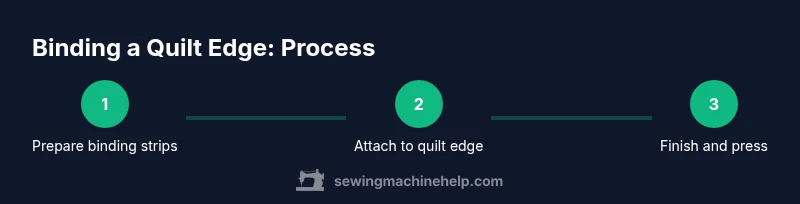
- 1
Prepare binding strips
Cut binding fabric strips and join the ends to form one long length. Press the strips flat to remove waviness. Test the length by laying it around the quilt edge.
Tip: Use a thread trail to keep joins smooth and avoid bulk at the corners. - 2
Attach binding to quilt edge
Place raw edges together and align with seam allowance; sew with a 1/4-inch seam, using clips to keep edges aligned. Stop stitching a few inches from the end to join later.
Tip: Start and stop with a backstitch to secure the seam. - 3
Join binding ends
When you reach the starting point, press the end into the seam allowance and trim to keep a clean join. Overlap by a small amount and tuck to form a neat miter.
Tip: Use a seam roller to flatten the join prior to sewing. - 4
Turn binding to back, trim, and crease
Fold binding to the back side and press to set. Use clips to hold while you prepare for final stitching. Ensure the fold lies flat against the backing fabric.
Tip: Press the binding gently to avoid stretching bias strips. - 5
Topstitch or blind stitch onto back
Choose either topstitching along the front edge or a near-invisible back-stitch close to the seam line. Baste if necessary to prevent shifting before final stitch.
Tip: If topstitching, use a right-side stop that matches your binding color. - 6
Finish corners and trim threads
Miter the corners cleanly and trim loose threads. Inspect the edge for evenness and press again. Remove clips.
Tip: Take your time with corners; neat miters make a big visual difference. - 7
Final press and quality check
Give the entire edge a final press, check for puckering, and test the quilt on a flat surface. If needed, do minor touch-up stitching.
Tip: Run a test wash on a sample piece to verify durability.
Your Questions Answered
What binding width should I use for most quilts?
Most quilters use binding strips that balance durability and bulk; start with a practical width and test on a scrap piece to see how it lies along the edge.
Start with a practical binding width and test on scrap,
Is a binding foot necessary when binding a quilt?
A binding foot helps maintain a consistent distance from the edge and can simplify the process, especially on larger quilts.
A binding foot helps keep stitches even and is worth using.
Can I bind without a walking foot?
Yes, binding can be done without a walking foot, but a walking foot reduces shifting on thick fabrics. If unavailable, pin and sew slowly.
Yes, you can bind without a walking foot, but it helps.
What’s the difference between bias binding and straight-grain binding?
Bias binding is flexible and good for curves; straight-grain binding is stable for straight edges. Both have distinct looks and handling.
Bias binding for curves; straight binding for straight edges.
How can I prevent puckering when binding?
Ensure stitches aren’t too tight, use appropriate needle for fabric weight, and baste binding before final stitching to stabilize.
Baste first and choose the right needle to prevent puckering.
How long will machine-bound edges last with regular washing?
With proper technique and care, machine-bound edges hold up well under normal washing. Follow care instructions for the fabric.
Proper technique and care keep binding durable.
Watch Video
The Essentials
- Choose binding type by edge curve and fabric.
- Use a binding foot for consistent seam allowance.
- Press frequently for crisp edges and neat corners.
- Miters and trimming create neat corners.
- Practice on scraps before binding a full quilt.