Difference Between Sewing Machine Needles: A Practical Guide for Home Sewers
Explore the difference between sewing machine needles, covering universal, ballpoint, microtex/sharp, and denim needles, plus sizing, fabric compatibility, and practical selection tips for home sewers.


According to Sewing Machine Help, the difference between sewing machine needles boils down to type, size, and fabric purpose. For most projects, universal needles cover woven fabrics, while ballpoint needles suit knits; microtex/sharp needles handle delicate synthetics, and jeans/denim needles tackle heavy fabrics. Understanding these distinctions helps prevent skipped stitches, needle breakage, and fabric damage, so you can sew with confidence.
The core differences between sewing machine needles
The difference between sewing machine needles is defined by three core factors: type, size, and intended fabric. For home sewists, selecting the right needle affects stitch quality, fabric preservation, and machine longevity. According to Sewing Machine Help, understanding these dimensions helps you choose confidently rather than guessing, which reduces skipped stitches and broken needles.
In practice, you’ll encounter several broad categories that influence how your machine forms stitches. The tip shape determines how the needle penetrates fabric; the metal shaft length and shank type determine compatibility with your model; and the scarf and eye size influence thread path. Getting these basics right minimizes fabric damage and yields stronger seams.
Needle types and their best uses
Sewing machines use several needle types designed for specific fabrics and stitches. The most common categories for home sewers are:
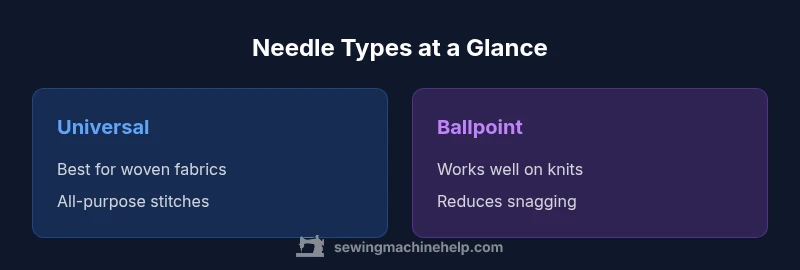
- Universal needles: designed for woven fabrics and most standard sewing tasks; they offer a balanced point and a wide eye.
- Ballpoint needles: shaped to push between knit fibers without snagging, ideal for jersey and stretch fabrics.
- Microtex/Sharp needles: have a fine point for precise perforation in lightweight to medium-weight synthetics and microfibers.
- Jeans/Denim needles: with a reinforced blade for heavy fabrics and heavy seams.
- Leather/Denim composite needles: for heavy leather or vinyl; reserved for specialist projects.
Each type pairs with typical stitch families (straight, zigzag, stretch) and fabric kinds. When in doubt, test on a scrap fabric to evaluate fabric feed, skipped stitches, and thread tension. The Sewing Machine Help team recommends keeping a small kit with one needle of each basic type to cover most projects.
Size matters: reading numbers and choosing the right size
Needle sizes are a quick way to gauge compatibility and performance. Manufacturers use two systems, most commonly the metric size (e.g., 60/8, 70/10) and a US number (e.g., 11, 14). The lower the number, the finer the needle. For light fabrics like chiffon or silk, use finer sizes; for medium cottons, 70/10 to 90/14; for heavy fabrics like denim, 100/16 or larger is recommended. Always match needle size to fabric weight and thread type; using too large a needle can leave holes, while too small can break or skip stitches.
Fabric compatibility: when to reach for microtex vs ballpoint
Fabric type strongly guides needle choice. Knits with stretch rely on ballpoint needles to avoid snagging and pulled stitches. Wovens, especially tightly woven cottons or synthetics, benefit from microtex/sharp needles that cut cleanly and reduce fraying. Use universal needles for everyday woven fabrics that aren’t specialty-weight. For delicate silks or fine chiffons, microtex with a small eye can help prevent fabric damage. When working with thick layers or decorative fabrics, consider specialty needles suited to the project and test on scraps first.
Needle systems and machine compatibility
Needle systems differ by brand and machine family. Common domestic systems include the household standard shank and newer high-tech versions. Before sewing, verify your machine’s needle system and size range in the user manual or manufacturer site. If you’re unsure, bring a sample fabric and your current needle to a local shop for a quick compatibility check. A misfit needle can cause skipped stitches, excessive needle deflection, or even damage to the needle plate.
How to swap needles safely and test stitch quality
Turn off the machine and remove the presser foot. Loosen the needle screw, gently pull the old needle out straight, and insert the new needle with the flat side facing the correct direction for your model. Tighten the screw firmly but not overly tight. Run a few stitches on a scrap fabric to check stitch formation, thread tension, and fabric feed. If you notice skipped stitches or snags, re-seat the needle or try a different size or type.
Common mistakes and troubleshooting
Common mistakes include using the wrong needle type for the fabric, inserting the needle backward, or using a needle that’s bent or dull. Skipped stitches, thread breaking, or this tearing along the fabric edge are typical symptoms of a misfit needle. Regularly inspect needles for nicks or burrs and replace them promptly. Always test stitches on a scrap before committing to a project buttonhole or topstitch.
Project-based needle recommendations
Different projects demand different needles: a basic garment made from woven cotton benefits from a universal needle; a knit t-shirt benefits from a ballpoint needle; delicate satin or chiffon performs best with microtex; a denim bag needs a jeans/denim needle. For leather or heavy vinyl, a leather-specific needle is essential. Keeping a mapped kit helps you switch quickly between project types without guesswork.
Maintenance and lifespan of needles
Needles wear out with use, even if you cannot see visible damage. Replace dull or bent needles promptly to avoid fabric snags and stitching errors. Store needles in a labeled case, sorted by type and size. Routinely rotate needles in your kit to ensure you have sharp options on hand, and avoid leaving needles in humid environments that can accelerate corrosion.
Buying guide and practical tips for purchase
Buy quality needles from reputable brands and stock a few basic types for a wide range of fabrics. When starting a new project, keep a scrap swatch to verify the needle choice, stitch quality, and fabric tolerance. Look for smooth finishes, clean eye openings, and no burrs on the needle shaft. Compare prices but prioritize durability and brand reliability over the lowest price.
Quick-start cheat sheet for beginners
Begin with a universal needle for most woven fabrics, switch to ballpoint for knits, and reserve microtex for delicate synthetics. Check your fabric weight, test on a scrap, and adjust needle size as needed. Maintain a simple kit with one needle of each major type and a few sizes to cover common projects.
Feature Comparison
| Feature | Universal needle | Ballpoint needle | Microtex/Sharp needle | Jeans/Denim needle |
|---|---|---|---|---|
| Best fabrics | Woven fabrics (cotton, linen, blends) | Knit fabrics (jersey, rib knits) | Delicate synthetics and lightweight weaves | Heavy fabrics (denim, canvas) |
| Needle point | Medium piercing point with flatter profile | Rounded point to push between knit fibers | Fine sharp point for precise perforation | Reinforced piercing edge for thick materials |
| Typical size range | 60-90 (light to medium) | 70-110 (medium to heavy knits) | 60-90 or 70-100 (light to medium) | 90-110 (heavy fabrics) |
| Best for stitch types | All-purpose stitches on wovens | Stretch stitches and seams on knits | Fine straight and topstitch on delicate fabrics | Heavy seams and topstitching on thick fabrics |
| Fabric perforation risk | Moderate; versatile for many tasks | Lower risk for knitting fabrics | Lower risk for delicate looms | Higher risk on dense fabrics; test first |
Strengths
- Versatile for most everyday sewing
- Widely available and affordable
- Easy to find compatible threads and accessories
- Provides reliable performance on a broad range of fabrics
Negatives
- Can be ineffective for specialized fabrics (knits or leather)
- May cause skipped stitches if used inappropriately
- Misalignment or use with wrong machine can cause damage
- Overreliance on one type can neglect better results with specialty needles
Balanced approach: start with universal needles and add specialty types as needed
Universal needles cover most projects, offering good performance and value. For knits, heavier fabrics, or delicate fabrics, supplement with ballpoint, denim, or microtex needles. The right needle choice depends on fabric and stitch; testing on scraps is essential for best results.
Your Questions Answered
What is the difference between universal and ballpoint needles?
Universal needles are designed for a wide range of woven fabrics and provide balanced penetration. Ballpoint needles have a rounded tip that pushes fibers apart in knit fabrics, reducing snags. For most beginners, start with universal; switch to ballpoint for knits and stretchy fabrics.
Universal is the go-to for woven fabrics; ballpoint is better for knits. Test on scraps to confirm, then proceed.
How do I determine the right needle size for fabric?
Choose needle size based on fabric weight and fiber. Lighter fabrics use smaller numbers (e.g., 60/8–70/10), medium fabrics use mid-range sizes (e.g., 70/10–90/14), and heavy fabrics use larger numbers (e.g., 100/16–110/18). Always test on a scrap.
Pick a size by weight, test on scrap, and adjust as needed.
Can I use a sharp needle on knit fabrics?
Sharp needles can damage knit fibers and cause skipped stitches. Ballpoint needles are typically preferred for most knits because they separate fibers rather than cut them. Use microtex only if the fabric is extremely smooth and the project requires precise perforation.
No, sharp needles aren’t ideal for knits; ballpoints work best for knit fabrics.
Why do needles break or cause skipped stitches?
Needles break or skip stitches when the needle is wrong for the fabric, the needle is bent, or the needle is not inserted correctly. Always confirm the needle type and size matches the fabric and stitch you plan to sew, and reseat if you experience issues.
Wrong needle for fabric or a bent needle is a common culprit.
How often should I change needles?
Change needles when they become dull, bent, or after finishing a project that uses specialty fabrics. Visible defects or frequent skipped stitches indicate it’s time for a new needle. Keeping spare needles of each type ensures you’re never caught mid-project.
Change needles when they’re dull or damaged.
Are sewing machine needles interchangeable between brands?
Many brands use standard delivery systems that are compatible across brands, but some machines require specific needle systems. Always check your machine’s manual for compatible needle types and sizes before purchasing.
Check your manual for compatibility—most common needles fit many brands, but some machines need specific types.
The Essentials
- Start with universal needles for most woven fabrics
- Add ballpoint needles for knits to avoid snagging
- Reserve microtex needles for delicate synthetics
- Use denim needles for heavy fabrics like jeans
- Test on scraps before committing to a project