If Sewing Machine Is Jumping Thread: Troubleshooting Guide
Urgent, practical troubleshooting for when your sewing machine jumps threads. Learn quick fixes, diagnostic steps, and prevention tips to restore smooth stitching for home sewists.


Most thread-jump issues stem from simple causes: incorrect top threading, a bent or wrong-size needle, or bobbin misplacement. Re-thread the upper path, replace the needle with the correct size, and reinsert the bobbin ensuring proper orientation. If the problem persists, test with a fresh spool and standard needle, then follow the detailed steps below for thorough diagnosis.
Understanding the symptom and why it happens
When a sewing machine stitches with irregularities and the thread seems to jump out of place, it’s a symptom you can diagnose quickly. If sewing machine is jumping thread, the first step is to validate that the basics are correct: correct needle installed, top thread properly threaded, presser foot up, thread tension set to default, and a clean bobbin area. Without these checks, you’ll chase phantom issues. This guide explains how the symptom arises and how to approach it methodically, so you can fix it quickly and safely. The urgency is real, but the fix is usually straightforward: start with the simplest causes and verify every basic path before moving to deeper adjustments.
A common pitfall is assuming the problem is mechanical when it’s simply the thread path. Always tour the thread path, from spool to needle, and check for lint or damage at each stage. Remember: the goal is reliable, consistent stitches without repeatedly pulling or re-threading mid-project.
Common causes that lead to jumping threads
Commonly, jumping threads happen because the top threading is incorrect, the needle is bent, or the bobbin is mis-threaded. Other frequent culprits include using the wrong needle size for the fabric, a damaged needle eye, or a bobbin case with negative tension. Fabric type and thread choice play a role too—thick fabrics with fine thread can stress the system and trigger thread jumps. Finally, lint buildup in the bobbin area can disrupt thread cars and tension discs, causing unpredictable thread behavior. Tackle each cause in sequence to isolate the issue.
Quick checks you can perform before disassembly
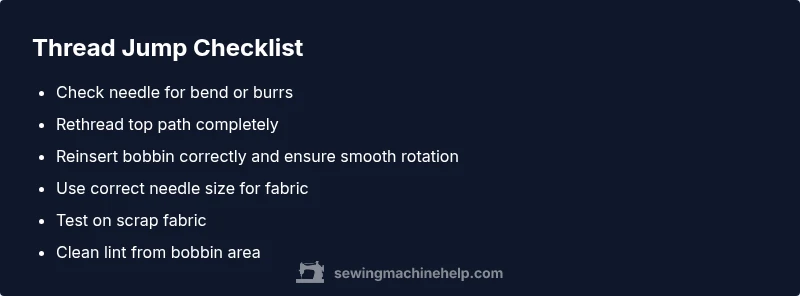
Before taking apart the machine, do these safe checks to rule out common mistakes:
- Turn off the machine and unplug it.
- Ensure the presser foot is up and the spool is correctly loaded.
- Rethread the top thread, following the path from the spool to the needle eye, ensuring the thread seats properly in each guide.
- Remove and inspect the needle for bends or burrs, then replace if needed.
- Remove the bobbin, clean any lint, and reinsert it according to your model’s rotation and placement.
- Test on a scrap fabric to see if the issue recurs. If yes, proceed to targeted fixes.
These checks address the majority of simple thread-jump scenarios and are safe for beginners to perform.
Re-threading the top thread path correctly
Accurate top-threading is the backbone of consistent stitches. Remove the needle, re-thread from the spool using a thread guide, pass through all tension discs, and thread the needle from front to back. Ensure the thread is seated properly in each guide and that the tension disks are clean and free of lint. Refitting the needle immediately after re-threading helps confirm you’ve locked the path correctly. Finally, re-seat the presser foot, wind a test stitch on scrap fabric, and watch for improvements.
Bobbin and bobbin case setup
Bobbin issues are a frequent source of thread-jumping symptoms. Remove the bobbin, unwind a fresh length of thread, and reinsert it in the correct rotation as specified by your machine’s manual. Spin the bobbin to ensure it moves freely and does not snag. When reinstalling, place the bobbin case back snugly but not overly tight, and ensure the thread advances smoothly when pulling on it. After this, re-test on fabric to confirm stability.
Needle health and fabric compatibility
A bent or dull needle can bend the thread path and cause jumps. Replace the needle with a fresh one matching your fabric type (e.g., sharp for woven fabrics, ballpoint for knits). Make sure the needle is fully inserted and tightened. Not all fabrics require the same needle; using the wrong needle can cause skipped stitches and fabric snags that look like thread jumping. Always verify needle size and type before testing again.
Tension and stitch settings: how to adjust safely
Tension issues can mimic thread-jump symptoms. Start with the printer-default setting on your machine, then gradually adjust the upper thread tension while sewing on scrap fabric. If issues persist, check the bobbin tension as well—both must be balanced for the fabric and thread. Do not over-tighten or force changes; small, incremental adjustments yield the best results. When in doubt, reset to the manufacturer’s recommended settings and re-test.
Prevention: routine maintenance to avoid future thread jumps
Regular maintenance keeps thread-jumping at bay. Clean lint from the bobbin area, oil only where required by your manual, and store threads away from dust. Replace needles every 8–12 hours of sewing or sooner if you notice burrs. Use the appropriate needle size for each project and avoid cheap or damaged threads. A documented routine reduces the likelihood of sudden thread-jump events.
When to seek professional help
If you’ve exhausted the basics and the problem persists, it’s time to consult a professional technician. Persistent thread jumping could point to timing issues or internal wear that requires specialized tools. A qualified repair technician can assess tension, gears, and timing and provide a precise fix. Don’t delay repair if you regularly rely on the machine for work or large projects.
Steps
Estimated time: 30-60 minutes
- 1
Inspect and replace the needle
Power off, remove the needle plate, and inspect the needle for bending or burrs. If damaged, replace with the correct size and type for your fabric. Reinsert securely and return to the machine.
Tip: Always handle the needle with a blunt-nosed tool to avoid finger injury. - 2
Rethread the top path
Follow the full thread path from the spool, through guides, and into the needle eye. Ensure the thread sits properly in each guide and that the tension discs are clean and engaged.
Tip: Use a thread guide and avoid forcing the thread through tight spaces. - 3
Reinsert and test the bobbin
Take out the bobbin, unwind a small amount of thread, and reinsert according to your manual. Spin the bobbin to ensure smooth rotation and reinstall the bobbin case correctly.
Tip: Check that the bobbin winds clockwise and sits flat against the case. - 4
Check fabric compatibility
Choose an appropriate needle and stitch setting for your fabric. For example, use a sharp needle for woven fabrics and a ballpoint for knits. Re-test on scrap fabric.
Tip: If you’re unsure, start with a universal needle and standard stitch on scrap fabric. - 5
Adjust tension gradually
Begin with the default tension. Make small adjustments on the upper thread tension and test stitches until you achieve even tension on both sides.
Tip: Document your settings for future projects to prevent repeat issues. - 6
Comprehensive test
Sew a few inches on scrap fabric with different stitch types to confirm stability. If issues recur, proceed to professional service.
Tip: Keep a scrap pad handy to compare stitch quality across tests.
Diagnosis: Threads wiring or bunching/jumping during stitching
Possible Causes
- highIncorrect top threading
- highBent or incorrect needle
- highBobbin mis-threaded or inserted incorrectly
- mediumTension misadjustment (top or bobbin)
- lowLint or debris in bobbin area
- lowFabric-thread incompatibility or needle size mismatch
- lowTiming or internal wear (less common)
Fixes
- easyRethread the top path and replace the needle if bent
- easyReinsert bobbin correctly and clean the bobbin area
- mediumReset tension discs to default and test on scrap fabric
- easyCheck needle size against fabric type and re-test
- easyOil only where specified by manual and remove lint buildup
- hardIf persists, consult a professional technician for timing/checks
Your Questions Answered
What causes a sewing machine to jump threads?
Thread jumps are most often caused by incorrect top threading, a bent needle, or bobbin mis-placement. Other factors include tension issues and lint in the bobbin area. Systematically checking these areas usually resolves the problem.
Thread jumps are usually from threading errors, a bent needle, or bobbin setup. Check these areas first, then test on scrap fabric.
Can a damaged needle cause jumping threads?
Yes. A bent or dull needle can deflect the thread, causing it to jump out of place. Replace the needle with a new one suited to your fabric and stitch setting.
A damaged needle can cause jumps, so replace it with a fresh needle matched to your fabric.
How do I know if bobbin tension is the issue?
If top thread looks fine but bottom stitches are uneven or loose, the bobbin tension may be off. Reinsert the bobbin and adjust the case tension gradually following your model’s manual.
Uneven bottom stitches usually point to bobbin tension. Reinsert and adjust gradually per your manual.
Is it safe to use any thread for all fabrics?
Not all threads are suitable for every fabric. Use high-quality thread appropriate for the fabric weight and type to minimize lint and tension problems.
Use the right thread for the fabric to prevent issues and ensure smooth stitches.
What if none of the fixes work?
If the problem persists after standard fixes, the timing or internal gears may be worn. A professional technician should diagnose and repair these deeper issues.
If fixes fail, consult a professional for timing or internal wear diagnostics.
Watch Video
The Essentials
- Verify top threading and needle condition first.
- Bobbin placement and tension are often the root cause.
- Test fixes on scrap fabric to confirm success.
- Use the correct needle size for fabric type.
- Seek professional help if timing or internal wear is suspected.