Tension Issues Sewing Machine: Quick Fixes and a Step-by-Step Troubleshooting Guide
Diagnose and fix tension issues sewing machine with practical, step-by-step guidance. Re-thread, check the needle, adjust tension, and restore smooth stitches on fabric.


Most tension issues sewing machine come from simple setup errors. The quickest fix is to rethread both the upper thread and the bobbin, reseat the needle, and test on scrap fabric. If stitching remains uneven, adjust the upper thread tension dial gradually while feeding consistent fabric. For persistent problems, check needle size, thread type, and bobbin insertion and consult your manual for model-specific guidance.
Why tension issues occur on sewing machines
Tension is not a single dial you set once and forget. It’s the balance between the upper thread and the bobbin thread, and it can change with fabric, thread, and needle. When this balance is off, you’ll see top-stitching problems, such as loops on the underside, tight stitches on the top, or thread nests at the needle. The most common culprits are misthreading, using the wrong needle for the fabric, a bent or dull needle, or a bobbin inserted incorrectly. Other factors include cheap or mismatched thread, a bobbin wound unevenly, lint in the bobbin area, and timing issues in older machines. For home sewists, tension issues often start with a simple setup error that cascades into stubborn stitches. By understanding the relationship between upper and lower thread tensions, you can diagnose quickly and fix most problems with basic adjustments and careful testing on scrap fabric.
Quick checks you can perform before diving in
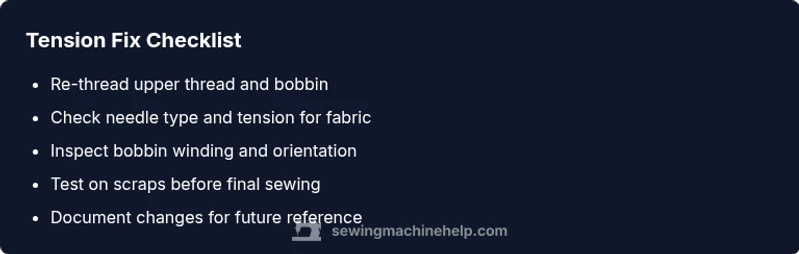
Start with the simplest fixes. Re-thread both the upper thread and the bobbin, following the path shown in your user manual. Make sure the needle is the correct type and size for your fabric and that it’s not bent. Remove and reinsert the bobbin, ensuring it sits correctly in the case and winds smoothly. Check that the bobbin thread is feeding from the correct direction and that the bobbin case isn’t blocked by lint. Use high-quality thread and match needle to fabric (e.g., ballpoint needle for knits, sharp needle for woven fabrics). Then test on a scrap piece of fabric with a straight stitch at a mid-range tension. If the stitch looks even on the scrap, you’re likely ready to move to finer adjustments; if not, proceed to the diagnostic steps. These checks catch 90% of tension issues in practice.
Diagnostic mindset: translating symptoms into fixes
Use a simple symptom-to-diagnosis framework to avoid chasing every possible cause. Common symptoms and their likely causes include: top stitches too loose with bobbin visible on the underside → upper tension too loose or bobbin tension too tight. If the top looks neat but the underside shows loops, the bobbin tension may be off or the bobbin isn't seated correctly. Balanced stitches on both sides but fabric feeds unevenly → check feed dogs, presser foot pressure, and machine timing if needed. Uneven stitch length or thread fraying → the thread path may be slipping on the take-up lever. Document each change and test with the same fabric type to compare results. A methodical approach reduces trial-and-error and speeds up getting back to productive sewing.
Common scenarios and how to test them
Consider common fabric types and scenarios. For example, testing on a woven cotton vs jersey knit helps identify whether tension is fabric-dependent. If you recently changed a needle, retest—needles can shift the thread path. If the thread keeps snagging, check for thread compatibility and spool orientation. Ensure the bobbin case moves freely and isn’t binding. If you still see issues after these checks, you may be dealing with a timing problem or a worn tension assembly that requires professional service.
Prevention tips to avoid tension issues in the future
Create a maintenance routine: clean lint around the bobbin area after every few hours of sewing, oil the machine according to the manual, and replace needles before they become dull. Use quality thread and the correct needle for your fabric, and never force fabric through the needle. When switching fabrics, recheck tension and adjust gradually. Store spools upright and cover the machine to keep dust out of the thread path. A little care now prevents stubborn tension problems later.
Safety and when to seek professional help
Always unplug the machine before cleaning or changing needles. If basic checks don’t resolve the tension issue after testing on scraps, and the problem persists across fabrics, you may have a timing issue or a worn tension device. In such cases, schedule service with a qualified technician. Regular professional servicing can prevent bigger problems and prolong your machine’s life. If you notice grinding, unusual noises, or a measurable drop in stitch quality after a cleaning, stop and seek professional help.
Data-driven approach: keep a quick testing log
Maintain a simple log of fabric type, thread, needle, tension setting, and results after each adjustment. This data helps you see patterns: for instance, which fabric requires higher or lower tension or whether a certain needle consistently produces better stitches. Over time, you’ll build a reference sheet you can reuse across projects, reducing guesswork and speeding up fixes.
Bonus troubleshooting for specific machines
Different brands and models respond to tension tweaks in unique ways. If you own a vintage mechanical model, small dial adjustments near the take-up lever may produce bigger changes than you expect. For modern computerized machines, a factory reset can help when tension seems out of range, but always consult the manual first. In all cases, verify you’re using the correct presser foot, check for firmware updates if applicable, and avoid replacing parts prematurely before confirming the root cause.
Case study: typical homeowner repair
A home sewist noticed loose top stitching on a woven fabric. After re-threading both paths, replacing a dull needle, and testing on scraps, the stitches became even and balanced. The problem was solved by a simple needle replacement and a fresh bobbin. The sewist kept notes on tension settings for future projects and avoided recurrences by sticking to a routine.
What to pack for a service call
If you’re calling a technician, bring a few scraps of your common fabrics, the current needle, and the bobbin case. Also note the last maintenance date, tension settings that produced the best stitches, and any changes you’ve tried. This helps the technician diagnose faster and gives you a written baseline for future reference.
Steps
Estimated time: 30-45 minutes
- 1
Re-thread top thread and bobbin
Power off and unplug the machine. Follow the threading path exactly as shown in your manual, ensuring the thread seats snugly in guides and the take-up lever. Rethread the bobbin, ensuring it winds smoothly and feeds in the correct direction.
Tip: Use the machine’s threading guide; a small misroute here causes major tension issues. - 2
Check needle installation
Remove the needle and inspect for bends or burrs. Replace with a new needle of the correct type and size for your fabric. Reinsert fully and snug the needle clamp.
Tip: If the needle is loose, it can throw off the thread path entirely. - 3
Inspect bobbin winding and insertion
Wind the bobbin evenly and insert it in the correct direction. Ensure the bobbin case moves freely and isn’t blocked by lint or thread tails.
Tip: A tightly wound or incorrectly seated bobbin is a common tension culprit. - 4
Test stitch on scrap fabric
Set a mid-range tension and sew a few inches on scrap fabric. Inspect top and bottom stitches for balance before proceeding.
Tip: Testing on scrap fabric prevents waste and reveals early signs of improvement. - 5
Make incremental tension adjustments
Adjust the upper thread tension dial in small increments and retest on scrap fabric. Repeat until stitches are balanced on both sides.
Tip: Tiny changes yield noticeable results; avoid large jumps. - 6
Re-test with multiple fabrics
Try the same settings on a second fabric type to confirm stability. If results vary widely, you may need fabric-specific tension adjustments or additional maintenance.
Tip: Keep a fabric log to reference future projects.
Diagnosis: Stitches uneven or loops when sewing
Possible Causes
- highMisthreading or incorrect threading path
- mediumWrong needle for fabric or bent/dull needle
- mediumBobbin wound or inserted incorrectly
- lowFabric type requiring different tension
Fixes
- easyRe-thread both upper and bobbin paths following the manual
- easyReplace bent/dull needle and ensure correct type
- easyRewind and reinsert bobbin, ensure correct orientation
- easyTest with scraps and adjust tension in small increments
Your Questions Answered
What are the most common causes of tension issues on a sewing machine?
Misthreading, wrong needle or bobbin setup, fabric type, and lint or timing issues are the usual culprits. Fix them in order from simplest to most complex.
Common causes are misthreading and incorrect needle or bobbin setup; start there and test on scraps.
Why is my bobbin thread visible on the top side of the fabric?
The upper thread tension may be too tight or the bobbin is not seated correctly. Re-thread the upper path and recheck the bobbin placement.
If bobbin thread shows on top, check upper tension and bobbin seating.
Can tension problems be caused by using the wrong needle?
Yes. The wrong needle can distort the thread path and asymmetrically pull threads, leading to uneven stitches.
Using the wrong needle can mess with tension—check needle type and size for your fabric.
Is tension adjustment safe for beginners?
Yes, but make small adjustments and test on scraps. Avoid forcing fabric or making big tension changes at once.
Totally safe; just tweak in small steps and test first.
When should I seek professional help for tension issues?
If tension remains uneven after basic checks or if the machine shows timing or mechanical issues, a professional service is recommended.
If it still acts up after basics, call a technician.
Watch Video
The Essentials
- Re-thread both paths to fix most tension issues
- Use the correct needle and bobbin for fabric
- Test on scraps and document changes
- Seek professional help if timing or internal components are suspect