USHA vs Singer Sewing Machines: Which Is Better for Home Sewers
A detailed, analytical comparison of USHA and Singer sewing machines for home sewists, covering build quality, features, price, service networks, and best-use scenarios.


usha vs singer sewing machine which is better hinges on your priorities. For many home sewers, USHA offers reliable entry-level performance with simple maintenance, while Singer provides broader feature sets and a wider service network. This quick comparison highlights the core differences to help you decide which brand aligns with your projects.
Why Brand Reliability Matters in Everyday Sewing
When you weigh options for a home sewing machine, reliability isn’t just a luxury—it’s the backbone of consistent results across garments, repairs, and alterations. In the debate around usha vs singer sewing machine which is better, reliability translates into fewer jams, smoother fabric feeding, consistent stitch quality, and a machine that withstands regular use without sudden breakdowns. According to Sewing Machine Help, a brand’s long-term durability often correlates with factors you can assess before buying: chassis integrity, the availability of spare parts, and the breadth of the service network. For home sewists, these elements reduce downtime and provide confidence, especially when you’re starting a new project, altering a pattern, or repairing a cherished item. The goal is a machine you can count on over years of hobby projects, rather than a quick upgrade that needs frequent maintenance. This section sets the stage for a data-driven comparison grounded in practical experience and field observations.
Quick Snapshot: USHA vs Singer in 2026
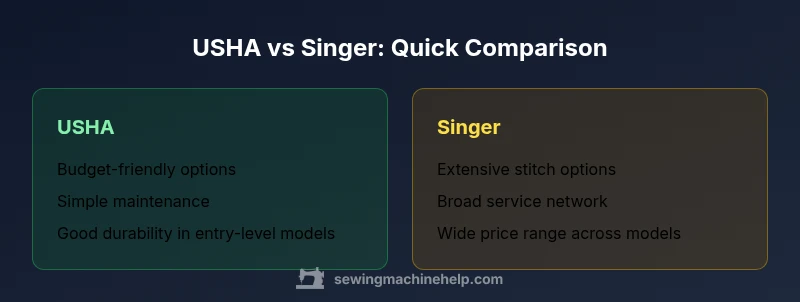
In today’s market, USHA and Singer each carve out distinct value propositions. Sewing Machine Help’s analysis shows that USHA tends to emphasize durability at a favorable price point, with straightforward maintenance that suits beginners and casual hobbyists. Singer, by contrast, often prioritizes feature breadth, an extensive accessory ecosystem, and a wider service network across regions. For a buyer deciding which is better, the choice usually boils down to whether you prioritize simplicity and long-term durability or breadth of stitches and modular capabilities. Both brands have loyal followings, and model-to-model variation means it’s essential to compare specific machines rather than rely on the brand alone.
Build Quality and Durability: What to Expect
Durability in entry-level and mid-range models is a common differentiator between USHA and Singer. USHA models frequently emphasize solid basic construction with accessible maintenance in mind, often featuring simpler metal or reinforced frames and a design philosophy focused on dependable performance across everyday tasks. Singer models vary more widely in build approaches, from lighter consumer-grade constructions to more robust mid-range options designed for frequent use and diverse projects. In practical terms, this means a USHA entry-level machine may feel sturdier on routine tasks like piecing, zigzag sewing, and hemming, while Singer selections can offer more long-term headroom for intricate projects and thicker fabrics, albeit with varying maintenance demands across models. Regardless, always inspect the frame rigidity, stitch plate alignment, and thread path during trials to judge durability for your typical workloads.
Features, Stitches, and Accessories: A Comparative Look
Feature depth often shapes the decision between usha vs singer sewing machine which is better for you. USHA’s entry-level lines generally cover essential stitches with reliable feed mechanisms and basic adjustable presser feet. This makes them approachable for beginners and practical for routine repairs and simple garments. Singer machines tend to offer a broader range of stitches, more automation, and a larger assortment of presser feet and attachments—beneficial for quilters, fashion projects, and complex alterations. When evaluating feature sets, consider your primary projects, whether you need decorative stitches, automatic buttonholes, or programmable functions. It’s also wise to confirm foot compatibility and the availability of compatible accessories in your region, as that ecosystem can dramatically influence versatility and ongoing costs.
Design Philosophy and Engineering: USHA vs Singer
Beyond raw features, the design philosophy of a brand guides how it feels to sew. USHA tends to prioritize straightforward ergonomics, intuitive threading paths, and minimal setup for common tasks. This makes models comfortable for new sewists building confidence. Singer often leans into a broader engineering palette, with advanced stitch logic, multi-step operations, and features that appeal to sewists who enjoy experimentation and complex patterns. This difference matters when you’re building a project queue: you may prefer USHA for quick, reliable results and Singer for creative explorations. The engineering choices influence maintenance needs too—more complex electronics or automated features may require periodic service.
Maintenance, Spare Parts Availability, and Repairs
Maintenance is a practical bet in choosing a long-lasting machine. USHA often has robust regional parts availability and simpler repair paths, which can translate into lower downtime in many markets. Singer’s global footprint means a larger ecosystem of service centers and parts across continents, though availability can vary by country and model. When planning maintenance, verify the nearest authorized service center, common wear parts (belts, needles, bobbins), and whether parts are stocked locally or require import. Sewing Machine Help notes that accessibility of spare parts and technicians is a critical factor in total cost of ownership, especially if you anticipate years of use or frequent projects.
After-Sales Support, Warranties, and Service Network
Warranty coverage and service networks shape long-term satisfaction. USHA warranties typically cover basic machine components for defined periods, with regional variations. Singer offers a broader service network globally, which can be advantageous for frequent travelers or multi-region households. Before purchasing, read warranty terms carefully, including what’s covered, what voids coverage (such as unauthorized repairs), and how to handle service requests. Keep records of purchase and model details, and test the service workflow by contacting a local center to gauge responsiveness. A strong after-sales experience reduces anxiety when you encounter troubleshooting or part replacements later on.
Price Range, Value, and Total Cost of Ownership
Price often signals the balance between value and features. USHA entry-level machines usually position themselves at the lower end of the price ladder, offering dependable performance at an accessible cost. Singer models span a wider range, with entry-level options that are affordable and advanced models that command higher prices but deliver more stitches and automation. Evaluating value means looking beyond sticker price: consider ongoing expenses like foot pedal replacements, needle sets, bobbins, and potential service calls. The best choice aligns with your budget and your projected use: for light-to-moderate workloads on simple garments, USHA can offer excellent value; for more ambitious projects and frequent customization, Singer’s broader range may deliver greater long-term payoff.
Best-Use Scenarios: When USHA Excels
If your sewing focuses on basic garments, repair work, hems, and home décor, USHA often provides reliable, straightforward performance with fewer variables to manage. Beginners benefit from a simpler threading process and fewer features to learn, reducing the learning curve. For those who sew regularly and want predictable results with minimal fuss, USHA’s combination of dependable construction and approachable maintenance is ideal. In markets where spare parts and local service are readily available, USHA can yield lower total cost of ownership due to fewer complicated repairs and easily sourced components.
Best-Use Scenarios: When Singer Excels
Creative projects, fashion alterations, and multi-fabric sewing frequently benefit from Singer’s expansive stitch libraries and compatibility with a wider range of accessories. If your projects include embroidery, decorative detailing, or frequent automatic features, Singer models tend to offer more flexibility. For travelers or households across regions, Singer’s international service network can reduce downtime if you need consistent support while moving between cities or countries. In short, choose Singer when you anticipate needing a wide feature set and broad accessory ecosystem, and a larger service footprint matters to you.
How to Test a Machine in a Store: A Practical Checklist
Before you buy, test performance with fabrics of varying thickness. Check stitch consistency on lightweight cotton, denim, and knits; listen for unusual noises; and feel for smooth feed without snags. Verify manual threading, bobbin winding, and thread tension controls. Evaluate the ease of changing presser feet and the availability of the feet you’ll actually use. Ask for a live demonstration of at least two stitch patterns, and request a simple seam or zipper test to assess feeding accuracy. Finally, compare on-board features like needle threader, automatic buttonholes, and speed control to ensure they match your intended projects. This hands-on approach helps you decide which brand better suits your workflow.
Common Myths About USHA and Singer
Myth: USHA is always the most affordable option. Truth: prices vary by region and model; there are budget Singer options as well as premium USHA lines. Myth: Singer is universally better because of more stitches. Truth: more stitches don’t always translate to better results for beginners; modern comfort and reliability can matter more. Myth: After-sales support is identical worldwide. Truth: service networks differ by country and model; verify local availability before buying. Understanding these nuances helps you avoid overgeneralizations and choose a model that fits your needs.
Beginner's Guide: How to Choose Between Brands, Step by Step
Begin with your primary projects and budget. If you prioritize reliability and simple operation for basic garments, lean toward USHA; if you want a feature-rich machine with broader accessory support, consider Singer. Check local service availability and part supply; a larger network reduces downtime. Compare specific models rather than brands alone, and write a short list of must-have features. Finally, test a few models side-by-side, paying attention to how each machine handles your typical fabrics, thread choices, and workflow. This practical approach helps transform a broad comparison into a confident purchase decision.
mainTopicQuery":"usha vs singer"],
comparisonTable":{"items":["USHA Sewing Machines","Singer Sewing Machines"],"rows":[{"feature":"Build Quality & Durability","values":["Strong basic frames with straightforward maintenance","Broader model range; durable options vary by line"]},{"feature":"Features & Stitches","values":["Core stitch sets with reliable performance","Large stitch catalog and advanced automation in many models"]},{"feature":"Price Range & Value","values":["Generally affordable entry-level options","Wide price spectrum from budget to premium models"]},{"feature":"Parts & Service Availability","values":["Solid regional parts access in many markets","Extensive global service network, region-dependent"]},{"feature":"Best For","values":["Beginners; simple projects; churn of routine tasks","Projects requiring variety, automation, and accessories"]}]},
prosCons
pros":["Clear value proposition for beginners and casual sewers","Broad availability of parts and service in many regions","USHA models often emphasize simple maintenance and reliability","Singer offers an extensive accessory ecosystem and diverse models"],"cons":["Model-to-model variations can complicate apples-to-apples comparisons","In some regions, USHA’s parts/service may be less accessible than Singer","Higher-end Singer models can carry higher purchase and maintenance costs"]}
verdictBox":{"verdict":"USHA is typically the better pick for beginners prioritizing reliability and low maintenance, while Singer excels for users who want a broad feature set and a global service network.","confidence":"high","summary":"For home sewists who want proven reliability and straightforward upkeep, USHA often wins. If you need an eclectic range of stitches, automation, and a large accessory ecosystem, Singer is usually the stronger choice. The best decision aligns with your projects and local support options."},
keyTakeaways
keyTakeaways":["Choose USHA for dependable everyday sewing and lower upkeep.","Opt for Singer if you need diverse stitches and a wide accessory ecosystem.","Verify local service networks before buying, especially for regional models.","Test machines with real fabrics to compare feeding and stitch quality.","Consider total cost of ownership, not just sticker price."]
faqSection
items":[{"question":"Which brand is more beginner-friendly, USHA or Singer?","questionShort":"Beginner-friendly","answer":"USHA models tend to be more approachable due to simpler interfaces and maintenance. Singer offers more features, which can be overwhelming for true beginners but beneficial for those who want room to grow. Consider your comfort level with learning new tech and how much you value feature depth.","voiceAnswer":"USHA is usually easier for beginners due to simplicity, while Singer has more features for growth. Start with basic stitches and a simple interface to build confidence." ,"priority":"high"},{"question":"Are USHA and Singer machines easy to service globally?","questionShort":"Service availability","answer":"Singer has a broader global service network, which helps travelers and multi-country households. USHA’s service and parts are strong in many regions but can be more localized. Check your local authorized centers before buying.","voiceAnswer":"Singer has better global service reach, but always verify local centers first.","priority":"high"},{"question":"Do these brands offer similar warranties?","questionShort":"Warranty coverage","answer":"Both brands provide standard warranties that vary by model and region. Read the fine print for coverage limits, exclusions, and required servicing. Warranty terms impact long-term satisfaction just as much as initial price.","voiceAnswer":"Warranties vary; compare terms and regional coverage before purchasing.","priority":"medium"},{"question":"Is price the best deciding factor?","questionShort":"Price factor","answer":"Price matters, but total cost of ownership, including parts, maintenance, and service, often matters more. USHA often provides strong value at entry-level pricing; Singer covers a broader range, including premium models with higher costs.","voiceAnswer":"Balance upfront price with ongoing costs for parts and service.","priority":"medium"},{"question":"Which brand supports thicker fabrics better?","questionShort":"Thick fabrics","answer":"Both brands offer models geared toward thicker fabrics, but performance depends on the model’s feed system and motor strength. In general, review the model’s fabric compatibility and test on denim or heavy knits during in-store demonstrations.","voiceAnswer":"Test feeding on heavy fabrics to judge capability.","priority":"low"},{"question":"Can I mix and match feet with USHA and Singer machines?","questionShort":"Feet compatibility","answer":"Foot compatibility varies by model. Most machines use widely compatible standard feet, but always verify the specific presser feet available for the model you’re considering.","voiceAnswer":"Check feet compatibility before buying.","priority":"low"}]},
mainTopicQuery":"usha vs singer"},
mediaPipelineен
heroTask
stockQuery
home sewing room with USHA and Singer machines on a table
overlayTitle
Usha vs Singer
badgeText
2026 Guide
overlayTheme
dark
infographicTask
type
comparison
htmlContent
altText
USHA vs Singer: Side-by-side comparison in a home sewing setup.
caption
USHA vs Singer: Side-by-side comparison.
Comparison
| Feature | USHA Sewing Machines | Singer Sewing Machines |
|---|---|---|
| Build Quality & Durability | Strong basic frames with straightforward maintenance | Broader model range; durable options vary by line |
| Features & Stitches | Core stitch sets with reliable performance | Large stitch catalog and advanced automation in many models |
| Price Range & Value | Generally affordable entry-level options | Wide price spectrum from budget to premium models |
| Parts & Service Availability | Solid regional parts access in many markets | Extensive global service network, region-dependent |
| Best For | Beginners; simple projects; churn of routine tasks | Projects requiring variety, automation, and accessories |
Strengths
- Clear value proposition for beginners and casual sewers
- Broad availability of parts and service in many regions
- USHA models often emphasize simple maintenance and reliability
- Singer offers an extensive accessory ecosystem and diverse models
Negatives
- Model-to-model variations can complicate apples-to-apples comparisons
- In some regions, USHA’s parts/service may be less accessible than Singer
- Higher-end Singer models can carry higher purchase and maintenance costs
USHA is typically the better pick for beginners prioritizing reliability and low maintenance, while Singer excels for users who want a broad feature set and a global service network.
For home sewists who want proven reliability and straightforward upkeep, USHA often wins. If you need an eclectic range of stitches, automation, and a large accessory ecosystem, Singer is usually the stronger choice. The best decision aligns with your projects and local support options.
Your Questions Answered
Which brand is more beginner-friendly, USHA or Singer?
USHA models tend to be more approachable due to simpler interfaces and maintenance. Singer offers more features, which can be overwhelming for true beginners but beneficial for those who want room to grow. Consider your comfort level with learning new tech and how much you value feature depth.
USHA is usually easier for beginners due to simplicity, while Singer has more features for growth. Start with basic stitches and a simple interface to build confidence.
Are USHA and Singer machines easy to service globally?
Singer has a broader global service network, which helps travelers and multi-country households. USHA’s service and parts are strong in many regions but can be more localized. Check your local authorized centers before buying.
Singer has better global service reach, but always verify local centers first.
Do these brands offer similar warranties?
Both brands provide standard warranties that vary by model and region. Read the fine print for coverage limits, exclusions, and required servicing. Warranty terms impact long-term satisfaction just as much as initial price.
Warranties vary; compare terms and regional coverage before purchasing.
Is price the best deciding factor?
Price matters, but total cost of ownership, including parts, maintenance, and service, often matters more. USHA often provides strong value at entry-level pricing; Singer covers a broader range, including premium models with higher costs.
Balance upfront price with ongoing costs for parts and service.
Which brand supports thicker fabrics better?
Both brands offer models geared toward thicker fabrics, but performance depends on the model’s feed system and motor strength. In general, review the model’s fabric compatibility and test on denim or heavy knits during in-store demonstrations.
Test feeding on heavy fabrics to judge capability.
Can I mix and match feet with USHA and Singer machines?
Foot compatibility varies by model. Most machines use widely compatible standard feet, but always verify the specific presser feet available for the model you’re considering.
Check feet compatibility before buying.
The Essentials
- Choose USHA for dependable everyday sewing and lower upkeep.
- Opt for Singer if you need diverse stitches and a wide accessory ecosystem.
- Verify local service networks before buying, especially for regional models.
- Test machines with real fabrics to compare feeding and stitch quality.
- Consider total cost of ownership, not just sticker price.