Who Makes Sewing Machines: Brands, Makers, and How They Come Together
Explore who makes sewing machines—from legacy brands to contract manufacturers—and how their collaboration shapes durable, affordable machines for home crafters and professionals.


Who makes sewing machines? It’s a blend of legacy brands and contract manufacturers, not a single company. Historic names like Singer, Bernina, Husqvarna Viking, Janome, and Brother lead consumer lines, while modern players such as Juki, Pfaff, and Baby Lock appear across markets. Many labels are produced by contract manufacturers assembling for multiple brands, shaping features, availability, and service networks.
Who Makes Sewing Machines
Who makes sewing machines is a question about brands, factories, and the supply chains that bring a needle, motor, and stitch regulator into your home or studio. When you examine the provenance of a machine, you’re looking at a complex collaboration between historic makers and modern manufacturers. According to Sewing Machine Help, the core answer is that sewing machines are produced by a mix of legacy brands with deep histories and newer players that specialize in technology and efficiency. The landscape spans consumer models designed for beginners, mid-range machines for hobbyists, and industrial units built for production floors. Understanding who makes sewing machines helps you gauge durability, parts availability, and the network you’ll rely on for service and attachments.
The roots go back to the 19th century, when inventors and small shops began mass-producing sewing machines. Over time, many brands merged, licensed designs, or outsourced assembly to contract manufacturers. Today, you’ll find the same machines sold under multiple labels in different markets, sometimes with subtle design tweaks. The result is a marketplace where the maker behind a machine is as important as the features it advertises. The Sewing Machine Help team notes that the ecosystem is shaped by decisions around design ownership, manufacturing scale, and regional service capabilities.
Legacy brands and their enduring focus
For more than a century, a handful of brands have anchored the sewing machine market. Brands like Singer, Bernina, Husqvarna Viking, Janome, Brother, and Pfaff built reputations on reliability, global service networks, and long-term spare parts support. These legacy makers tend to emphasize durability, firmware updates (in computerized models), and strong dealer channels that offer training and repair services. They often maintain global manufacturing footprints, sometimes producing in multiple countries to reach diverse markets. In consumer segments, these brands compete on features such as stitch variety, ease of use, and quiet operation, while in professional settings they emphasize speed, presser-foot versatility, and uptime. According to Sewing Machine Help, the strength of legacy brands lies not only in the machines themselves but in the ecosystem of support and compatibility that surrounds them. Home sewists benefit from easy access to attachments, foot options, and reliable warranty coverage. The trade-off can be price and the speed at which new features arrive, but the balance typically favors brands with well-established service networks. For many users, the choice of an old-brand name signals confidence in ongoing parts availability and repair ability for years to come.
Modern players and contract manufacturing
In recent decades, several modern manufacturers and contract partners have reshaped who makes sewing machines. Companies like Juki, Pfaff (now part of a larger group that includes other brands), Baby Lock, and some lines under Brother operate with strong emphasis on automation, electronics, and speed. Many traditional brands also rely on contract manufacturers to assemble certain lines, allowing them to scale production and reduce costs while maintaining brand control over design and features. This division of labor means a model may be labeled under one brand but produced in facilities that serve multiple labels. The result is a more diverse market with options ranging from minimalistic, budget-friendly machines to feature-rich models designed for quilting, embroidery, or heavy-duty sewing. For buyers, the practical implication is straightforward: research not just the label, but the actual maker and the factory practices behind it. Good questions to ask include where the machine is assembled, who designed the electronics, and how spare parts are distributed globally. This landscape favors brands that publish clear warranties and have robust service networks, since repairability and longevity are often tied to who makes the machine and how it’s supported in your region.
How sewing machines are built: from design to final finish
A sewing machine starts as a concept, then moves through stages of mechanical and electronic design, prototyping, and tooling. Engineers select materials for gears, cams, and bushings that balance smooth operation with longevity. For computerized machines, software drivers, sensors, and firmware are integrated, and makers test thousands of stitches and algorithms before release. After design, tooling for mass production is created, including stamping dies, injection molds, and assembly fixtures. In the factory, components arrive from suppliers and cycles of assembly begin on dedicated lines. Quality control checks are embedded at multiple steps: sub-assemblies are tested, final machines run through diagnostic cycles, and many brands perform abrasion and endurance tests to simulate years of use. The finish is not cosmetic alone; it can influence durability against dust, lint, and heat. Finally, machines are boxed, labeled, and shipped to distributors, with some brands offering extended warranties and service programs to support the life of the product. Understanding this process helps buyers assess the durability and service life of any machine, regardless of the label it wears.
Geography of manufacturing and supply chains
Today’s sewing machine ecosystem relies on a geographically dispersed network. Many major components and assembly steps originate in Asia, with final assembly often taking place in multiple regions to serve local markets. Europe and the United States host regional hubs for distribution, service centers, and some value-added manufacturing. This geographic spread helps brands maintain competitive pricing and broad coverage, but it also means supply chain resilience is essential. Delays in a single region can ripple through distribution, especially for computerized machines that include imported chips and sensors. Brands mitigate risk through diversified suppliers, regional warehousing, and strong dealer networks. For home sewists, this translates into easier access to service centers, compatible spare parts, and firmware updates in many regions. For hobbyists, it means more affordable entry-level machines, but buyers should be mindful of regional variations in model availability. In short, where a machine is made and how it travels to your doorstep matters for repairability and ongoing support.
Evaluating makers when buying a machine
When shopping, buyers should expand their evaluation beyond feature lists to the maker’s ecosystem. Check the manufacturer’s service network: Are there authorized repair centers near you? How easy is it to obtain spare parts and needles, foot pedals, and bobbins? Review the warranty terms and whether the company offers classes, online tutorials, or guaranteed updates for computerized models. Consider the lifecycle of the model: How long will it be produced, and is there a history of durable revisions? In addition, assess the compatibility of attachments and presser feet across different lines from the same maker. Some brands maintain a large catalog of snap-on tools, while others are more restricted. Finally, read user reviews and ask local shop technicians about common repair issues. Approaching the decision with a maker-centric lens helps ensure that your machine will be supported long after purchase, reducing the risk of obsolescence and making maintenance easier for beginners and seasoned sewists alike.
The future of sewing machine production
The industry continues to evolve as automation, digital design, and data-driven quality control become more common. Expect more sophisticated software integration, improved diagnostics, and smarter threading and tension systems that adapt to fabric types. Some manufacturers are exploring modular, upgradable designs and standardized interfaces so users can upgrade features without buying a new machine. Open communication between brands and the maker community could foster more compatible accessories and faster parts availability. For home sewists, this shift promises greater longevity, easier repairs, and more customization options without sacrificing reliability. As always, the best buyers are those who understand who makes sewing machines and why that maker’s approach matters for service, parts, and long-term value.
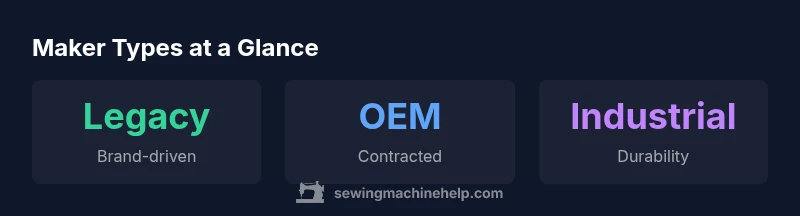
Comparison of maker types
| Maker Type | Key Roles | Typical Models | Notes |
|---|---|---|---|
| Legacy brands | Consumer to light-industrial | Domestic/export | Long history; strong service networks |
| Contract manufacturers | OEM/white-label | Mid-range to high-end | Produce for multiple brands; flexible capacity |
| Industrial manufacturers | Heavy-duty and high-speed | Industrial/commercial | Durable; maintenance-focused |
Your Questions Answered
Who are the main manufacturers of sewing machines?
The major makers include legacy brands such as Singer, Bernina, Husqvarna, Janome, and Brother, along with modern players like Juki and Pfaff. Many of these brands also use contract manufacturing for certain lines.
The major manufacturers include both historic brands and modern players, often using contract production.
Do brands produce in-house or outsource assembly?
Not always. Some brands design in-house but outsource assembly to contract manufacturers, while others sublicense designs under private labels. This arrangement helps manage costs and scale.
Some brands design in-house but outsource assembly; others license designs.
Are industrial machines made by the same companies as home machines?
There is overlap in capabilities, but many industrial machines come from specialized manufacturers or divisions within larger groups. They emphasize durability, speed, and service contracts.
Industrial machines often come from specialized manufacturers, not always the same as home-use brands.
How can I identify who makes my machine?
Check the model name, serial number, and any labels on the machine. Manufacturer brochures and the user manual usually reveal the maker. If in doubt, contact customer support with your model information.
Check labels and manuals; contact support for confirmation.
What should I consider when evaluating makers?
Consider service networks, availability of spare parts, warranty terms, and the lifecycle of the model. Also assess attachment compatibility and software updates if you buy computerized machines.
Look at service, parts, warranty, and upgradability.
“Understanding who makes sewing machines helps buyers evaluate durability, service networks, and future parts availability.”
The Essentials
- Brand variety matters for service and parts
- Legacy brands offer strong support and stability
- Contract manufacturing expands options and availability
- Buyers should evaluate service networks and lifecycle