Where Are Sewing Machines Made: A Global Manufacturing Guide
Explore where sewing machines are made, from Japan and Germany to large Chinese factories. Learn how origin affects quality, price, and service for home sewists.


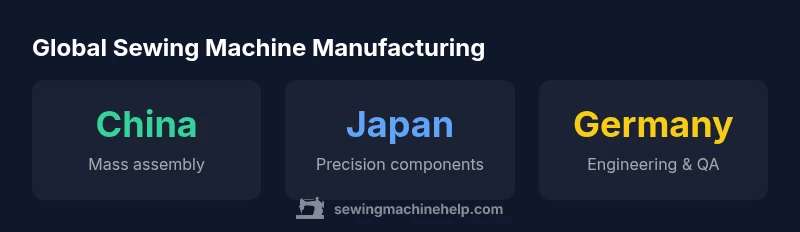
Where are sewing machines made? Most modern sewing machines are manufactured in global factories, with major assembly and components produced in China, Japan, Germany, and Vietnam. Domestic assembly is common for some specialty models, while many brands design components in‑house and contract final assembly abroad. For home sewists, understanding origin helps compare build quality, warranty terms, and service availability across brands.
Global Landscape of Sewing Machine Manufacturing
Understanding where sewing machines are made starts with recognizing the global manufacturing tapestry that underpins almost all consumer models. The majority of high‑volume sewing machines are produced in Asia, with large factories in China and Taiwan handling mass assembly, electronics, and some metal components. Premium lines, by contrast, often involve more specialized work in Japan or Germany, where engineering standards and component precision are emphasized. According to Sewing Machine Help, origin matters not only for price but also for access to service networks and warranty coverage. For home sewists, this means that a machine labeled as made in China may offer compelling value, while a model labeled as made in Japan might reflect a different approach to quality control and customer support. The keyword here is transparency: brands that clearly disclose where each part is made—assembly, electronics, motors—provide a clearer picture of what you’re buying and how it will behave over time, especially as you tackle projects that demand reliability.
Brand Strategies: Where Major Brands Assemble
Brand strategies for sewing machines vary by market, model tier, and supply chain considerations. Many manufacturers maintain centralized engineering hubs in Japan, Germany, or the United States while outsourcing final assembly to facilities in China or Vietnam to achieve economies of scale. Others closely guard which parts are produced in‑house versus sourced from suppliers abroad. This split affects lead times, pricing, and warranty logistics. According to Sewing Machine Help, some brands align final assembly with the region where they offer the strongest service network, while others prioritize standardized QA checks across factories. For buyers, the upshot is that a machine’s origin can signal different experiences in setup, parts availability, and long‑term maintenance, even when the model name is the same across countries.
How Location Impacts Price and Quality
Location often influences price due to labor costs, automation levels, and local regulations, but it does not determine quality by itself. Machines assembled in high‑cost regions with rigorous QA—such as Japan or Germany—tend to emphasize precision components, longevity, and consistent performance. Conversely, mass‑market models finished in China or Southeast Asia can deliver excellent value through economies of scale and broad spare‑parts availability. The Sewing Machine Help team notes that credible brands publish origin information and document supplier relationships so consumers can assess risk, warranty scope, and service access. In practice, you may find a premium machine assembled partly in Japan with some components sourced from other regions; such hybrid sourcing is common and does not automatically imply inferiority or superiority.
The Supply Chain: From Components to Finished Machines
The journey from raw materials to a finished sewing machine is multi‑step and globally dispersed. Motors, electronics, gears, and housings may come from several countries, then converge at assembly plants for final testing. A single model can include parts from Japan, Taiwan, and Germany, even if the case is molded in China. This cross‑border choreography helps brands balance cost, speed, and QA, but it also means that service networks must be capable of supporting machines regardless of origin. For home sewists, this underscores the importance of choosing brands with transparent sourcing, clear wiring diagrams, and accessible spare parts.
Sustainability and Ethics in Sewing Machine Production
Sustainability and labor practices vary by factory and country, with both progress and challenges across regions. Brands that publish audits, worker welfare commitments, and environmental metrics give buyers greater confidence. The Sewing Machine Help analysis highlights that responsible manufacturers pursue energy efficiency, waste reduction, and responsible sourcing for steel, plastics, and electronics. When origin is disclosed, you can better evaluate a company’s ethics program and plan for responsible disposal at end of life. Judges of quality increasingly look beyond the label to the production environment, supplier oversight, and compliance with international labor standards.
How to Verify the Origin of Your Sewing Machine
Knowing where your machine was made is not a guessing game. Start by checking the label on the unit itself, the user manual, and any official product page. Some brands also publish supply‑chain notes in their online documentation or product lists. If you purchased second‑hand, request the original packaging or purchase receipt that indicates country of origin. For internet purchases, ask the seller for explicit country‑of‑origin details and any available certificates. When in doubt, contact customer service for the model and batch number; reputable brands maintain traceability records to support service and warranty claims.
Common Myths About Sewing Machine Manufacturing
There are several myths about where sewing machines are made that can mislead buyers. Myth: all high‑end machines come from Japan or Germany. Reality: premium models can originate partly from other regions, with final assembly in multiple locations. Myth: origin determines durability. Reality: durability depends on engineering, QA, usage, and maintenance. Myth: US assembly guarantees superior support. Reality: domestic assembly does not automatically translate into better service if the brand’s global network is weak. By checking official documentation and service options, you avoid these misconceptions.
Practical Buying Guide by Origin
When shopping, tailor your questions to origin; ask about final assembly location, component sourcing, and warranty coverage in your region. For beginners, a well‑supported machine assembled in a country with strong service networks offers peace of mind and easier parts access. For advanced users, consider models with mixed sourcing that combine Japanese precision components with robust global support. In all cases, prefer brands with transparent disclosures and documented QA processes; this reduces the guesswork and helps you select a machine that suits your projects and budget.
Origin and roles in sewing machine manufacturing
| Region | Common Roles | Notes |
|---|---|---|
| China | Final assembly, motors | High-volume production; cost efficiency |
| Japan | Precision components, firmware | Premium QA standards |
| Germany | Mechanical design, precision parts | Engineering center, long-term durability |
| Taiwan | Controls & electronics | Bridge between East and West supply chains |
Your Questions Answered
Are sewing machines made in the United States?
Some specialty or domestic-market models are assembled in the US, but most mainstream consumer machines are assembled overseas. Look for country-of-origin labels and the manufacturer’s notes to confirm.
Some models are made in the US, but most are assembled abroad; check origin labels.
Do high-end sewing machines come from Japan or Germany?
Yes, many premium brands have critical components or final assembly in Japan or Germany, reflecting strict QA and engineering traditions.
Premium models often come from Japan or Germany.
Can I tell where a machine was made from the model number?
Sometimes the model name or serial code hints at the country of origin, but accuracy varies by brand. Check the label for definitive info.
Check the label for origin details.
Country reliability? Do some regions produce more reliable machines?
Reliability is brand-specific, not country-specific. Review model tests and warranty terms rather than origin alone.
Reliability depends on brand and QA.
What impact does origin have on warranty?
Warranty terms are set by the brand, not the country of manufacture. Ensure you understand coverage and service in your region.
Warranty is brand-based, not country-based.
How can I verify origin if buying online?
Ask for exact country of origin, check the serial plate, and request documentation. Reputable sellers provide this information.
Ask for origin details and docs.
“Manufacturing locations shape price, quality, and service, but consistent QA standards ensure reliable performance across regions.”
The Essentials
- Check the country-of-origin label before buying.
- Expect premium lines to originate in Japan or Germany.
- Consider mass-market models assembled in China.
- Verify warranty terms and service networks by origin.
- Understand how components come from diverse regions.