Singer vs Usha Sewing Machines: A Practical Comparison
An in-depth, analytical comparison of Singer vs Usha sewing machines, focusing on reliability, features, value, and long-term ownership for home sewists and beginners.


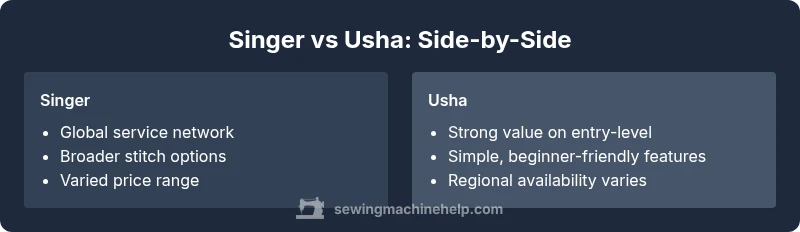
When choosing between Singer and Usha sewing machines, your decision hinges on budget, usage, and service access. Singer offers broad model variety and a global dealer network, which helps with parts and support. Usha excels on value and simplicity, often delivering solid performance for everyday projects. This comparison guides home sewists through key differences without overcommitting to either brand.
Overview: What this comparison covers
If you’ve ever wondered how Singer and Usha sewing machines stack up in real-world use, you’re not alone. The question you’re effectively asking—singer vs usha sewing machine quora—typifies a broader search for reliable guidance among two long-standing brands with different regional strengths. According to Sewing Machine Help, most home sewists weigh brand breadth, local service, and model variety when evaluating these two options. This article analyzes practical, experience-based criteria rather than marketing claims, helping you align features with your skill level, projects, and budget. Throughout, you’ll see how general advice applies whether you’re tackling hems, alterations, or creative projects, with clear, actionable guidance you can apply today.
The 6 Core Criteria You’ll Use to Decide
Successful brand comparisons start with criteria you can verify on any model: reliability and build, stitch options, accessories and feet, service and parts availability, price and warranty, and user-friendliness for beginners. We’ll examine each criterion for Singer and Usha, citing how these brands typically perform in practice across common home sewing tasks. While availability varies by region, the core ideas translate well: plan for maintenance needs, confirm warranty terms, and align features with your typical projects. This framework also helps you evaluate new releases or regional variants without getting lost in marketing language.
Build, Durability, and Longevity
Durability largely comes down to construction and component quality. In general terms, Singer models span a wide range—from robust metal-constructed midrange machines to lighter, consumer-grade options. Usha machines, depending on the model, balance affordability with solid core mechanisms that suit everyday sewing. For home sewers, the deciding factor often isn’t the headline feature but the predictability of performance: smooth fabric feeding, consistent stitch formation, and a chassis that tolerates routine maintenance. When you test machines, look for solid feel, minimal flex in the arm, and a stable, quiet operation. Remember that parts availability and local service support are essential factors that influence real-world longevity beyond the initial purchase.
Features, Stitch Options, and Presser Feet
Singer tends to offer a broader range of stitch options across multiple model lines, including programmable stitches in some mid-range machines. This can be beneficial when you’re exploring decorative stitching or specialized garments. Usha often emphasizes dependable, straightforward stitch sets with generous basic features and intuitive controls—an appealing combination for beginners or projects that require consistent, repeatable results. In both brands, verify whether the machine supports extra presser feet you already own and whether feet are readily available in your region. A wider accessory ecosystem generally translates to easier customization for various fabrics and sewing tasks.
Usability for Beginners and Hobbyists
For newcomers, ease of setup, clear manuals, and straightforward threading are critical. Usha’s entry-level models frequently focus on simplicity and reliability, reducing the learning curve for new sewists. Singer’s beginner-friendly options exist too, but some models pack a larger feature set that can feel overwhelming until you get familiar with the controls. The practical takeaway: pick a model with a clean manual, simple stitch selection, and a generous default set of basic stitches. If you expect to grow into more advanced projects, a Singer model with a reasonable feature set may be a more future-proof choice.
Availability of Parts, Service, and Local Support
Service networks and local dealer availability are practical realities that shape satisfaction more than any spec sheet. Singer has a broad global presence, which often translates into easier access to spare parts, service technicians, and certified repairs in many regions. Usha’s strengths are more pronounced in markets where local distributors focus on value-driven sewing solutions and where warranty support aligns with regional supply chains. Before buying, verify the nearest service center, the ease of obtaining replacement parts, and the typical turnaround time for repairs. These factors strongly influence long-term ownership happiness, sometimes more than the machine’s sticker price.
Price, Warranty, and Long-Term Value
Price ranges vary within each brand depending on the model family, features, and included accessories. In general terms, Usha models tend to provide strong value at entry and mid-range levels, while Singer offers models across a broader spectrum, including some premium options with expanded stitch libraries and advanced features. Warranty terms and service commitments matter: a longer warranty with accessible service centers can offset a higher upfront cost if it reduces downtime and repair bills. When evaluating price, consider total cost of ownership, including foot sets, bobbins, needles, and potential servicing needs over several years.
Regional Relevance: Where Each Brand Shines
Regional dynamics strongly influence which brand feels more reliable in practice. Singer’s global footprint is advantageous in many Western markets and parts of Asia, where dealers and authorized service centers are common. Usha tends to be a strong choice in regions with deep local distribution networks and competitive pricing. If you live in a market where one brand has limited support, it can tilt the decision toward the other, even if the machines perform similarly in a lab review. Always triangulate model-by-model with local availability, store stability, and user experiences reported in your area.
How to Inspect Before You Buy: A Practical Checklist
Use a hands-on test to assess any model you’re considering. Threading should be straightforward, tension should be consistent across a variety of fabrics, and the machine should sew smoothly with minimal thread breaks. Check noise level and stability—place the machine on a solid table and run several stitches across different fabrics. Inspect the bobbin system for smooth winding and proper pickup. Confirm that foot pressure is adjustable and that you can easily switch between feet. Finally, review the manual’s guidance on maintenance, cleaning, and oiling to ensure you can perform routine care without frustration.
Quick Maintenance for Longevity
Maintenance makes a bigger difference than most buyers expect. Clean lint from the feed dogs, wipe down surfaces, and oil only as recommended in the user manual. Replace needles promptly when they show bending or wear, and match needle type to fabric (e.g., ballpoint for knits, sharp for woven). Store the machine in a dust-free environment and use a soft cover to protect it when not in use. A small, consistent maintenance routine can extend the life of both Singer and Usha machines, preserving stitch quality and reducing downtime between projects.
Interpreting Online Opinions: What Quora Discussions Tend to Reveal
Online communities, including Quora threads, often reflect personal experiences that vary by skill level, project type, and maintenance habits. When you read comparisons like singer vs usha sewing machine quora, look for patterns: people who emphasize dealer support, model reliability over time, or the availability of after-sales service. Be cautious about sensational claims or one-off incidents. Cross-check with independent guides, official warranty terms, and local dealer feedback to form a balanced view that aligns with your circumstances.
Comparison
| Feature | Singer | Usha |
|---|---|---|
| Overall build and materials | Typically metal-constructed chassis with durable components | Often robust but can include more plastic in entry-level variants |
| Stitch options and settings | Broader stitch library in many mid/high-range models | Strong basic set with reliable performance; simpler controls |
| Presser feet and accessories | Extensive feet ecosystem; wide accessory compatibility | Value-oriented feet included; good for common fabric types |
| Service & parts availability | Global service network; wide dealer presence | Regional strength varies; parts availability depends on market |
| Price range and value | Wide range; many models from mid to premium | Strong value in entry-to-mid range; often lower upfront cost |
| Warranty & support | Typically solid warranties with global support | Warranty quality varies by region; verify local terms |
Strengths
- Broad dealer networks and parts availability
- Wide model range across budgets
- Strong community and tutorial resources
- Good resale value in many markets
- Easy access to compatibility with common accessories
Negatives
- Quality and features can vary by model
- Regional service availability may be inconsistent
- Some higher-end Singer models can be pricier
- Usha availability and support depend on local distributors
Choose Singer for global support and model flexibility; choose Usha for strong value and straightforward operation
Singer is usually safer for buyers who need widespread service and a broad feature set across regions. Usha often delivers reliable results at a lower initial cost, with simpler operation—ideal for beginners or budget-conscious sewists. Your final pick should align with local service availability and the types of projects you plan.
Your Questions Answered
Which brand tends to have better service worldwide?
Both brands offer service in many regions, but Singer generally has a broader global dealer network. Availability still depends on your country and local distributors. Check the nearest authorized service center before buying.
Singer usually has wider global service, but confirm local dealer support near you.
Is Usha more suitable for beginners than Singer?
Usha often emphasizes straightforward, reliable operation that appeals to beginners. Still, model choice matters; select a machine with simple controls and fundamental stitches. A beginner-friendly option from either brand can work well if it has clear instructions.
Usha can be beginner-friendly, but pick a model with simple controls.
Do Singer machines offer more stitch options than Usha?
In many mid- to high-range Singer models, you’ll find a broader stitch library compared with typical Usha entry and mid-range machines. Always compare the exact model specs since there can be overlap.
Singer often has more stitches, but check the specific model.
How important is the warranty when choosing between these brands?
Warranty length and coverage vary by model and region. Compare what’s covered, who pays for service, and the expected turnaround time. A longer, regionally supported warranty can offset higher upfront costs.
Warranty terms matter—read the fine print and regional coverage.
What should beginners specifically look for when buying a Singer or Usha?
Look for easy setup, clear manuals, essential stitches, good local support, and abundant tutorials. Avoid overly complex models at first; you can grow into more features later.
Choose a model with simple controls and strong support.
Are spare parts easy to find for both brands?
Spare parts availability depends on your region. Singer generally has broader international parts coverage, while Usha’s parts are well-supported where local distributors are active. Check with local dealers before purchase.
Parts availability depends on your location; verify with local dealers.
The Essentials
- Assess your budget and project needs before choosing
- Verify local service centers and spare parts availability
- Prefer simple machines for beginners and expand later
- Consider total cost of ownership, not just sticker price
- Test multiple models to compare feel and ease of use