Can You Machine Sew Knitting? A Practical Guide
Discover whether you can machine sew knitted fabrics, which stitches and needles to use, and a clear step-by-step plan with tips, warnings, and practice exercises for home sewists.


In this guide, you can learn whether it’s feasible to machine sew knitting and how to choose the right stitch, needle, and settings. Yes, you can machine sew most knit fabrics with care, using a stretch or zigzag stitch and appropriate needle. This article explains fabric compatibility, stitch options, tension adjustments, and safety tips to prevent skipped stitches or runs.
Can knitting be machine sewn? Understanding fabric properties
Knits are fabrics composed of loops that naturally stretch along the jersey grain. This elasticity makes them comfortable but tricky to sew, because seams can grow or shrink as you sew. According to Sewing Machine Help, most common knits (jersey, interlock, ponte) respond well to the right machine settings, but you must manage fabric feed, needle choice, and stitch type to avoid distortion. Knits behave differently across weights; a light jersey curls at edges while a heavier ponte can pucker if your tension is too tight. The key is to respect the fabric’s recovery and plan your seam accordingly. Always test on a scrap piece to observe how the fabric feeds under the presser foot and how the stitch behaves. If the test swatch holds its shape and the seam lies flat, you’re ready to proceed.
Knits: types, risks, and how they sew
Knits vary by weight and construction. Common types include lightweight jersey, midweight interlock, ponte, rib knits, and double-knits. Each has different stretch direction and recovery, affecting how the fabric behaves as you sew. The biggest risk with knits is distortion: they can shift, curl, or run if the feed and tension aren’t balanced. Stabilize with light stay tape or careful stabilizers, and choose a compatible needle and stitch. Jersey typically sews well with a narrow zigzag; interlock and ponte may tolerate a longer stitch and more stable feed. Heavier knits can be forgiving but require slower feeding and, if possible, a walking foot.
Stitches that work best on knits
For most home sewing of knits, you’ll reach for a stretch/serging-capable stitch. A narrow to medium zigzag (about 1.5-2.0 times the stitch width) allows the seam to stretch with the fabric. A three-step zigzag can add extra stability for light to mid-weight knits. If your machine supports, a coverstitch or twin needle finish is ideal for hems on stable knits, but these options are often used on dedicated machines. Use a gentle stitch length (around 2.5-3.0 mm) to avoid creating bulk, and avoid straight stitches unless you’re purposely opting for a flat-felled or topstitched seam. Remember to keep the fabric moving evenly under the needle and avoid pulling.
Tools and machine settings for knits
Essential tools include a sewing machine with stretch stitch capability, a ballpoint or jersey needle (size 75/11 or 90/14), and knit-friendly thread (polyester). A walking foot is highly recommended when you’re new to knits, but not strictly required for all fabrics. Set your machine to a stretch stitch or a narrow zigzag, depending on your fabric. Start with a stitch length around 2.5-3.0 mm and test on a scrap to confirm the seam sits flat without gather. Ensure your bobbin thread matches the top thread quality so the stitch balance remains even. Keep pins parallel to the seam and remove them just before the needle reaches them to avoid bending needles.
Preparing a project: planning and prep work
Before you start sewing knits, plan your seam allowance and choose the finish. For most apparel knits, a 1/2 inch seam with a finishing stitch works well, while lighter knits may use 1/4 inch. Stabilize edges if necessary with tissue paper, lightweight stay tape, or a small stabilizer under the seam. Cut with sharp scissors and mark notches with tailor’s chalk; this helps prevent distortion. If you’re working with a length of fabric that’s prone to curling, consider a temporary stay or an edge-finisher to hold shape until stitching begins.
Common issues and troubleshooting
If the fabric curls away from the needle, try stabilizing with tissue or stay tape and slow the feed rate. Skipped stitches often come from a dull or wrong needle for knits; replace with a ballpoint or jersey needle. Tension issues can cause loops or puckers; try loosening the top tension slightly and ensure the bobbin tension is balanced. If stitches break or pull, reduce the stitch length a bit and confirm the fabric isn’t being stretched while sewing. For fraying edges, consider a light binding or finishing stitch.
Care, finishing, and long-term results
Finish knits with gentle seams and avoid aggressive pulling. Press with a low-heat setting and a steam-safe press cloth to prevent stretching. For hems, consider a twin needle finish or narrow overlock-style edge if available. Store knits flat to avoid stretching strain or hanger marks. Clean and lubricate your machine as per user manual to maintain smooth feeding for knit fabrics.
Authority sources and further reading
- Extension services from universities (OSU Extension): https://extension.oregonstate.edu
- University of Illinois Extension: https://extension.illinois.edu
- NIST: https://www.nist.gov
Practice plan to build knitting sewing skill
Begin with practice swatches: stitch on lightweight jersey, then move to interlock, ponte, and rib. Create small samples of seam types (plain seam, overlock-like seam, topstitch) to observe behavior. Keep a notebook with tension settings, stitch length, and feed dog position that produced the best results. Repeat with different weights until you feel confident. Progress to a simple project such as a knit scarf or baby tee to apply what you’ve learned.
Tools & Materials
- Sewing machine with stretch stitching capability(Must offer a stretch or zigzag stitch; check manual)
- Ballpoint or jersey needle (size 75/11 or 90/14)(Use needles designed for knits)
- Knitting-friendly thread (polyester)(Choose polyester for stretch and recovery)
- Walking foot (optional but recommended)(Helps feeding on slippery knits)
- Stretch stitch foot or zigzag foot(Enhances stitch flexibility)
- Sharp scissors for knit fabrics(Clean cuts prevent snags)
- Pins or clips(Hold knit layers without distorting)
- Measuring tape(Check seam allowances accurately)
- Seam ripper(Undo mistakes without damaging fabric)
- Stabilizer or tissue paper (for edges)(Helpful for very curl-prone knits)
Steps
Estimated time: 60-90 minutes
- 1
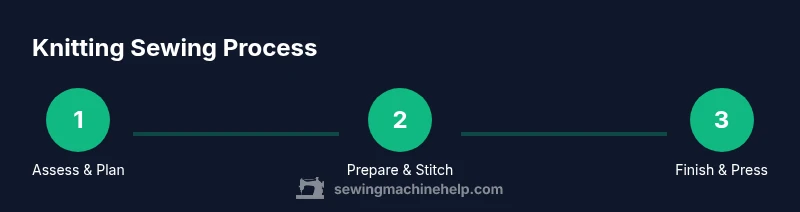
Assess fabric and plan seam
Identify knit type and weight; decide seam allowance and finish. This planning reduces distortion and sets expectations for stretch along the seam.
Tip: Sketch a quick plan on scratch paper before threading the machine. - 2
Install the correct needle
Insert a ballpoint or jersey needle sized to fabric weight. A sharp needle can nick the knit and create runs, whereas a ballpoint glides between loops.
Tip: Always test needle choice on a scrap first. - 3
Prepare thread and bobbin
Thread the upper with polyester knit thread and wind an even bobbin. Knit fabrics rely on balanced tension between bobbin and thread above for a stable seam.
Tip: Use a slightly longer bobbin thread to reduce tension differences. - 4
Set machine for knit-friendly stitch
Choose a stretch stitch or narrow zigzag, and start with stitch length around 2.5-3.0 mm. This allows stretch without creating gaps.
Tip: Do a quick stitch test on a scrap to confirm balance. - 5
Test on a knit swatch
Sew a small seam on scrap knit to observe feed, curl, and seam flattening. Adjust tension or stitch width based on results.
Tip: Mark the test swatch with chalk so you can compare easily. - 6
Sew your main seam with even feed
Position fabric evenly and guide it rather than pull. Maintain consistent speed to avoid dragging or bunching.
Tip: Use clips instead of pins at the seam allowance near the needle. - 7
Finish the edge
If possible, finish with a narrow zigzag or use a walking foot to help the edge lie flat. This minimizes fraying and curling.
Tip: Consider an edge-binding for delicate knits. - 8
Press carefully
Press seams with a low-heat setting and a press cloth to avoid stretching knits. Avoid steam directly on very delicate knits.
Tip: Place a cloth between iron and fabric to protect loops. - 9
Evaluate and adjust for future projects
Record what tension, stitch, and weight worked best. Apply insights to your next knit project.
Tip: Keep a small sewing notebook for quick reference.
Your Questions Answered
Can you machine sew knitting with a regular sewing machine?
Yes, you can sew knits on a standard home machine. Use a ballpoint/jersey needle, a stretch or zigzag stitch, and a balanced tension. Start with a test seam to dial in settings before working on your project.
Yes, you can sew knits on a regular sewing machine. Use a ballpoint needle and a stretch stitch, and always test first to dial in the settings.
Which stitch is best for knit fabrics?
A stretch zigzag or three-step zigzag typically works best for most knits. If available, use a cover stitch for hems on stable knits, but many home machines achieve good results with a narrow zigzag.
For knits, start with a stretch zigzag and adjust length for your fabric.
Do I need a walking foot for knits?
A walking foot is highly helpful for feeding knits evenly, especially slippery or multi-layer projects. It’s not strictly required for all knits, but it makes control easier.
A walking foot helps, especially on slippery knits, but you can start without one.
Can I finish knits with a serger?
A serger can finish knits quickly and cleanly, but a regular sewing machine with a zigzag or overedge stitch can also do the job. Choose based on your equipment and comfort.
Yes, sergers are great for knits, but you can also finish seams with a zigzag on a regular machine.
What needles should I use for knit fabrics?
Use a ballpoint or jersey needle sized to the knit weight. A sharp needle can snag loops and create runs, so choose the right point.
Ballpoint needles are best for knits; pick the size to match your fabric weight.
Should I pre-wash knits before sewing?
Pre-washing knit fabrics is recommended in many cases to prevent post-sewing shrinkage and distortion. Check the fabric supplier’s instructions.
Yes, pre-wash knits when the pattern or fabric guide recommends it.
Watch Video
The Essentials
- Test swatches before starting a knit project
- Choose knit-friendly needle and stitch options
- Balance tension between needle thread and bobbin
- Use walking foot for better fabric control
- Finish edges to prevent curling and fraying