What size sewing machine needle for fleece: a practical guide
Discover the best sewing machine needle size for fleece, including ballpoint vs stretch needles, weight-based recommendations, stitch length tips, and testing strategies from Sewing Machine Help.


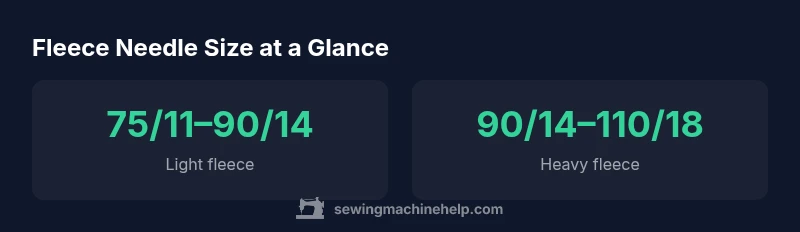
For fleece, start with a ballpoint needle in sizes 75/11 to 90/14 for light fleece and 90/14 to 110/18 for heavier fleece. If the fabric has more stretch, use a stretch needle and a slightly shorter stitch. Always test on scrap fleece to avoid skipped stitches or puckering.
Why the right needle size matters for fleece
For fleece, start with a direct answer to the question what size sewing machine needle for fleece. The choice of needle size and type dramatically affects stitch quality, seam stability, and fabric appearance. According to Sewing Machine Help, fleece is a knit fabric and sews best with a ballpoint needle that pushes fibers rather than cutting them. The wrong needle can cause skipped stitches, snagging, or puckering, especially on thicker or very stretchy fleece. By picking the right size within the ballpoint family, you reduce fabric distortion and achieve a smoother seam that wears well over time.
Ballpoint vs stretch needles for fleece
Fleece typically benefits from ballpoint needles because they glide between the knit fibers rather than piercing them. This reduces snagging and helps maintain elasticity across the seam. Use a stretch needle only when the fleece has notable stretch that would otherwise cause skipped stitches or breakage with a standard ballpoint. When in doubt, start with a ballpoint size appropriate for the weight of your fleece and move to a stretch needle if you observe small puckers at the seam line. This distinction is especially important for projects with structural seams or top-stitching that must look clean from edge to edge.
How to choose the needle size by fleece weight
Weight guides for fleece are not universal, but common practice splits fleece into light, medium, and heavy categories. For light fleece, try sizes from 75/11 to 90/14; for medium fleece, 90/14 to 100/14; and for heavy fleece, 90/14 to 110/18. These ranges balance fiber protection and stitch visibility. Always test on a scrap swatch of the same fleece to confirm that the chosen needle size delivers even feeds, clean stitches, and no fabric distortion. If the fleece is very bulky, you may benefit from a larger ballpoint needle within the recommended range and a slightly longer stitch length on some machines.
Other needle considerations for fleece
Beyond needle size, remember that needle type matters as much as size. Ballpoint needles are generally preferred for fleece. If your fleece has substantial stretch, a stretch needle can improve seam integrity. Maintain a steady feeding technique to avoid fabric stretch and puckering, and consider using a slightly shorter stitch length to reduce bulk at seam lines. Thread choice also influences outcomes; polyester threads tend to pair well with fleece due to their slight give and durability. Keep the machine aligned with the presser foot pressure and tension adjusted to the fabric, testing on scraps if you make any changes.
Testing and adjusting stitch length on fleece
Always begin with a test swatch on the same fleece you will sew. Start with a conservative stitch length in the 2.0–2.5 mm range and observe how the fabric feeds and how the thread sits on the surface. Increase or decrease in small increments until stitches sit cleanly without looping or puckering. If you notice skipped stitches, reconsider needle size first, then check tension and fabric handling. A controlled sewing speed often yields better results than rushing through bulky fleece layers. Document what works for future projects, especially if you switch fleece brands or finishes.
Common fleece variations and their impact on needle choice
Fleece fabrics vary: microfleece, brushed fleece, and thick polar fleece each behave a little differently under the needle. Microfleece may sew easily with smaller ballpoint needles in the 75/11–90/14 range. Brushed fleece can tolerate mid-range sizes like 90/14–100/14, while thick polar fleece might benefit from 90/14–110/18. In very stretchy fleece variants, switch to a stretch needle and adjust your stitch length to avoid tension-induced puckers. Test on each new fleece type to confirm the balance between needle size, stitch length, and fabric behavior before committing to a full project.
Troubleshooting: skipped stitches, puckering, snagging
If skipped stitches occur, verify needle size matches fleece weight first, then switch to a ballpoint or stretch needle as needed. Puckering usually indicates tension or stitch length issues; try shortening the stitch length slightly and re-checking fabric feed. Snags can result from using too sharp a needle on knit fleece—stick with ballpoints and avoid aggressive turning of seams. Finally, ensure you are not fighting the fabric with excessive tension or a hurried sewing pace; calm, steady feeding tends to produce better fleece seams.
Needle size guidance by fleece weight
| Fleece Weight | Recommended Needle Size | Needle Type | Notes |
|---|---|---|---|
| Light fleece | 75/11–90/14 | ballpoint | Soft drape, easy to sew |
| Medium fleece | 90/14–100/14 | ballpoint/stretch | Balanced stiffness and stretch |
| Heavy fleece | 90/14–110/18 | ballpoint/stretch | Bulkier seams; slower pace |
Your Questions Answered
What size needle should I use for fleece?
For light fleece use 75/11 to 90/14; for heavier fleece use 90/14 to 110/18. Ballpoint is preferred; adjust by weight.
Use a ballpoint needle in sizes 75/11 to 90/14 for light fleece, or up to 110/18 for heavy fleece.
Is a ballpoint needle better than a sharp needle for fleece?
Ballpoint needles push fibers apart, reducing snags on knits like fleece. Sharp needles can cut fibers and cause runs; opt for ballpoint for most fleece.
Yes, ballpoint is better for fleece in most cases.
Should I adjust stitch length when sewing fleece?
Yes, use a slightly shorter stitch length, typically 2.0–2.5 mm, to minimize bulk and puckering. Test on scraps first.
Yes—try 2.0 to 2.5 mm and test on scraps.
Can I use a universal needle for fleece?
A universal needle can work on lightweight fleece, but ballpoint or stretch needles usually perform better for knit fleece.
A ballpoint or stretch needle generally works better for fleece than universal.
How can I prevent skipped stitches when sewing fleece?
Match needle size to fleece weight, use ballpoint/stretch needles, avoid pulling fabric, and test on scraps.
Use the right needle size and test on scraps to prevent skips.
Does fleece require a walking foot?
A walking foot helps feed bulky fleece evenly but isn’t strictly required. It can reduce shifting and puckering on thick fleece.
A walking foot can help, especially with bulky fleece.
“A correctly chosen needle size for fleece dramatically reduces skipped stitches and fabric snags. Pair it with the right stitch length and test on scraps before final sewing.”
The Essentials
- Start with ballpoint needles in the size range that matches fleece weight
- Always test on scraps to confirm stitch quality
- Use stretch needles only if the fleece shows significant stretch
- Adjust stitch length to about 2.0–2.5 mm to reduce puckering
- Consider a walking foot for bulky fleece if available