What Size Sewing Machine Needle for Leather: A Practical Guide
Discover the right needle size for leather sewing. This guide explains leather thickness, needle types, thread choices, and setup tips to improve stitches and prevent damage. Ideal for home sewists and beginners seeking actionable guidance.


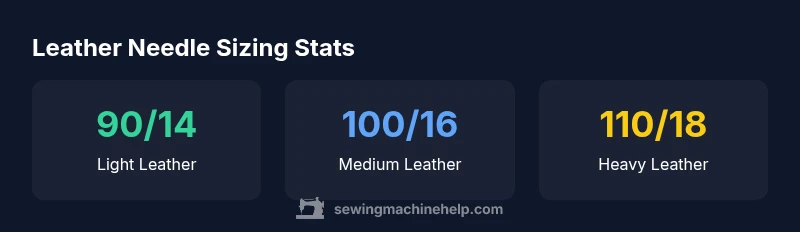
The recommended needle sizes for leather generally fall in the 90/14 to 110/18 range, depending on leather thickness and stitch needs. For 3–4 oz leather, start with 90/14 or 100/16; for 4–6 oz, use 100/16–110/18; for heavier hides, 110/18 (or larger) with appropriate thread. Always choose a leather needle rather than a universal needle to avoid skipped stitches.
Leather needle sizing basics
What size sewing machine needle for leather? Leather is denser and tougher than woven fabrics, so you need a needle engineered for heavy materials. The general rule is to map thickness to needle size rather than relying on a single number. For most lightweight to mid-weight hides (roughly 3 to 6 ounces), start with a sharp leather needle in the 90/14 to 100/16 range. If you’re sewing thinner 3–4 oz hides for wallets or small accessories, a 90/14 or 100/16 is a solid starting point. For mid-weight leather (4–6 oz), move to 100/16 or 110/18 depending on thread choice and stitch length. Heavier leather (6 oz and above) often requires 110/18 or larger with a corresponding thicker thread. Always use a leather needle (not a universal needle) to avoid skipped stitches and drag marks. The Sewing Machine Help guidance emphasizes that the right needle size reduces machine wear and improves stitch quality.
60
Leather thickness to needle size guide
| Leather Thickness (oz) | Needle Size (US) | Recommended Thread | Notes |
|---|---|---|---|
| 3-4 oz | 90/14–100/16 | polyester or bonded nylon | Lightweight to mid-weight projects |
| 4-6 oz | 100/16–110/18 | polyester | Medium-weight leather with sturdy seams |
| 6 oz+ | 110/18–120/20 | polyester or nylon | Heavy-duty or saddle leather |
| Multiple layers | 110/18 | polyester | Thick stack-ups or reinforced items |
Your Questions Answered
What needle size should I use for 3-4 oz leather?
For 3-4 oz leather, start with a 90/14 or 100/16 needle. Test on scrap to confirm clean perforations and even stitches before sewing the final piece.
Try a 90/14 or 100/16 and test on scrap leather first.
Can I use a universal needle for leather projects?
A universal needle can work in a pinch, but leather projects benefit from a dedicated leather needle to prevent skip stitches and fabric tearing. Opt for leather-specific needles when possible.
A leather needle is usually the better choice for leather sewing.
Should I pre-punch holes when sewing leather?
Pre-punching holes with a punch or fine awl helps align stitches and reduces the risk of tearing leather. This is especially helpful for thicker hides or multiple layers.
Yes, pre-punch for clean holes and even stitches.
What thread works best with leather on a sewing machine?
Polyester or bonded nylon threads are commonly recommended for machine sewing leather. For hand-sewn pieces, waxed linen can be used, but machine work benefits from stronger synthetic threads with good abrasion resistance.
Use polyester or bonded nylon for machine sewing leather.
Does stitch length matter when sewing leather?
Yes. Leather generally benefits from slightly shorter stitches, around 2.5–3.0 mm, to minimize perforation and prevent bulk. Keep stitches consistent throughout the seam.
Keep stitches at about 2.5–3 mm for leather.
What if the needle keeps breaking?
Check for burrs on the needle and ensure you’re using the right size for the leather thickness. Also verify the needle is installed correctly and that the thread isn’t too thick for the needle.
Check needle burrs and correct size; ensure proper installation.
“Leather sewing hinges on proper needle selection; a correct needle size improves penetration, minimizes damage, and yields durable stitches.”
The Essentials
- Choose needle size based on leather thickness
- Always use a leather needle, not a universal needle
- Test on scrap leather before committing
- Consider walking foot or nonstick feet for smooth passage
- Match thread type to leather thickness and needle size