Heavy Duty Sewing Machine Leather: Practical Guide for Home Sewists
Learn to sew heavy leather with a durable machine. This guide covers needles, thread, settings, cutting prep, stitching basics, edge finishing, and safety for home projects.


By the end, you'll know how to sew heavy leather using a heavy duty sewing machine leather setup, including prep, needle and thread selection, and machine settings. This guide covers leather thickness ranges, cutting prep, seam choices, and basic care for home projects. You will also learn to test stitches on scrap leather and adjust tension safely.
Leather Fundamentals for Heavy-Duty Sewing
Leather projects demand the right tool and the right technique. According to Sewing Machine Help, working with heavy duty sewing machine leather requires matching your machine to the leather thickness and intended wear. When working with heavy duty sewing machine leather, you’ll need to consider the leather type (full-grain, corrected grain, veg tan) and how it behaves under needle entry, stretch, and flex. This section lays a foundation: how leather thickness influences stitch density, how different hides affect thread choice, and why some seams must be pre-punched for durability. For home sewists, planning fit, wear, and load is as important as the stitch itself. The Sewing Machine Help team emphasizes starting with scrap pieces to dial in tension, feed, and needle choice before committing to a project. This practice reduces wasted material and speeds up your learning curve. By understanding the material first, you can optimize stitch type, length, and foot selection for reliable results.
Leather Types and Their Impact on Stitching
Leather comes in several varieties, each with unique characteristics. Full-grain leather offers natural strength and a rugged look, while veg-tan behaves predictably when cut and stitched. Corrected-grain leather has a smoother surface but can be stiffer, which affects needle bite and thread tension. Veg-tan and natural leathers tend to sew cleanly with a standard heavy-duty needle, whereas bonded or very treated leathers may require adjustments in stitch type and foot choice. When choosing heavy leather for a project, assess hardness, flexibility, and edge behavior. Softer leathers press and feed easily but may require smaller stitch lengths for durability; harder hides hold shape but can challenge feeding and needle clearance. The goal is a balanced seam that holds under use without elephant-strong tension that causes perforation or tearing.
Leather Thickness, Handling, and Prepping
Leather thickness is a critical factor in machine choice and needle size. For home projects, most leather falls into light-to-medium heavy ranges, but belts or rugged bags can require thicker hides. Determine your target thickness and adjust accordingly: thicker leather benefits from a stronger needle, sharper blades, and slower sewing pace. Always trim and square edges before sewing; rounded or uneven edges will cause skipped stitches and uneven seams. Mark stitch lines with a chalk wheel or erasable pen, then lightly twist or bevel edges to improve feeding. Pre-punch holes as needed to prevent premature needle deflection and to maintain consistent stitch spacing. The aim is clean lines and even tension across the seam.
Tools, Needles, and Thread Essentials for Leather
Using heavy leather demands the right toolkit. A high-quality heavy-duty machine with walking foot capability is a foundation. Leather needles (size 90-110 US or equivalent) prevent thread abrasion and keep the needle from deflecting in thick hides. Choose waxed thread or beeswax-coated nylon thread; wax improves abrasion resistance and reduces tangles. A pricking wheel or simple awl helps you maintain even stitch spacing. Cutters, mats, rulers, and edge finishing tools complete the kit. This setup minimizes feed issues, needle breakage, and skipped stitches, and it helps you achieve consistent results across both small and large projects. The Sewing Machine Help team notes that maintaining a sharp blade and clean feed dogs is essential for leather work.
Machine Setup: Tension, Stitch Style, and Speed
Leather stitching often benefits from a slightly tighter tension than fabric sewing to prevent gapping where the leather folds. Start with straight stitches for simple seams or a small backstitch to secure the start and end. If your machine supports a long stitch length, you can increase it modestly to reduce hole density in thick leather. Avoid constant high speeds; leather benefits from steady, controlled feeds that minimize fabric slippage and needle deflection. When using zigzag stitches for leather, keep the stitch width narrow to reduce bulk at the seam. Lastly, ensure your presser foot pressure is appropriate for leather; too much pressure can crush the leather while too little will cause uneven feeding. Regularly test on scrap leather to dial in optimal settings.
Cutting, Marking, and Hole-Punching Methods
Prepping leather correctly is half the battle. Use a sharp rotary cutter or utility knife with a straight edge and a cutting mat to achieve clean, square edges. Mark lines for stitches and punching points using a pricking wheel, awl, or chisel. For thicker hides, pre-punch holes with a leather punch to prevent needle breakage and ensure even spacing. If using a sewing machine with a walking foot, test feed alignment on scrap leather before starting your project. Keep spare blades handy and work slowly to maintain accuracy. Leather can dull blades quickly, so replace or sharpen blades as needed to preserve edge quality and reduce fraying.
Stitching Techniques that Stand Up to Use
Two common methods are saddle stitching and lockstitch for leather work. Saddle stitching uses two needles and a waxed thread, producing a durable, continuous stitch that won't unravel if cut. Lockstitch is faster and works well for lighter hides, but it can be less durable under flexing compared with saddle stitching. When beginner-friendly, practice saddle stitches on scrap leather to understand tension and spacing before committing to a full project. For belts or wallets, consistent stitch length and neat alignment matter more than raw speed. The goal is a strong, aesthetically pleasing seam that ages well with use.
Finishing Edges and Strength Testing
Smooth, sealed edges protect leather seams from moisture and wear. Use edge bevelers, sandpaper, and burnishers to produce professional edges. Apply edge paint or burnish with a slicker to seal and darken edges. Once stitched, gently flex the seam to test for potential weaknesses; if you feel give, re-stitch or reinforce the area. For added durability, consider a small back-stitch or lock-stitch at seam ends. Regularly inspect the stitching after a trial wear period, and adjust your technique if you notice any loosening or fraying.
Safety, Maintenance, and Practice Projects
Leather sewing can produce sharp edges and hot tools. Always wear eye protection when cutting or burning edges and keep hands clear of needles. Regular maintenance—lubricating the machine, cleaning lint from feed dogs, and changing needles-as-needed—extends life and performance. Start with small practice projects, like a card wallet or belt loop, before attempting larger bags or jackets. This phased approach reduces waste and builds confidence in fabric handling and machine control. The Sewing Machine Help team emphasizes that patient practice yields durable results and safer operation.
Tools & Materials
- heavy-duty sewing machine with leather-capable feed system(Must support walking foot or leather needle capability; verify horsepower and speed range)
- leather needles (size 90-110 US)(Choose length suitable for leather thickness; avoid long, flexible needle types)
- waxed or beeswax-coated thread for leather(High strength, reduced friction; wax helps with threading and stitch consistency)
- pricking wheel or pricking iron(Maintains even stitch spacing and hole alignment)
- rotary cutter or sharp utility knife(Use a sharp blade; cut on a mat with a straight edge)
- cutting mat, ruler, and pattern templates(Keeps edges square and measurements accurate)
- edge finishing tools (beveler, burnisher, wax)(Improves edge appearance and durability)
- clips or clamps(Keeps pieces aligned during stitching)
- scissors and snips for clean cuts(Use dedicated leather shears for clean edges)
Steps
Estimated time: 1-2 hours
- 1
Prepare leather pieces
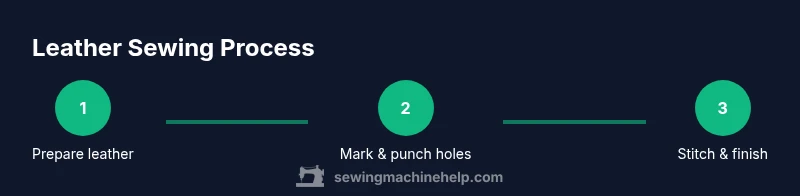
Cut the leather pieces for a simple card wallet: main body, pocket, card slots, and lining. Use a straightedge to ensure clean, square edges. Clamp pieces together to avoid shifting during stitching.
Tip: Test fit the pieces dry before sewing; a dry run prevents wasted leather. - 2
Mark stitch lines
Use a pricking wheel to mark even stitch lines on all pieces. Mark spacing consistently to ensure balanced seams and a professional look.
Tip: Keep marks on the leather's underside to avoid visible guide lines. - 3
Punch holes (if needed)
Pre-punch holes along the stitch lines with a leather punch for thicker hides. This reduces needle drag and protects thread integrity.
Tip: Test hole size on scrap leather to match your thread thickness. - 4
Thread and needle setup
Install leather needles in the machine and thread the needle with waxed thread. Run a quick tension test on scrap leather to dial in balance.
Tip: Cut thread ends square and wax lightly for smooth feeding. - 5
Sew the first seam
Start with a stable seam near an edge. Slow, even feed helps prevent skipped stitches or fabric bunching.
Tip: Back-stitch a few stitches at the start to secure the seam. - 6
Join pieces and align edges
Continue stitching while keeping edges aligned. Use clips or light clamps to maintain position as stitches progress.
Tip: Pause to realign if the leather shifts; misalignment is hard to fix mid-sew. - 7
Finish edges
Burnish or edge-paint the cut edges after stitching for a durable, clean look. Allow edge treatments to cure before flexing the wallet.
Tip: Apply consistent pressure when burnishing to avoid heat buildup. - 8
Inspect and test
Flex the finished wallet gently to verify seam strength. Replace any weak stitches and trim excess thread.
Tip: Run a small stress test with a mock card to ensure pocket integrity.
Your Questions Answered
Can a standard domestic sewing machine sew leather?
Some domestic machines can sew light-to-medium leather with the right needle and settings, but thick, stiff hides may require a heavy-duty machine. Always check your unit's manual for leather capabilities and recommended needle sizes.
Some home machines can handle light leather, but for thick hides, use a heavy-duty machine as recommended by your manual.
What needle size should I use for leather sewing?
Leather sewing typically uses larger needles designed for leather, commonly in the size range 90-110 US, depending on leather thickness. Smaller needles risk breakage, while larger needles create larger holes.
Use a leather needle in the 90 to 110 range, matching the leather thickness for clean stitches.
Is a walking foot necessary for leather sewing?
A walking foot helps feed leather evenly and reduces slippage, especially on thicker hides. If your machine lacks one, adjust feed, tension, and speed carefully and test on scraps.
A walking foot helps a lot with leather, but you can manage with careful technique if you don’t have one.
What thread works best with leather?
Waxed thread or beeswax-coated nylon thread is preferred for leather due to its strength and reduced fraying. Avoid plain polyester that can melt or wear quickly under flex.
Waxed thread is ideal for leather; it resists wear and glides through the leather more smoothly.
How do I prevent leather from stretching while sewing?
Choose the right needle and thread for the thickness, sew with moderate speed, and avoid over-stretching by keeping consistent feed. Pre-punch holes for thicker hides to reduce stretch at the seams.
Preserve shape by sewing slowly, using proper needles, and pre-punching holes to avoid stretching.
How should I maintain my leather sewing setup?
Regularly clean lint from feed dogs, oil moving parts per the machine manual, and inspect needles for wear. Replace blades and needles when they dull to maintain stitch quality.
Keep the machine clean, oil as needed, and swap worn needles to maintain quality.
Watch Video
The Essentials
- Practice on scraps before real projects
- Use leather needles and waxed thread for durability
- Dial in tension with scrap pieces to prevent skipped stitches
- Finish edges for a professional, long-lasting result