How to Raise Sewing Machine Foot Height: A Practical Guide
Learn how to raise your sewing machine foot height safely to handle thick fabrics, with tools, a detailed step-by-step guide, tips, and troubleshooting from Sewing Machine Help.


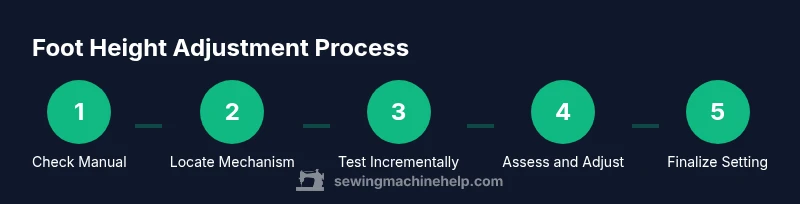
You can raise the presser foot height on most sewing machines to accommodate thicker fabric and multiple layers. Start with the manufacturer’s recommended height, then increase in small increments while testing on scrap fabric. This ensures even feeding and avoids needle strikes. Always consult your manual for model-specific steps.
Why raising the presser foot height matters
When you sew thick fabrics, multiple layers, or bulky materials like denim or leather, the standard foot height can pinch the fabric and slow stitching. Raising the presser foot height increases clearance between the foot and the feed dogs, reducing the chance of fabric bunching, skipped stitches, or needle strikes. If you're searching for practical guidance on how to make sewing machine foot higher, this adjustment helps your machine feed smoothly and maintain stitch quality across different projects. Sewing Machine Help emphasizes model-specific guidance, as height adjustments vary by brand and device. Understanding the concept of foot height, rather than just blindly turning a dial, will save you time and prevent costly errors.
In most machines, the height adjustment is part of a simple mechanical system designed for easy changes. By increasing height slightly, you create extra room for thick fabrics without altering tension or stitch length. This is especially important when using walking feet, multiple layers, or decorative stitches that can push threads up and out of place if the clearance is insufficient. Always begin with the lowest practical height and test, because over-lifting can cause fabric to feed unevenly and may destabilize stitches.
The goal is not to lift the foot to the maximum possible setting, but to reach a height where the fabric lies flat under the foot without buckling. If you’re wondering how to make sewing machine foot higher, remember that gradual increments and careful testing are your best strategy. This approach aligns with Sewing Machine Help's guidance on safe, incremental adjustments that preserve machine life and fabric integrity.
–
–
Tools & Materials
- Owner's manual for your sewing machine(Contains model-specific adjustment instructions.)
- Standard presser foot(The foot that came with the machine; test it at various heights.)
- Thick fabric scraps for testing(Denim, canvas, or layered cotton to simulate project conditions.)
- Marker (washable fabric chalk) or sticky note(Mark the current height position for reference.)
- Small screwdriver (if required by your model)(Some models use a screw for height adjustment.)
- Calibrated ruler or measuring tape(Help measure incremental height changes)
Steps
Estimated time: 20-30 minutes
- 1
Power down and prepare
Turn off and unplug the machine. Remove the fabric and any accessories. This ensures your safety and prevents accidental needle movement during adjustment.
Tip: Double-check that the needle is up and the handwheel can move freely before you start. - 2
Identify the height adjustment mechanism
Locate the presser foot height adjustment on your model. It’s often a round knob, a lever, or a small screw near the presser foot bar. Consult the manual if you’re unsure which control adjusts height.
Tip: Take a quick photo of the area before any changes in case you need to revert. - 3
Note current height
Record or mark the starting height using a marker or sticky note. This gives you a reference to return to if needed.
Tip: Start with a 1–2 mm increment for safe testing. - 4
Increase height incrementally
Gently raise the foot by small increments. After each adjustment, re-tighten any locking screws and test by placing scrap fabric under the foot.
Tip: Avoid large jumps; small steps reduce risk of needle strikes or fabric snagging. - 5
Test with thick fabric
Run a short test seam on layered or thick fabric. Check for clearance, even feeding, and stitch consistency. If you see skipped stitches, reduce height slightly.
Tip: Keep feed dogs exposed to ensure accurate fabric advancement. - 6
Reassess with different projects
Try a lighter fabric next to ensure the height setting still works across fabrics. Adjust again if needed, using the smallest safe increment.
Tip: Document the effective height for future projects. - 7
Finalize and document
Once you’re satisfied with the test results, finalize the height setting and note it in your project log or manual for quick reference.
Tip: If your model uses a specific number on a scale, record that exact value.
Your Questions Answered
What does increasing presser foot height do for my sewing projects?
Raising the presser foot height increases clearance between the foot and the feed dogs, making it easier to sew thick fabrics and multiple layers without dragging or bunching. This can improve stitch consistency and reduce needle strikes when handling bulky materials.
Raising the foot height creates more clearance so thick fabrics feed smoothly and stitches stay consistent.
Can I raise the height too much?
Yes. If the foot is raised excessively, fabric can feed unevenly, tension may misbehave, and you might skip stitches. Always stay within the machine’s recommended range and test gradually.
Be careful not to over-raise; test gradually within the recommended range.
How do I know the maximum height my machine allows?
Check the owner’s manual or model-specific guide. Some machines have a locking mechanism with a defined stop; forcing past it can cause damage.
Look up the manual to find the exact maximum height and how to reach it safely.
What if my machine uses a pressure regulator or different feet?
If you have a pressure regulator, adjust it in conjunction with the height adjustment. Some feet require different base heights, so test with the specific foot you’ll use for the project.
Some feet sit higher or lower; test with the exact foot you’ll use.
Should I lower the height for delicate fabrics?
Yes. For delicate fabrics, keep height at the minimum that still prevents fabric snagging. Excess height can cause fabric to shift and damage stitches.
Use the smallest height that works for delicate fabrics.
Watch Video
The Essentials
- Raise height gradually and test before sewing.
- Use scrap fabric to verify clearance and stitch quality.
- Document your effective height setting for consistency.
- Refer to the manual for model-specific limits and steps.