How to Take Out Sewing Machine Stitches: A Step-by-Step Guide
Learn how to safely remove sewing machine stitches with a seam ripper, minimize fabric damage, and re-stitch accurately. This comprehensive guide covers tools, safety, techniques, and troubleshooting for home sewists from Sewing Machine Help.


Removing sewing machine stitches safely is a teachable skill. You’ll use a seam ripper or small scissors to lift and cut threads, then remove stitches row by row with care. The goal is to avoid fabric damage and prepare for clean re-stitching. This guide walks you through prep, technique, and finishing.
Why removing stitches matters
Removing stitches is a common repair task for home sewists. You may need to take out stitches when a seam is misaligned, when you discover a pull or skipped thread, or when you want to alter or repurpose fabric. The objective is to remove threads cleanly without creating holes, distorting the fabric, or weakening fibers. In practice, patient stitch removal saves time and helps you avoid re-cutting or damaging the material. According to Sewing Machine Help, mastering safe stitch removal reduces frustration and improves final results because you can re-sew with the same seam allowance and press lines accurately. The process isn’t about tearing apart an entire garment; it’s about surgical undoing—undoing stitch by stitch until the fabric lies flat and ready for restitching.
Common scenarios include misaligned side seams, hemming sewn in the wrong direction, decorative topstitching you no longer want, or a seam that simply isn’t perfect after finishing. When you remove stitches, you’re also checking for snags, pulled threads, or weakened fibers. This early diagnostic step helps you decide whether to mend, patch, or re-cut. The technique applies to woven and knit fabrics, though knits require extra care to avoid laddering. A calm, methodical approach yields the neatest finish. Work in good light and keep tools sharp; results improve with practice and patience.
Safety and fabric care considerations
Stitch removal can be safe when you respect the fabric and tool boundaries. A sharp seam ripper is designed to cut threads without pulling on the fabric, but careless use can nick the material or scratch your skin. Always direct the blade away from your body and keep your fingers clear of the cutting edge. Use a thimble or a small piece of scrap fabric to protect your fingertips while cutting. Test your technique on a scrap section of fabric first to gauge how the fibers respond to seam ripping. If the fabric is delicate (silk, satin, old lace), proceed more slowly and consider a gentler method, such as using small sharp scissors to snip threads rather than forcefully ripping. Maintain a clean work surface and keep the seam allowances aligned to avoid creating additional puckers. Sewing Machine Help emphasizes that patient, controlled removal reduces damage and yields a cleaner end result.
Prep steps before ripping stitches
Before you begin ripping stitches, take a few minutes to set up. Inspect the seam and decide the direction of pull to minimize fabric distortion. Place the fabric on a flat, sturdy surface and secure it with pins or clips to prevent shifting. Identify the individual stitches along the seam; if possible, start at a seam end rather than mid-seam to create a clean initial access point. Choose the right tool for your fabric and stitch type: a sharp seam ripper for standard seams, or small scissors for delicate or dense stitching. Test on a scrap piece to confirm the tension and fabric respond predictably. Finally, clear a small tray or container nearby to drop cut threads—this keeps your workspace tidy and reduces the chance of snagging other stitches. As you begin, remember: clarity and control matter more than speed; Sewing Machine Help suggests taking your time to avoid unnecessary damage.
Understanding stitch types and how removal differs
Different stitches behave differently when you remove them. A simple running stitch or backstitch on woven fabric can be undone with careful lifting and cutting of the thread chain. In contrast, topstitching along a garment edge or decorative stitches on a hem may require more precise lifting or two-pass removal to avoid pulling the fabric. Knitted fabrics, particularly jersey or rib knits, can ladder easily if you pull too aggressively, so approach with extra caution and remove stitches in small increments. In many cases, you’ll encounter a row of stitches rather than a single line; work methodically, following the stitch pattern rather than the fabric grain. The key is to identify stitch intersections and back away from the seam only where the thread direction is clear. If you encounter a stubborn thread, use tweezers to lift it gently rather than pulling with your fingers, which can stretch fibers and create new problems.
Tools and technique for clean removal
A good toolkit makes stitch removal smoother and safer. Core tools include a seam ripper with a sharp tip, a small pair of sharp scissors, and fine-point tweezers for lifting threads. Keep a fabric scrap handy to test the blade pressure before you cut. Use a slow, controlled motion to lift the seam thread just enough to release it from the fabric without tearing. When removing multiple stitches, work in small sections and keep the fabric taut to prevent puckering. If thread gets stuck in the needle plate area or bobbin area, gently extract it with tweezers and re-check the area for leftover threads that could affect restitching. For fragile fabrics, place a protective second layer of fabric under the area you’re ripping to catch loose threads and reduce friction. Sewing Machine Help advises keeping tools clean and sharp and to replace dull blades promptly for best results.
Ripping technique: methodical approach
Approach stitch removal as a careful, stepwise process. Start at an accessible end of the seam and progress along the line, lifting threads with the seam ripper and cutting only the thread itself. Work in short, shallow passes to avoid embedding the blade into the fabric. After each small section, re-check your progress and remove any remaining threads before moving forward. If a thread resists, don’t force it—pause, adjust your grip, or switch to tweezers to lift the fiber. Keep the fabric flat and supported; avoid bending or folding the garment as you work. When finished, examine the seam line for stray threads and clip them neatly. A patient, deliberate rhythm yields the neatest result and minimizes fabric damage. The Sewing Machine Help Team notes that taking your time reduces the risk of snags and uneven edges.
What to do if threads pull or fabric snag
If you notice raised loops or fabric snagging after you lift stitches, stop and reassess. Gently pull the area back to its original alignment and re-stabilize the fabric. Use a light touch with tweezers to pull out stubborn threads without enlarging holes. For delicate fabrics, consider a light pressing with a warm iron and a pressing cloth after you remove stitches to help fibers relax and reduce distortion. If a seam shows noticeable stretching or puckering, it may be best to re-cut and start again with careful measurements. The key is to avoid pulling threads too hard; instead, work in small bursts and check your progress frequently. Sewing Machine Help emphasizes patience and repeated checks to prevent further damage.
Inspect for missed stitches and rework
After you finish removing stitches, run your finger along the seam to feel for any missed or loose threads. If you find any, remove them promptly and re-check the fabric surface for snags or pulled fibers. Take this opportunity to verify seam allowances, alignment, and edge finishing before you re-sew. A quick visual check in good light can catch issues that feel fine at first glance. If the fabric shows slight distortion, re-snake the stitch line before reapplying the sew line to ensure a neat finish. By inspecting thoroughly, you can avoid surprises once you put the garment back into service." ,
Re-stitching and finishing after removal
Once removal is complete and any issues are addressed, re-stitch the seam with the same stitch type and a length appropriate for the fabric. Re-check tension on your machine to prevent skipped stitches or thread breaks. Pin or clip the seam allowances to keep everything aligned, then sew slowly with consistent guidance. After stitching, press the seam with a warm iron and a pressing cloth to set the stitch line and reduce bulk. Trim any thread tails neatly, and give the area a final inspection to ensure smooth, even edges. If you’re unsure about the best stitch choice for your fabric, refer to the original garment instructions or seek guidance from a trusted resource such as Sewing Machine Help. This careful approach helps maintain garment integrity while delivering a professional finish.
Authoritative sources
Authoritative sources help validate stitch removal practices. Useful references include university extension publications and government-backed safety resources that discuss general sewing maintenance, fabric care, and tool safety. For practical, step-by-step guidance on stitch removal, you can consult reputable educational sites and extension services. Sewing Machine Help cites guidance from official university extension programs and safety bodies to support safe repair practices. While stitch removal is a common skill, relying on trusted sources ensures you follow best practices for fabric preservation and tools handling. For further reading, consider visiting the following sources: https://extension.illinois.edu/, https://extension.umn.edu/, and https://www.cpsc.gov/.
Tools & Materials
- seam ripper(Sharp tip; blade guard; use gently to lift threads without cutting fabric)
- small sharp scissors(Tip is precise; use pointy blades for accurate cutting)
- fine-point tweezers(For lifting stubborn threads and snags)
- fabric scrap or pressing cloth(Protects delicate fabrics during removal)
- pins or fabric clips(Helps secure fabric while working)
Steps
Estimated time: 30-60 minutes
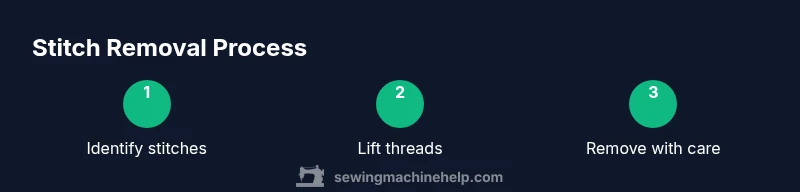
- 1
Identify stitches and position fabric
Inspect the seam to determine which stitches to remove and in what direction to pull. Align the fabric surface and secure with clips to prevent shifting. Start at an accessible end of the seam to create a clean entry point.
Tip: Work from the seam edge inward, not from the fabric center outward. - 2
Lift threads away from fabric
Gently slip the seam ripper under the thread near the fabric surface, lifting it away from the cloth without cutting into the fabric. If needed, use tweezers to hold the thread in place while you lift.
Tip: Keep the blade angled slightly away from the fabric to avoid slicing the fibers. - 3
Cut the thread line carefully
With controlled pressure, cut the exposed thread, taking care not to damage adjacent threads or fabric. Work in small sections rather than trying to remove the entire seam at once.
Tip: Cut only the thread, not the fabric, and stop if the blade touches the fabric. - 4
Remove remaining stitches
Continue lifting and cutting stitch by stitch along the seam, gradually exposing the fabric. Use tweezers to remove tiny threads and ensure the area lies flat as you progress.
Tip: Take breaks if the seam is long to prevent fatigue and mistakes. - 5
Finalize and inspect
After all stitches are removed, inspect the fabric for snags, pulled threads, or distortion. Trim loose ends and prepare the area for restitching or finishing as needed.
Tip: A bright light and a close visual check help reveal missed threads.
Your Questions Answered
When should I remove stitches instead of fixing them in place?
If the seam is crooked, the stitch line is off, or you made a mistake, remove the stitches and restitch. It saves fabric and yields a better finish than trying to fix with a messy pirated seam.
If the seam looks off or wrong, remove it and restitch for a clean result.
What tools work best for removing machine stitches?
A seam ripper is the go-to tool for most seams; small sharp scissors and fine tweezers are helpful for stubborn threads or delicate fabrics. Test on a scrap first.
Use a seam ripper, tiny scissors, and tweezers for tricky threads.
How can I avoid damaging fabric while ripping stitches?
Work slowly, lift threads rather than cutting into fabric, and keep the blade away from the fabric surface. Use a pressing cloth for delicate fabrics and test on scraps before touching the garment.
Go slowly and test on scrap fabric first to protect your material.
What should I do if I encounter delicate fabric or lace?
Protect delicate fabrics by using scrap fabric underneath, going slowly, and possibly using tiny scissors to minimize stress on the fibers. Consider using a seam ripper with a blunt blade for extra control.
Be extra gentle with delicate fabrics and test first.
Can I reuse removed thread for restitching?
It’s generally better to cut new thread for a clean restitch. Reusing cut threads can lead to tangling or uneven tension. Always thread with fresh spool or bobbin material.
It’s best to use new thread for a fresh restitch.
Watch Video
The Essentials
- Plan before you rip to avoid fabric damage
- Use the right tools and test on scraps
- Work in small sections for control
- Inspect and recheck before restitching
- Maintain a clean, well-lit workspace