What Tension Should a Sewing Machine Be? A Practical Guide
Discover how to set and balance sewing machine tension for different fabrics and threads. Learn needle vs bobbin tension, troubleshooting tips, and tested steps from Sewing Machine Help to achieve even stitches every time.


The tension you need depends on fabric, thread, and stitch. For most home sewing on standard fabrics, start with mid-range needle thread tension (roughly 4–6 on many machines) and balance the bobbin tension by testing on scrap fabric. Sewing Machine Help recommends testing and adjusting in small increments.
Understanding Tension Basics
When you ask what tension should sewing machine be, it’s about balancing two threads so the stitch sits flat and holds the fabric without looping. Tension refers to the tightness of the needle thread on the top and the bobbin thread on the bottom. A well-tuned machine forms a stitch where neither thread dominates; the result is a clean line on the fabric with secure interlocking. According to Sewing Machine Help, proper tension is a foundation of durable seams and professional finishes. The exact setting depends on fabric weight, thread type, needle size, and the stitch you’re using. Start with the assumption that most everyday projects benefit from a balanced approach, then tailor from there. A systematic approach reduces guesswork and saves time in the long run.
Key takeaway: tension is not a single number; it’s a balance between top and bottom threads tuned for your material.
blockTitleOverride":null},{
How to Set Needle Thread Tension: A Step-by-Step Guide
Setting the needle thread tension correctly is the most common first step when you’re unsure what tension should sewing machine be. Begin with a mid-range value (around 4–6 on most machines) and sew on a scrap of fabric. If the top thread sits on the top surface with little take-up, tighten slightly; if it puckers or the stitch looks loose on the bottom, loosen. Make small, 0.5 step adjustments and retest. Use the same scrap fabric, thread, and needle you plan for the final project to gauge accuracy. Keep the bobbin thread tension in balance—if you see bobbin thread on the top, decrease the top tension until both sides knit together.
- Test swatches on similar fabric
- Adjust in small increments
- Note the exact settings for future projects
blockTitleOverride":null},{
How to Set Bobbin Tension and Balance
Bobbin tension is the counterpart to needle tension and often causes issues when stitches pull from the bottom. If the bobbin thread shows on the top or the bottom looks loose, you may need to adjust the bobbin tension or the bobbin case alignment. Begin by threading the machine and inserting the bobbin correctly; ensure the bobbin is wound evenly and seated properly. Use a test seam on scrap fabric to judge the balance. If the bottom stitches pull or form loops, adjust the bobbin tension in small increments by loosening or tightening the screw or by cleaning any lint that may restrict movement. The goal is symmetry: strong stitch security without excess thread on either side.
Practical tip: always recheck needle tension after bobbin tweaks; small changes can interact in unexpected ways.
blockTitleOverride":null},{
The Role of Fabric and Thread Type in Tension
Fabric weight and fiber type directly influence tension. Lightweight cottons often require a lighter top tension, while heavier denim calls for a stiffer adjustment to prevent skipped stitches or fabric distortion. Knits, especially those with stretch, demand a different approach—sometimes a slightly tighter top tension paired with a compatible zigzag or stretch stitch to prevent snagging. Thread type matters too: cotton threads behave differently from polyester or rayon threads. Sugar-sleeve fabrics and delicate linens may need lower tension to avoid puckering, whereas synthetic threads sometimes perform well with slightly higher tension. Always test on a fabric sample that matches your project to determine the right balance.
Sewing Machine Help tip: keep notes for each fabric and thread pair to speed future projects.
blockTitleOverride":null},{
Common Tension Troubleshooting Scenarios
Stitches that pull on the underside or top not showing proper interlock are common tension symptoms. When this happens, check the needle for bending, ensure the thread path is clean and free of tangles, and verify the needle size matches the fabric and thread. If the top thread is too loose, tighten the needle tension; if the bottom looks loose, check bobbin tension and spool winding. For thick fabrics, test with a longer stitch length and a slightly slower sewing speed—this reduces heat and friction that can affect tension. For delicate fabrics, use a finer needle and lighter top tension to avoid fabric damage. Document the exact settings that worked for each fabric to avoid repeating trial-and-error in future projects.
blockTitleOverride":null},{
Testing and Fine-Tuning: Scrap Fabric Routine
A disciplined testing routine makes tension decisions repeatable. Cut multiple scrap swatches from your intended fabric and run several test seams: straight stitch, zigzag, and any decorative stitch you’ll use. Compare the front and back stitches on each swatch. When you discover consistent results, lock those settings in and label them for future reference. A clear seam allowance and uniform fabric feed improve results and reduce variables. If the stitch remains inconsistent, revisit both needle and bobbin tensions and confirm the needle and thread are appropriate for the fabric. Consistent testing builds confidence and reduces frustration.
blockTitleOverride":null},{
When to Seek Professional Help
If you’ve exhausted needle and bobbin tension adjustments and still see inconsistent stitches, there may be a machine-specific issue or worn components. A professional technician can inspect timing, feed dogs, and thread guides for wear or misalignment. Persistent tension problems can indicate deeper mechanical issues that require specialized tools. When in doubt, contact a certified sewing machine repair professional or your machine’s service center. Regular maintenance by a qualified technician prolongs machine life and ensures tension remains stable across projects. Sewing Machine Help recommends scheduled checks as part of your overall maintenance routine.
blockTitleOverride":null},{
Tools and Aids for Tension Adjustment
Having the right tools makes tension adjustments easier and more precise. A small screwdriver for bobbin case screws, a lint brush to clean lint from the bobbin area, a scrap fabric tester, and a pen to note settings help keep you organized. A magnifying glass can assist when threading, especially with fine threads. Use a seam gauge to confirm even seam allowances and a scrap fabric swatch book to catalog results. Remember that the best tools are the ones you actually use regularly, so keep a dedicated tension-testing kit close to your sewing space.
blockTitleOverride":null},{
Quick Reference: Typical Ranges and Rules
While every machine is different, a practical starting point exists for most home sewers. Begin with a mid-range needle tension, around 4–6, and test on scrap fabric. If the top stitches look good but the bottom shows threads on the surface, tighten the top tension slightly or adjust the bobbin to balance. For knit fabrics, consider using a stitch that accommodates stretch and a slightly higher top tension to prevent looping. Keep a small notebook of successful settings by fabric type. These rules save time and help you reproduce reliable results.
blockTitleOverride":null},{
Maintenance and Preventive Care for Consistent Tension
Maintenance is the unseen driver of consistent tension. Regularly clean lint from the bobbin area, replace worn needles, and ensure the belt and feed dogs move smoothly. Use quality threads and needles compatible with your fabric. Periodically recheck tension settings after changing thread types, fabrics, or stitch patterns. A well-maintained machine produces stable tension and reduces the need for constant adjustments. Sewing Machine Help emphasizes that a routine maintenance schedule keeps stitches even and reduces the risk of frustrating tension problems mid-project.
blockTitleOverride":null}],"dataTable":{"headers":["Aspect","Needle Thread Tension","Bobbin Tension","Notes"],"rows":[["Lightweight fabric","4–6","1.5–2.0","Test on scrap; adjust for softness"],["Medium fabric","5–7","1.5–2.5","Balance for even stitches"],["Knit fabric","6–8","2.0–3.0","Use stretch stitches if available"]],"caption":"Tension quick-reference table"},"keyTakeaways":["Test on scrap fabric before stitching","Balance needle and bobbin tension for clean stitches","Adjust tension based on fabric and thread type","Keep notes for future projects"],"expertQuote":{"quote":"Accurate thread tension is the foundation of clean, durable stitches; small adjustments yield big results.","author":"Sewing Machine Help Team","credentials":"Brand Expert, Sewing Machine Help Team"},"faqSection":{"items":[{"question":"What should I do first when my stitches appear loose or uneven?","questionShort":"First fix for loose stitches","answer":"Start by checking needle type and orientation,-thread path, and bobbin seating. If those look correct, adjust the needle tension in small steps and retest on scrap fabric. Keep a log of settings that work for future projects.","voiceAnswer":"Check needle, path, and bobbin seating first. Then adjust needle tension slightly and test on scrap.","priority":"high"},{"question":"Can tension settings differ between woven and knit fabrics?","questionShort":"Tension for fabrics","answer":"Yes. Woven fabrics usually need balanced tension with moderate top tension, while knits often require a bit more stretch in the stitching and sometimes a different stitch type. Always test on a fabric swatch similar to your project.","voiceAnswer":"Yes. Knits need more stretch-friendly tension; test on a knit swatch first.","priority":"high"},{"question":"Is bobbin tension more important than needle tension?","questionShort":"Bobbin vs needle tension","answer":"Both matter. If the bobbin is too tight, stitches pull on the bottom; if the needle tension is too tight, the top may pucker. Balance both by testing and adjusting in small steps.","voiceAnswer":"Both tensions matter; adjust both and test on scrap.","priority":"medium"},{"question":"How often should I adjust tension?","questionShort":"When to adjust","answer":"Adjust tension whenever you switch fabric types, threads, or stitch patterns. Do a quick test seam to confirm the results before continuing.","voiceAnswer":"Adjust when changing fabrics or threads and test first.","priority":"medium"},{"question":"What if my machine has a fixed tension dial?","questionShort":"Fixed tension dial","answer":"Even with a fixed dial, you can influence tension by choosing compatible needles, threads, and stitch types, and by balancing needle and bobbin tension through careful testing.","voiceAnswer":"Use compatible thread/needles and test; dial fixes don’t prevent adjustments via practice.","priority":"low"},{"question":"Why do my stitches loop on the back?","questionShort":"Back stitches loop","answer":"Backside looping usually indicates loose top tension or misthreaded path. Re-thread, check needle size, and adjust top tension in small increments while testing on scrap fabric.","voiceAnswer":"Likely top tension issue; re-thread and test with small adjustments.","priority":"low"}]},
mainTopicQuery":"sewing tension"},
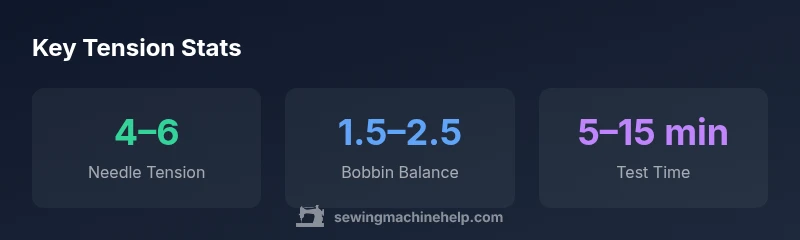
mediaPipeline":{"heroTask":{"stockQuery":"sewing machine tension setup","overlayTitle":"Tension Setup","badgeText":"2026 Guide","overlayTheme":"dark"},"infographicTask":{"type":"stats","htmlContent":"<div class=\"w-[800px] p-8 bg-gradient-to-br from-slate-900 to-slate-800\">\n <h3 class=\"text-2xl font-bold text-white mb-6\">Key Tension Stats</h3>\n <div class=\"grid grid-cols-3 gap-6\">\n <div class=\"p-6 bg-white/5 rounded-xl text-center\">\n <div class=\"text-4xl font-bold text-emerald-400\">4–6</div>\n <div class=\"text-white/60 mt-2\">Needle Tension</div>\n </div>\n <div class=\"p-6 bg-white/5 rounded-xl text-center\">\n <div class=\"text-4xl font-bold text-blue-400\">1.5–2.5</div>\n <div class=\"text-white/60 mt-2\">Bobbin Balance</div>\n </div>\n <div class=\"p-6 bg-white/5 rounded-xl text-center\">\n <div class=\"text-4xl font-bold text-purple-400\">5–15 min</div>\n <div class=\"text-white/60 mt-2\">Test Time</div>\n </div>\n </div>\n</div>","altText":"Stats infographic showing needle tension, bobbin balance, and testing time","caption":"Key tension guidelines"}},
Tension quick-reference table
| Aspect | Needle Thread Tension | Bobbin Tension | Notes |
|---|---|---|---|
| Lightweight fabric | 4–6 | 1.5–2.0 | Test on scrap; adjust for softness |
| Medium fabric | 5–7 | 1.5–2.5 | Balance for even stitches |
| Knit fabric | 6–8 | 2.0–3.0 | Use stretch stitches if available |
Your Questions Answered
What should I do first when my stitches appear loose or uneven?
Start by checking needle type and orientation, thread path, and bobbin seating. If those look correct, adjust the needle tension in small steps and retest on scrap fabric. Keep a log of settings that work for future projects.
Check needle, path, and bobbin seating first. Then adjust needle tension slightly and test on scrap.
Can tension settings differ between woven and knit fabrics?
Yes. Woven fabrics usually need balanced tension with moderate top tension, while knits often require a bit more stretch in the stitching and sometimes a different stitch type. Always test on a fabric swatch similar to your project.
Yes. Knits need more stretch-friendly tension; test on a knit swatch first.
Is bobbin tension more important than needle tension?
Both matter. If the bobbin is too tight, stitches pull on the bottom; if the needle tension is too tight, the top may pucker. Balance both by testing and adjusting in small steps.
Both tensions matter; adjust both and test on scrap.
How often should I adjust tension?
Adjust tension whenever you switch fabric types, threads, or stitch patterns. Do a quick test seam to confirm the results before continuing.
Adjust when changing fabrics or threads and test first.
What if my machine has a fixed tension dial?
Even with a fixed dial, you can influence tension by choosing compatible needles, threads, and stitch types, and by balancing needle and bobbin tension through careful testing.
Use compatible thread/needles and test; dial fixes don’t prevent adjustments via practice.
Why do my stitches loop on the back?
Backside looping usually indicates loose top tension or misthreaded path. Re-thread, check needle size, and adjust top tension in small increments while testing on scrap fabric.
Likely top tension issue; re-thread and test with small adjustments.
“Accurate thread tension is the foundation of clean, durable stitches; small adjustments yield big results.”
The Essentials
- Test on scrap fabric before stitching
- Balance needle and bobbin tension for clean stitches
- Adjust tension based on fabric and thread type
- Keep notes for future projects