When to Adjust Tension on a Sewing Machine: Practical Guide
A comprehensive, step-by-step guide for home sewists on when to adjust tension on a sewing machine, how to test, and common fixes for top and bobbin tension. Includes safe testing tips, troubleshooting flow, and expert insights from Sewing Machine Help.


In stitching, the right balance between the upper thread and the bobbin is essential. The quick answer to when to adjust tension on a sewing machine is: test on scrap fabric, inspect the stitch on both sides, and adjust the upper thread tension first, then verify bobbin tension if needed. Start with small changes and re-test on a similar fabric. This approach helps you avoid guessing and protects your garment as you learn.
Understanding tension basics
Tension in a sewing machine is the balance between the upper thread and the bobbin thread as they meet the fabric. When to adjust tension on sewing machine is a common question for home sewists, especially after changing fabric weight, thread type, or needle size. In simplest terms, the upper thread should pull smoothly with the bobbin so the stitch sits evenly on both sides of the fabric. If you see loops on the top or bottom, it’s a signal that the tension is off and needs adjustment. According to Sewing Machine Help, most tension issues arise from threading paths, incompatible thread types, or a mismatched bobbin, rather than a single faulty part. Sewing Machine Help Analysis, 2026 emphasizes starting with the basics: verify correct threading, choose the right needle for the fabric, and work with a scrap sample before committing to your project. This foundation helps you approach tension changes with confidence and reduces trial-and-error frustration.
To get the mechanics right, know that tension is controlled by several interacting parts: the presser foot height, thread path through the take-up lever, the discs that regulate upper thread, and the bobbin case. Changes to one area can affect others, so small, incremental adjustments usually yield the best results. Keep your fabric choice consistent for testing, and note the results so you can reproduce successful settings later. This mindset makes tension adjustments less mysterious and more repeatable, especially for beginners who are learning how different fabrics respond to stitch length and needle type.
Signs your upper thread tension is off
If your upper thread tension is off, you’ll notice stitches that look good on the bottom but show loose loops on the top, or vice versa. On woven fabrics, a top-thread loop indicates the upper tension is too loose, while a too-tight upper tension can cause the top thread to break or form a small ridge along the seam. On knits, you may see the opposite effect because knit fabrics compress differently and require a slightly looser upper tension to allow the fabric to feed without puckering. Look for signs such as thread fraying on the fabric surface, a stitched line that appears uneven or wavy, and punched holes where the needle seemed to fight the thread. If you see these cues, it’s time to reassess the upper thread tension. Remember to re-test after any adjustment and compare the test result to your target fabric texture. The goal is stitches that lie flat on the surface with balanced tension on both sides of the fabric, not a fan of loose or tight loops. The guidance here helps you translate symptoms into a specific adjustment rather than guessing.
Signs your bobbin tension is off
Bobbin tension directly affects the balance of the stitch from the underside of your fabric. If your bobbin tension is too tight, you may see tight, dense stitches on the bottom with little or no thread showing on the top; the fabric can even pucker. If it’s too loose, you’ll get loose bottom stitches that pull to the top, or horizontal loops on the underside. The most reliable way to diagnose bobbin tension is to sew a straight line on a scrap sample and carefully observe the underside. When the bobbin is the culprit, changing the upper thread tension alone won’t fix the issue. In many cases, re-winding or re-inserting the bobbin, ensuring it spins in the correct direction, and confirming the bobbin case is properly seated will resolve the problem. After any bobbin adjustment, re-test on the same fabric and verify that both sides of the seam are balanced. It’s important to remember that bobbin tension is machine-specific; what works on one model may differ on another, so always test after any change.
How fabric type affects tension
Fabric type heavily influences how you approach tension. A lightweight cotton or dress-weight fabric behaves differently from heavy denim or canvas. For woven fabrics, a slightly tighter upper tension can help achieve a clean line, but you don’t want to over-tighten to the point of thread damage. For knits, you typically want a looser upper tension and a slower feed rate to allow the fabric to stretch naturally without creating abnormal loops. When testing, use scraps that match the fabric weight and fiber content of your project. If you’re switching from a delicate fabric to a thick material, anticipate a period of readjustment; the tension dial should be changed gradually and tested on similar scraps. Always recheck thread path after any fabric switch to prevent threading errors from masquerading as tension problems. Sewing Machine Help’s guidance notes that fabric versatility often requires a strategic set of tension adjustments rather than a single universal setting.
Practical tests you can perform at home
Here are pragmatic, repeatable tests you can perform at home to determine when to adjust tension on sewing machine. Start with a fresh needle and a scrap fabric that matches your project. Step 1: Re-thread the upper path and wind a fresh bobbin, ensuring the bobbin is seated correctly. Step 2: Sew a straight stitch on scrap fabric and examine both sides for balance. Step 3: If top stitches appear loose, tighten the upper tension by small increments (one notch at a time) and re-test. Step 4: If bottom stitches are loose or show looped threads, re-check the bobbin tension by adjusting the bobbin case tension slightly and test again. Step 5: Repeat the process with a fabric that is close to your final project to ensure the settings hold under real conditions. The iterative testing process is essential for building reliable, repeatable results. Remember to document the settings that produce optimal stitches for future projects, so you don’t have to re-derive them from scratch each time.
Sewing Machine Help emphasizes relying on hands-on testing and fabric-specific adjustments rather than chasing a generic setting. The practice reduces risk and builds confidence for future tension challenges.
Common mistakes and how to avoid them
A frequent pitfall is assuming that tension problems come from a single part. In reality, threads, needle, and fabric all influence tension, so changing one factor without re-testing can lead to confusion. Common mistakes include misthreading through the take-up lever, using an inappropriate needle size for the fabric, winding a bobbin incorrectly, or sewing with old or lint-filled tensions discs. To avoid these errors, always re-thread after a change, use the recommended needle size for your fabric, and clean the tension discs regularly. When tension feels off, start with the smallest possible adjustment and test on scraps before proceeding to a full project. Documentation of successful settings helps prevent repeating mistakes across different projects. Keeping your machine well-maintained and clean ensures the tension discs move smoothly and respond predictably to adjustments. Following these practices will make tension issues less intimidating and more manageable over time.
Diagnostic flow: a quick reference for troubleshooting
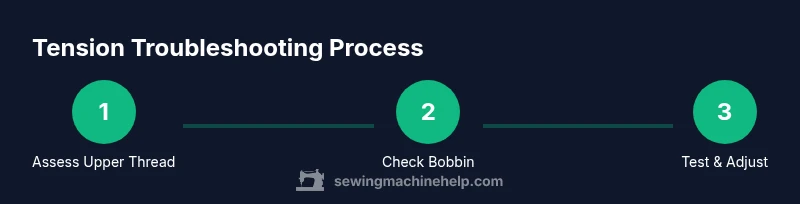
If you’re unsure whether tension needs adjustment, follow this quick diagnostic pattern. Start by testing on scrap fabric with the needle and thread type you plan to use. If the top looks good but the bottom shows issues, check bobbin tension and seating. If the bottom looks good but the top isn’t balanced, adjust the upper tension slightly and re-test. If neither side is balanced after a couple of adjustments, revisit threading, needle size, and fabric selection. If you continue to see errors, consult the machine’s manual for model-specific guidance and consider professional service for deeper issues. According to Sewing Machine Help, most home tension problems respond well to systematic testing, careful re-threading, and modest dial changes rather than drastic, single-swing adjustments. Based on Sewing Machine Help Analysis, 2026, your best strategy is to document what works for each fabric type and stitch you use, so you can reproduce success with confidence.
Tools & Materials
- Owner's manual for your sewing machine(Consult model-specific guidance for tension adjustments)
- All-purpose sewing thread (matching project color)(Used for testing and final stitching)
- Fresh bobbins wound with matching thread(Ensure proper winding direction and tension)
- Scrap fabric samples (woven and knit)(Used for testing fabric behavior)
- Needle appropriate for fabric (e.g., size 70/10 for lightweight, 90/14 for denim)(Avoid mismatched needle causing tension misreads)
- Small screwdriver (as provided by manufacturer)(Needed only for machines with exposed tension adjustments)
- Lint brush or can of compressed air(Keep tension discs clean to avoid sticky operation)
Steps
Estimated time: 60-90 minutes
- 1
Re-thread the upper path
Power off the machine and remove the needle. Rethread the upper thread path step by step, ensuring the thread seats properly in the take-up lever and through all thread guides. This resolves many mis-threading issues that masquerade as tension problems.
Tip: Watch the thread as it passes through each guide to ensure it sits in the groove and doesn’t slip out. - 2
Check the bobbin winding
Remove the bobbin and unwind a small length of thread. Rewind the bobbin smoothly, ensuring even wind and correct direction. Insert the bobbin back into its case with the correct orientation.
Tip: A poorly wound bobbin or incorrect orientation is a common cause of bottom-thread issues. - 3
Test upper tension on scrap
With the needle and presser foot in place, sew a straight stitch on scrap fabric. Observe whether the top thread pulls evenly and whether the bottom stitches pull to the top or bottom. If you see top loop loops, the upper tension is likely too loose or the thread path is not seated.
Tip: Make only small upper-tension adjustments (one click or one dial notch) at a time. - 4
Test bottom tension with scrap
Sew another straight stitch on scrap and examine the bottom. If there are loops on the underside, the bobbin tension is too loose; tighten slightly by adjusting the bobbin tension or repositioning the bobbin case as per your manual.
Tip: Always test on the same fabric type to maintain consistency in results. - 5
Adjust for fabric type
If you switch from a light to a heavier fabric, you may need to adjust both tensions and potentially the needle size. Start with the upper tension, then verify balance on a scrap of the new fabric.
Tip: Heavy fabrics often require a longer stitch length and more stable feed to prevent fabric gathering. - 6
Document your settings
Record the settings that produced balanced stitches on your common fabrics. This makes it easier to reproduce successful results on future projects without re-testing from scratch.
Tip: Keep a small notebook or digital note for each fabric type and thread weight. - 7
Re-test on project fabric
Before you sew your final piece, test on a fabric sample that mirrors your project. Confirm the stitch balance on both sides and adjust if necessary.
Tip: If you’re between two settings, choose the one that gives you the most even bottom stitches and the neatest top surface. - 8
Return to baseline if needed
If a project needs multiple fabrics or threads, consider returning to a baseline tension after finishing a fabric series. This avoids large, cumulative changes which can distort future stitches.
Tip: Periodic resets reduce long-term drift in tension behavior.
Your Questions Answered
How can I tell if my tension is off?
Look for top stitches that pull to one side or form loops on the opposite side. Uneven stitches on both sides, fabric puckering, or thread fraying are common signs of tension imbalance. Test with scrap fabric and adjust gradually until both sides look balanced.
Top loops or bottom puckering are signs your tension might be off. Test on scrap fabric and adjust gradually until both sides look balanced.
Can fabric type affect tension more than the needle?
Yes. Lightweight fabrics behave differently from heavy fabrics. Knits require a looser upper tension and sometimes a different needle. Always match needle size and type to fabric, and re-test on scraps when you switch fabrics.
Fabric type often dictates tension more than needle alone. Match needle to fabric and re-test on scraps.
Should I adjust tension if the stitches look good on top but not on the bottom?
Yes. If the top looks balanced but the bottom shows looseness or loops, check the bobbin tension and seating first, then adjust the bobbin path if needed.
If the top is fine but the bottom isn’t, focus on the bobbin tension and seating.
Is bobbin tension adjustable on all machines?
Most machines allow some adjustment to bobbin tension, but the method varies by model. Consult your manual and make small adjustments, testing with scrap fabric after each change.
Bobbin tension adjustments vary by model. Check your manual and test with scraps after small changes.
How often should I test tension when starting a new project?
Test at the start of a new project, especially when changing fabric weight, fiber content, or thread. Re-test after any change to confirm balance before stitching final seams.
Test tension at project start and after any change to fabric or thread.
Watch Video
The Essentials
- Test on scrap fabric before changing settings
- Balance upper and bobbin tension through small adjustments
- Different fabrics require different tension and needles
- Document proven settings for future projects