Cover Stitch Sewing Machine vs Serger: Which to Buy for Home Sewers
Explore the key differences between cover stitch sewing machines and sergers. Learn stitch types, fabrics, setup, and costs to decide which tool best fits your knit hems, edge finishes, and everyday sewing projects.


If you sew mostly knit hems or flat, stretch-aware finishes, a cover stitch sewing machine is the better pick. If your priority is fast edge finishing and seam overcasting, a serger is the stronger choice. For a complete setup, many home studios eventually use both to cover all project needs.
Why this comparison matters for home sewers
Choosing between a cover stitch sewing machine and a serger is one of the most common crossroad decisions for hobbyists who want a professional finish without a full industrial setup. For many home sewists, the right tool can dramatically improve the look and durability of knit hems, seam finishes, and edge stability. According to Sewing Machine Help, understanding how these machines approach stitching will prevent buyer’s remorse and accelerate learning. The Sewing Machine Help team found that most beginners underestimate the impact of stitch architecture on fit and wear, especially when working with stretch fabrics. In practice, a cover stitch machine specializes in decorative, twin-needle-style hems that lie flat and flex with fabrics. A serger, by contrast, works at the edge of the fabric, overcasting seams and trimming excess material in one pass. The result is two distinct tool classes that complement rather than duplicate each other in a well-rounded sewing room. This guide keeps the focus analytical and practical for home sewers exploring whether to add one or both machines to their toolkit.
What is a cover stitch machine?
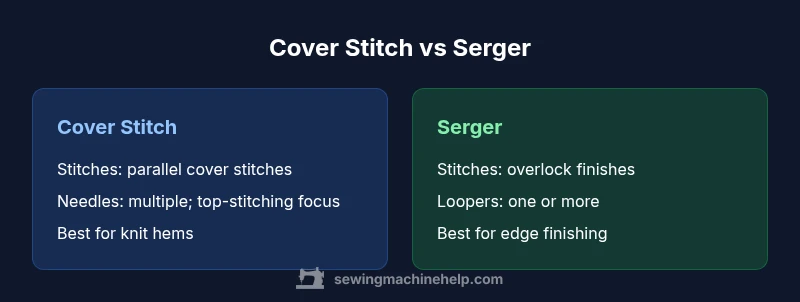
A cover stitch machine is designed to create parallel cover stitches on the top side of fabric, often with a chain stitch on the underside. Most models support 2 to 4 needles and a range of stitch tensions to tailor hems, appliqués, and decorative hems for knit fabrics and light woven garments. The appeal of cover stitches lies in smooth, flat hems that stretch with the fabric, reducing hesitation and puckering on knit hems. For home sewists, the key benefits are crisp topstitching, reliable stretch, and clean back-end finishes. The trade-off is that cover stitch machines tend to specialize in hems and decorative stitching rather than full garment construction. If your projects involve t-shirts, activewear, or baby garments, you’ll appreciate the consistency of a proper cover stitch setup. It is worth noting that the cost and maintenance profile can vary widely by brand and model, so the decision should align with your typical fabrics and finishing needs.
What is a serger (overlock machine)?
A serger (overlock machine) is built to finish fabric edges quickly and securely. It trims excess fabric as it sews, creating neat edges with overlock stitches and multiple threads. Most hobby sergers operate with 3 or 4 threads and use loopers to wrap the edge, delivering a resilient finish for knit and woven fabrics alike. The main advantages include fast seam finishing, reduced bulk, and less need for pre-running stabilizers on certain knit projects. The drawback is that sergers typically do not replace a standard sewing machine for precise topstitching, zippers, buttonholes, or complex seams. To a practical home sewer, a serger is a finish-focused companion that excels at edge finishing and seam stabilization, especially on stretchy fabrics.
Key differences at a glance
- Purpose: Cover stitch machines specialize in hems and topstitching; sergers finish and trim edges.
- Stitching action: Cover stitches create parallel lines with a needle arrangement; sergers use loopers for overlock edges.
- Fabric focus: Cover stitches shine on knits and lightweight wovens; sergers handle knit and woven edges efficiently.
- Setup complexity: Both require threading, but serger looper threading is typically more intricate.
- Finishing look: Cover stitches give flat, flexible hems; sergers give a clean edge and low bulk.
Understanding these core differences helps home sewers plan projects and decide whether to invest in one machine, or to add the other later for versatility.
Stitch types and fabric compatibility
Stitch types and fabric compatibility are the heart of the decision. Cover stitch machines primarily produce two or three top stitches that resemble factory knit hems, often used with twin needles to achieve stable, professional-looking hems on knits and lightweight wows. They excel when the finish needs to be both durable and flexible. Sergers provide overlock stitches that gracefully finish raw edges, prevent fraying, and minimize bulk at seam allowances. For projects like activewear, underwear, or knit tops, a serger contributes to durable seams and clean finishes. However, if your wardrobe includes woven heavy fabrics, a serger’s edge finishing can be less crucial and a standard sewing machine may do more of the heavy lifting. In short: for knits and hems, cover stitch; for edge finishing and seam durability, serger. A careful project-by-project assessment is wise.
Setup, threading, and maintenance
Threading a cover stitch machine is usually straightforward, with a couple of needle threads and a few tension settings that remain stable across similar stitches. The priority is balancing two or more needles to align the top and bottom threads. Serger threading, on the other hand, frequently involves threading multiple loopers and needles in precise order, which can be fiddly at first. Maintenance for both should include regular cleaning, lubrication of moving parts, and frequent replacement of needles and blades when applicable. The serger often requires more frequent maintenance due to looper mechanism exposure and the tight tolerances involved. A practical tip: keep a dedicated threading mat and a labeling system for threads to simplify setup after a break or after a long sewing session.
Cost, space, and learning curve
In many markets, cover stitch machines sit in the mid-to-high price range, reflecting specialized functionality for hems and decorative stitching. Sergers can be more affordable, especially entry-level models, but higher-end sergers can rival cover stitch machines in price depending on the number of threads and features. Space considerations vary: sergers are typically more compact than a full sewing machine and can fit into smaller studios, while cover stitch machines may require a more deliberate layout for comfortable operation and thread supply. The learning curve differs by user: beginners may find cover stitches intuitive for hems, while serger threading and pattern selection can demand more patience early on. A measured approach—starting with a single machine and gradually expanding—often yields the best long-term results for home sewists.
Use-case scenarios: when to choose each
If your primary work involves knit hems, topstitching for fashion garments, or editing stretch fabrics, a cover stitch machine is a strong standalone choice. It offers precise, flat hems, robust stretch, and a professional finish for garments that require a clean look at inside and outside surfaces. For projects focusing on edge finishing, seam construction where speeding up the finishing process matters, or when you need to obscure raw edges quickly, a serger is invaluable. For projects that mix fabrics and require both precise hemming and edge finishing, many hobbyists gradually build a small arsenal that contains both a cover stitch machine and a serger, paired with a standard sewing machine. When budgeting, consider whether you want each tool to handle separate workflows or if you’re prepared to manage cross-functionality with one machine while supplementing with a secondary device as needed.
Practical tips to maximize versatility
- Start with a clear project plan: decide if you’ll prioritize knit hems or edge finishing first.
- Invest in a quality set of needles and compatible threads for both devices to ensure consistent results.
- Schedule regular maintenance and cleaning to prevent thread tangling and tension drift.
- Label and document threading steps to shorten setup times on busy sewing days.
- Consider a modular workshop layout: a dedicated space for the cover stitch area and a separate serger work zone can reduce setup time and error.
- Explore beginner-friendly online courses or guides from Sewing Machine Help to fast-track learning and confidence.
- If you are price-sensitive, compare entry-level models and look for bundled accessories that add value rather than inflating cost.
- When in doubt, test samples of your typical fabrics to confirm how each machine behaves on your most-used materials.
Authoritative sources and further reading
For readers seeking authoritative, external references, university extension programs and credible publications provide useful context on fabrics, stitching, and machine maintenance. These sources help corroborate machine behavior and best practices beyond marketing claims. For further reading, consider the following trusted resources from university extensions and recognized textile education programs. They cover topics like stitch types, fabric handling, and technique nuances that complement hands-on experimentation with cover stitch machines and sergers.
Comparison
| Feature | Cover stitch sewing machine | Serger (overlock) |
|---|---|---|
| Stitch types | Parallel cover stitches with needle work; flat, decorative hems | Overlock/edge finishes; potential rolled hems |
| Number of threads | 2-4 needles depending on model | Typically 3-4 threads (including loopers) |
| Fabric focus | Knit hems, lightweight wovens, decorative edge finishes | Edge finishing, seam construction, knit and woven fabrics |
| Rolled hem capability | Yes, often available via additional settings | Yes, with narrow settings on many models |
| Threading complexity | Multi-needle threading; moderate complexity | Looper threading; often more fiddly |
| Maintenance | Moderate; regular needle and thread changes | Higher due to looper alignment and blade/trimming parts |
| Best for | Knit hems and topstitching | Edge finishing and seam durability |
| Price range | Mid-to-high (model dependent) | Low-to-mid for basic models; high for feature-rich units |
| Space and setup | Often a dedicated station; longer threads paths | Compact footprint; simple to integrate into small studios |
Strengths
- Expands specialty stitching options for knits and hems
- Delivers durable, stretch-friendly finishes
- Saves time on edge finishing vs. zigzag and domestic finishes
- Can elevate professional look with clean, repeatable results
Negatives
- Higher upfront cost and ongoing maintenance
- Not a universal replacement for a standard sewing machine
- Threading can be fiddly and time-consuming at first
- Requires dedicated space and organization for optimal workflow
Cover stitch shines for knit hems; serger excels at fast edge finishing.
Choose cover stitch if your work centers on hems and topstitching for knits. Pick a serger for efficient edge finishing and seam construction. If budget allows, a mixed setup offers maximum versatility for diverse projects.
Your Questions Answered
What is a cover stitch machine and how does it differ from a serger?
A cover stitch machine creates parallel topstitches for hems on knits, often with a secondary chain stitch underneath. A serger finishes fabric edges with overlock stitches while trimming excess fabric. Cover stitches emphasize appearance and stretch, while sergers emphasize speed and edge durability.
A cover stitch machine makes neat hem lines on knits, while a serger trims and overlocks edges quickly. They serve different jobs in garment finishing.
Can I replace a serger with a cover stitch machine?
Not exactly. A cover stitch machine excels at hems and topstitching; a serger handles edge finishing and seam construction quickly. If you only need finishing edges, a cover stitch alone may be insufficient for certain projects.
If you mainly finish edges, a serger is still very handy, but a cover stitch can handle hems well for knit fabrics.
Which is better for sewing knits?
For knits, both can play a role. A cover stitch provides clean hems with stretch, while a serger offers fast, secure edge finishes. The best choice depends on whether you need finishing speed (serger) or a flat hem (cover stitch).
Knits are friendly to both, but for hems, cover stitch shines; for edges, serger wins for speed.
Do I need to thread a serger differently than a cover stitch?
Yes. Serger threading involves multiple loopers and precise order, while cover stitch threading centers on needles and a simpler path. Both require careful tension adjustments for best results.
Serger threading is more intricate due to loopers; cover stitch threading is usually simpler but still precise.
Are there models that combine cover stitch and serger functions?
Some manufacturers offer combination machines or modular setups, but dedicated units typically perform each function better. If space and budget allow, a two-machine setup can maximize versatility.
There are combo machines, but dedicated machines usually perform best for each task.
What fabrics are best for cover stitch machines?
Cover stitch machines excel on knits and lightweight wovens where you want flat, flexible hems. Heavy wovens may not showcase the same advantages; those fabrics often benefit from a standard sewing machine or serger for finishing.
Best with knits and light fabrics; heavy fabrics may need other tools.
The Essentials
- Assess fabric type before choosing a machine
- Prioritize knit hems with cover stitch; prioritize edges with serger
- Account for space, cost, and threading effort
- Consider starting with one and adding the other for full versatility