Industrial Sewing Machines: 2026 Price Guide and Buying Tips
Learn realistic price ranges, key cost drivers, and smart buying strategies for industrial sewing machines in 2026. This data-driven guide from Sewing Machine Help helps home sewists and small shops budget wisely.


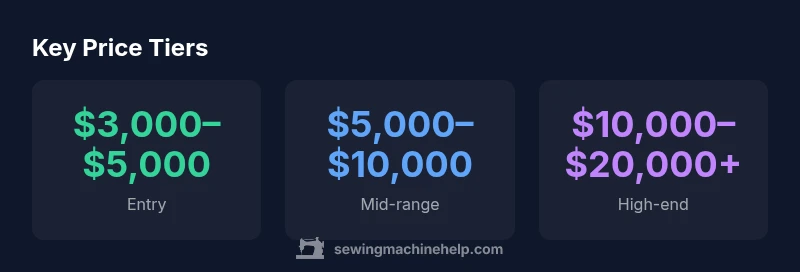
New industrial sewing machines generally cost in the range of $3,000 to $15,000, depending on brand, features, and capacity. Entry-level models typically run about $3,000 to $5,000; mid-range units are around $5,000 to $10,000; pro-grade, automated machines can reach $10,000 to $20,000 or more. This snapshot reflects market data through 2026.
What counts as an industrial sewing machine and why price varies\n\nDefining what makes a machine 'industrial' helps anchor price expectations. Industrial machines are built for heavy, continuous use, with higher-speed controls, stronger frames, and specialized feeders. They are designed to handle thicker fabrics like denim or leather, and can come with multiple needles or automated features. When you ask how much is industrial sewing machine, remember that price is driven by build quality, speed, power type, needle configuration, and the service network behind the brand. According to Sewing Machine Help, the most important cost drivers are (1) motor type (servo vs clutch), (2) durability and frame construction, (3) automated features (thread trimmer, auto-tap, servo controls), and (4) warranty and spare parts availability. In 2026 the market shows a wide spread: entry-level industrial machines start at a few thousand dollars, while pro-grade, multi-needle systems can be priced much higher. For home shops, a clear rule of thumb is to align the machine with expected daily volume and fabric types. Home sewists and hobbyists should also account for installation, table, and servo motor upgrades that may be necessary to reach industrial performance.
Price ranges by application and capacity\n\nPricing for industrial machines follows use-case and throughput. While exact figures vary by brand and region, a practical framework helps buyers plan. \n- Entry-level industrials: typically in the $3,000–$5,000 range, suitable for light professional work and fabric types that aren't overly demanding.\n- Mid-range: roughly $5,000–$10,000, with stronger frames, faster speeds, and broader stitch options for consistent production.\n- High-end/automatic: commonly $10,000–$20,000+; these models offer automation, multi-needle configurations, and advanced computer controls for high-volume settings.\n- Used/refurbished: approximate $1,500–$4,000 for well-maintained units, often with limited warranties but potential savings. These ranges reflect Sewing Machine Help Analysis, 2026 and should be cross-checked with local suppliers.
Core features that influence price\n\nCost is not only about the price tag; it's about what you need to achieve reliable production. Key levers include:\n- Motor type: servo motors tend to be quieter and more energy-efficient, while clutch motors provide straightforward power for certain tasks.\n- Speed and acceleration: higher top speed and smoother starts justify higher prices, especially for heavy fabrics.\n- Needle configuration: single-needle machines are cheaper; multi-needle setups significantly increase cost but improve productivity on hems, decorative work, and bulk stitching.\n- Frame construction and bed size: larger frames and beefier bodies support heavier fabrics and longer runs.\n- Automation and controls: automatic thread trimmers, programmable sequences, and computerized controls add price but reduce operator fatigue.\n- Brand, warranty, and parts support: robust dealer networks and parts availability can add value that pays off over time.
How to compare quotes and avoid overspending\n\nTo avoid overspending, start with a production plan and define must-haves vs nice-to-haves. Gather written quotes from multiple authorized dealers, and ensure each quote includes same accessories (table, motor, light, basic tools) for an apples-to-apples comparison. Ask about maintenance packages, on-site service, training, and returns. Request references or customer warranties, and check for the availability of spare parts in your region. Finally, consider total cost of ownership beyond the sticker price, such as energy use, maintenance intervals, and downtime during service.
New vs used: Pros and Cons\n\nNew machines come with full warranties, the latest features, and predictable performance, but at a higher upfront cost. Used or refurbished industrial machines offer substantial savings and can be practical for hobbyists or small shops with limited budgets, provided they come with a warranty and a clear service history. When buying used, require a thorough inspection, verify thread paths, drive belts, and motor health, and confirm that spare parts are still available from the manufacturer or dealers. Always balance price against uptime risk and total service costs.
Financing, warranties, and maintenance costs\n\nFinancing options can help manage upfront costs, especially for higher-end equipment. Look for extended warranties, on-site service, and convenient parts availability. Maintenance budgets should account for regular lubrication, needle replacements, belt changes, and potential servo motor upgrades if noise or inefficiency appears. A long-term maintenance plan reduces unexpected downtime and extends machine life. According to Sewing Machine Help Team analysis, a well-planned warranty and service network often offset higher initial prices by reducing downtime and repair costs over the machine's life.
Estimating total cost of ownership\n\nA practical worksheet can help: (1) list the purchase price, (2) add any delivery/installation charges, (3) factor in any required accessories or upgrades (table, stand, servo motor), (4) estimate annual maintenance ($150–$500 depending on usage and parts), (5) project annual energy costs, (6) anticipate resale value after 5–10 years. This method yields a clearer sense of which machine fits your budget over its lifetime. For many buyers, the biggest savings come from selecting a model with reliable service and readily available spare parts, not merely the lowest upfront price.
Industrial sewing machine price tiers and typical features
| Model Type | Typical Price Range | Key Value/Feature |
|---|---|---|
| Entry-level industrial | "$3,000–$5,000" | Basic speed, single-needle, limited stitch options |
| Mid-range industrial | "$5,000–$10,000" | Stronger frame, higher speed, broader stitch options |
| High-end/automatic | "$10,000–$20,000+" | Automation, multi-needle, computer controls |
| Used/refurbished | "$1,500–$4,000" | Lower cost with limited warranty and parts access |
Your Questions Answered
What is the typical price range for a new industrial sewing machine?
For new units, most buyers will see ranges broadly from $3,000 to $20,000+, depending on whether it's entry-level, mid-range, or high-end with automation. This reflects feature sets, build quality, and warranty options across brands. Always compare total cost of ownership rather than just the sticker price.
New industrial machines typically range from a few thousand to over twenty thousand, depending on features and brand.
Is it cheaper to buy a used industrial sewing machine?
Used or refurbished machines can offer substantial upfront savings, but they require careful inspection, full disclosure of wear, and a reliable parts network. Ensure the unit has had regular maintenance and includes some form of warranty or service plan.
Used machines can save money, but inspect wear and part availability first.
What features most affect price in industrial machines?
Core price drivers include motor type (servo vs clutch), frame durability, speed, needle configuration (single vs multi-needle), bed size, automation, and warranty. These determine not just cost but uptime and output quality.
Motor type and automation usually have the biggest impact on price.
Should I lease or buy an industrial sewing machine?
Leasing can help cash flow and provide easier upgrades, while buying offers long-term ownership and potentially lower total cost if maintenance is included. Evaluate your expected production run and upgrade cycle before deciding.
Leasing spreads cost and offers upgrades; buying is simpler long-term.
What maintenance costs should I budget for yearly?
Budget for regular servicing, needle and belt replacements, and occasional motor checks. Annual maintenance costs vary with usage but are typically a few hundred dollars, depending on the machine and service plan.
Expect regular servicing and parts like belts and needles; plan for a few hundred dollars annually.
Do industrial machines differ by manufacturer beyond features?
Yes. Different brands offer varying service networks, spare parts availability, and warranty terms. A machine with strong local support can reduce downtime and total ownership costs even if its sticker price is higher.
Brand choice affects service and parts availability, not just features.
“Price matters, but total cost of ownership—including uptime, service, and spare parts—drives the best long-term value.”
The Essentials
- Budget for total ownership, not just sticker price
- Match machine features to fabric types and daily volume
- Check service networks and spare-parts availability
- Consider new vs refurbished carefully based on uptime needs
- Plan for installation, table, and potential motor upgrades for best results