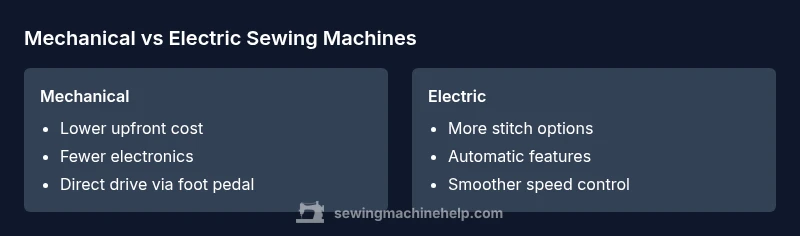
Mechanical vs Electric Sewing Machines: A Practical Comparison for Home Sewists
Explore a data-driven comparison of mechanical vs electric sewing machines for home sewers. Learn key differences, maintenance needs, and how to choose the best option for your projects.


For many home sewists, mechanical sewing machines offer reliable, budget-friendly operation with a straightforward learning curve, while electric models unlock a broader feature set, smoother speed control, and automation. The best choice depends on your projects, budget, and how much you value versatility. If you’re starting out, consider a mechanical model for simplicity; if you plan to tackle varied fabrics or decorative stitching, an electric machine adds powerful options.
Overview: mechanical vs electric sewing machines
When beginners first encounter the term mechanical vs electric sewing machine, they often wonder which type will best support their learning and projects. In simple terms, a mechanical sewing machine relies on gears, cams, and a hand- or foot-operated mechanism with minimal electronics. An electric sewing machine uses a motor, electronic controls, and often a more extensive feature set. For home sewers, the choice shapes everything from how fast you sew to how many stitches you can access without swapping parts. The Sewing Machine Help team emphasizes that there is no universal winner; it depends on your goals, budget, and how you like to work. If you are just starting, a mechanical model tends to emphasize reliability and straightforward operation. If you plan to sew diverse fabrics, use decorative stitches, or automate tasks, an electric machine can expand your capabilities. Also consider compatibility with accessories such as walking feet, needle sets, and foot-pedal ergonomics. The cost gap between the two categories can be a deciding factor for many hobbyists, especially when you factor in long-term maintenance and the learning curve associated with each type. In this article we compare the two in depth to help you choose a mechanical vs electric sewing machine that fits you.
Key design differences: how they work
The underlying differences between mechanical and electric sewing machines start with the drive system. A mechanical machine typically uses a belt or direct drive linked to a hand- or foot-operated mechanism. You adjust stitch width and length with dials and cams, and almost everything hinges on your control of the fabric and pedal pressure. An electric machine uses a motor connected to electronic controls, which can include speed control modes, programmable stitch sequences, and automatic functions. In practice, this means you can access a broader set of stitches without manual gear changes, and you can rely on more consistent performance across fabrics. Another notable difference is the user interface: mechanical models often rely on tactile knobs, levers, and little memory; electric models rely on push buttons, LCD readouts, and sometimes computer-assisted presets. Finally, consider the weight and build: mechanical machines often emphasize robust metal construction; electric machines general-purpose designs balance metal and plastic components to reduce weight and price. The choice matters because the design framework dictates how quickly you can switch between tasks and how much you will rely on the machine’s internal lubricants and service life. As you decide, align the design with your comfort with technology and your willingness to maintain electronics.
Mechanical performance: strengths and limits
Mechanical sewing machines excel at reliability and straightforward operation. They tend to be sturdy, with gear-driven mechanisms that deliver consistent straight stitches, durable needle-bar action, and a direct feel that many hobbyists associate with traditional sewing. For basic repairs, hems, and simple garment construction, a mechanical model can be fast, predictable, and highly controllable when you tune tension and foot pressure with your hands and feet. The trade-off is that most mechanical units offer a narrower range of built-in stitches and fewer automation features. Complexity rises when you push for decorative stitches or longer stitch programs, which often require manual threading changes or additional attachments. For leather or heavy canvas projects, a well-maintained mechanical machine can perform admirably, provided you use the right needles and presser foot and maintain the mechanical drive. If you value long-term durability over a wide stitch library, a mechanical machine remains a strong choice, especially in spaces where electronics may be prone to dust or temperature fluctuations.
Electric performance: versatility and automation
Electric sewing machines bring a diversified toolkit to the table. The motor and electronic controls unlock a wider variety of built-in stitches, automatic buttonholes, and programmable sequences, making it easier to explore decorative work, quilting, and specialty tasks without manual gear changes. Speed control often feels smoother with electronic management, and many models offer memory presets or embroidery compatibility. For quilters and fashion sewers, electric machines can save time on repetitive tasks and allow you to set up complex stitching with precision. However, the complexity of electronics introduces more components that may require professional service over time. Quiet operation is common due to modern motor designs and improved damping, but some users report that electronics can be sensitive to dust or power fluctuations. If your projects routinely require multiple stitch types or advanced features like programmable sequences, the electric option becomes increasingly compelling.
Maintenance and longevity
Maintenance considerations matter more than you might expect when weighing mechanical vs electric sewing machines. Mechanical machines tend to have simpler internals: gears, cam followers, and a belt or direct drive that are relatively easy to lubricate and repair. A basic service can restore performance without needing specialized equipment. Electric machines introduce circuit boards, sensors, and microcontrollers, which means maintenance may involve occasional firmware updates, cleaning of electronic housings, and ensuring a clean power supply. When a fault occurs, diagnosing electronics can be more complex and might require factory-level service. From a longevity perspective, both types can last many years when well cared for, but a mechanical machine is often easier to service in small shops and at home. The right maintenance routine—cleaning feed dogs, oiling moving parts, and replacing worn parts—still matters equally across both types, and selecting a model with accessible parts can reduce long-term costs.
User experience: noise, speed, and ergonomics
User experience differ in tangible ways. Mechanical machines tend to feel heavier and can be louder due to metal gear action, though many sewists appreciate the tangible, direct feedback. Speed control is physically grounded in pedal pressure and the machine's gearing, which some users find more engaging and precise for certain tasks. Electric machines typically offer smoother, whisper-quiet operation with electronic speed control, which can be advantageous for late-night projects or delicate fabrics. Their interfaces—buttons, dials, and screens—make stitch selection faster and more intuitive for many, especially beginners who value guided setups. Ergonomics matter: a foot pedal that’s comfortable to press, a clear needle position, and good access to bobbin winding can affect your efficiency. If you spend hours at a table, test the pedal curve and the machine’s stability, especially at higher speeds, to avoid fatigue and vibration.
Projects and best-use scenarios
Different projects benefit from different machine types. For simple clothing repairs, alterations, and craft tasks, a reliable mechanical machine often does the job with minimal fuss. If you anticipate quilting, decorative stitching, or garment construction with varied fabrics, an electric machine’s broad stitch catalog and automation can save time and elevate results. Leather and dense fabrics can be tackled by both types if you select the right needle, foot, and tension, but electric machines may offer more consistent results across long seams thanks to steady computer-assisted control. A practical approach is to map your typical projects—garments, crafts, home décor, quilting—and align the machine’s strengths with those needs. If budget allows, keep a mechanical unit for core stitching and an electric model for specialty or decorative work; otherwise, select a model with a generous feature set that matches your most frequent tasks.
Common myths and misperceptions
One common myth is that electric machines are always better, which ignores cost, simplicity, and repairability. Another misconception is that mechanical machines cannot handle modern fabrics; with proper needles and tension, many mechanicals still perform well on knits, wovens, and heavy fabrics. Some beginners believe that the most stitches automatically translate into better results; in reality, stitch choice should suit the project, not simply be abundant. A third misconception is that maintenance is optional; in truth, regular cleaning, oiling, and timely part replacement extend life for both types. Finally, there’s a belief that smaller, cheaper machines can’t be reliable; quality control varies by brand and model, but a well-maintained mechanical machine can outlast cheaper electronic units in certain uses. Understanding these nuances helps you make a more informed choice rather than chasing trends.
Quick-start guide: choosing and testing in-store
To choose confidently in a shop, start with your primary projects and budget. List must-have features—reliable straight stitch, basic zigzag, and a comfortable pedal for you. In-store, test both types with similar fabrics: a light cotton, a medium-weight denim, and a stretch knit to gauge how each handles feed dogs, tension, and foot pressure. Ask about service options, warranty terms, and accessory compatibility (walking foot, specialty needles, and extension tables). If possible, try several models within your price range to compare noise, vibration, and ease of use. Finally, assess future needs: will you outgrow a basic mechanical model quickly, or will you need the extra stitches and automations that an electric machine provides? By testing with your real materials, you’ll leave the store with a choice that balances practicality and performance for your projects.
Comparison
| Feature | Mechanical sewing machine | Electric sewing machine |
|---|---|---|
| Price range | lower upfront cost | higher upfront cost |
| Stitch options | basic stitch set (straight, zigzag) via dial | wide range of built-in stitches and decorative options |
| Speed control | pedal-controlled, manual speed | electronic speed control with presets |
| Maintenance complexity | fewer electronics, simpler repairs | more components, specialized service |
| Reliability/repairability | rugged construction, easier local service | electronics can require specialized care |
| Best for | beginners, budget-conscious projects | versatility and automation for varied tasks |
Strengths
- Lower upfront cost makes it accessible for beginners
- Fewer electronics means simpler maintenance in many shops
- Rugged build and direct drive offer reliable, long-lived performance
- Direct control via pedal can improve precision for basic seams
Negatives
- Limited stitch variety and automation compared to electric models
- Manual adjustments can be slower for complex tasks
- Potentially heavier and louder due to metal gear construction
- Limited future-proofing if you want automated features
Electric machines win on versatility; mechanical machines win on value and simplicity
If you value breadth of stitches and automation for varied projects, choose electric. If your focus is straightforward sewing with a lower upfront cost and easier maintenance, mechanical is the smarter pick—especially for beginners who want to learn fundamentals before expanding into more features.
Your Questions Answered
What are the fundamental differences between mechanical and electric sewing machines?
The core difference lies in how the machine is powered and controlled. Mechanical machines rely on gears and a hand/foot-operated mechanism with minimal electronics, while electric machines use a motor and electronic controls for multiple stitches and automated features. Your choice hinges on budget, project variety, and comfort with technology.
Mechanical machines use gears and pedals, electric ones use motors and buttons. Your choice depends on your budget and how many different stitches you need.
Is a mechanical machine suitable for beginners?
Yes. Mechanical machines are often praised for their simplicity, durability, and lower initial cost, which helps beginners learn the basics without navigating a lot of electronics. They’re a solid foundation for understanding stitch concepts, tensions, and fabric handling.
Yes. They’re straightforward and budget-friendly, great for learning the basics.
Do electric machines require more maintenance?
Electric machines can require more routine checks for dust buildup in electronic components and occasional firmware or service work. However, modern electric models are designed for ease of maintenance with accessible service options and user-friendly diagnostics.
They may need a bit more electronic care, but many models are easy to service.
Can a mechanical machine handle advanced fabrics like leather?
With the right needle, foot, and tension setup, a mechanical machine can handle heavy fabrics, though you may limit some automation options. For regular leather work, ensure the machine’s motor and gearing can sustain continuous load.
Yes, with proper setup, but it may require more manual adjustments.
What should I consider about warranty when buying?
Look for a warranty that covers both parts and labor and check whether service centers are nearby. An extended warranty or dealer-supported service plans can reduce downtime for electronics-heavy machines.
Check coverage and local service options so you’re not stuck if something goes wrong.
Which type is more affordable long-term?
Long-term cost depends on usage and maintenance. Mechanicals often have lower maintenance costs and easier DIY repairs, while electrics might incur higher parts or service costs but offer more efficiency and fewer manual adjustments.
It depends on how you use it; mechanicals can be cheaper to maintain, electrics may save time.
The Essentials
- Assess your typical projects before buying
- Mechanical models offer value and reliability for basics
- Electric machines provide broader stitch options and automation
- Test both types with your fabrics in-store
- Choose a model with accessible parts and good warranty