Sewing Machine and Serger in One: All-in-One vs Separate Machines
A data-driven comparison of sewing machine and serger in one solutions versus dedicated machines. Learn space, cost, performance, and use-case guidance for home sewers and beginners.


Choosing a sewing machine and serger in one can save space and money for light-to-moderate projects, making it ideal for small studios and beginners. It combines regular sewing with basic overlocking, but may compromise stitch quality or speed compared to dedicated devices. This all-in-one approach works well for simple hems and garment seaming, yet serious crafters may prefer separate machines for maximum performance. Sewing Machine Help offers a structured way to decide which setup fits your workflow.
What is a sewing machine and serger in one?
A sewing machine and serger in one is an all-in-one device that blends the functions of a standard sewing machine with the serger or overlock capabilities found in a separate machine. In practical terms, you get regular stitches (straight, zigzag, and sometimes decorative) along with built-in overlock options that trim edges and finish seams as you sew. For home sewists, this config can simplify small projects like hems, garment seaming, and craft items, reducing clutter and setup time. The key distinction from two separate machines is that the two core functionalities live inside a single chassis, sharing threads, tension settings, and a common power supply. That integration can make setup faster and storage easier, particularly in tight spaces.
According to Sewing Machine Help, the most affordable all-in-one units tend to be compact and aimed at beginners, with fewer presser feet and limited speed. They still require learning to balance both functions, and switching from sewing to overlocking often means adjusting presser foot, stitch length, and tension. For novices, this can be a friendly way to learn seam finishing without branching into a separate serger immediately. However, more serious projects may demand the precision and throughput of two dedicated machines, especially when working with heavy fabrics or delicate fabrics requiring careful edge finishing. Sewing Machine Help's guidance emphasizes evaluating your typical projects and space constraints before choosing.
How the all-in-one option differs from separate machines
All-in-one units are designed to minimize the number of devices on a workbench. In practical terms, you get a single motor, one set of feed dogs, and a combined threading path that both functions use (though many models still require separate threading for the serger function). Separate machines keep the sewing and serging tasks distinct: you have a sewing machine with its own bobbin system and stitch options, plus a dedicated serger with blade, loopers, and its own tension controls. This division means you can tune each device to the project needs—high-speed serging for seam finishing on knits, precise topstitching on wovens, and keeping needle and blade clean from incidental fabric mist. The trade-off is space: two machines take more desk area and drawer space for feet, needles, and threads. Maintenance also becomes more complex because you manage two different devices that wear differently. In terms of performance, many hobbyist all-in-one units deliver acceptable results for everyday garments and crafts, but professional-level projects may require the precision offered by separated equipment. If your workspace is small, or you’re just starting, this contrast matters.
Space, maintenance, and reliability considerations
Space is often the first constraint for home sewers. An all-in-one unit typically occupies a smaller footprint than a sewing machine plus a separate serger, freeing valuable real estate on a crowded table. Weight distribution and portability matter if you share a table with other crafts or move between spaces. Maintenance considerations differ as well: two separate machines mean you’re managing two servicing schedules, different needle types, and blade replacements for the serger. An all-in-one, by contrast, consolidates wear into one chassis, which can simplify routine care but concentrates risk—if a critical component fails, both sewing and serging functions may be affected. Reliability hinges on build quality, availability of spare parts, and the ease of accessing service manuals. For many hobbyists, the balance between space savings and the risk of a single point of failure drives the decision. Behavioral patterns like project variety, fabric types, and the number of hours spent sewing should inform whether an all-in-one or two separate machines is the superior choice.
Cost considerations and value for money
Cost is a major driver in both directions. All-in-one units generally offer a lower upfront investment than buying two machines, especially when you factor in space-saving benefits and reduced accessories. However, the price-to-performance ratio depends on the brand, feature set, and whether the built-in serger is a robust, full-featured unit or a lighter, entry-level option. Price ranges can vary widely: entry-level all-in-one models may be accessible to beginners, while mid-range and premium configurations add more stable stitch quality, faster serging, and broader presser-foot options. Compared with separate machines, the long-term cost may favor the all-in-one for casual sewists, but serious hobbyists and professionals often justify the investment in two dedicated machines for durability, speed, and versatility. When evaluating value, consider maintenance costs, parts availability, warranty terms, and the potential resale value of the combined unit versus two separate devices.
Use-cases: who benefits most
Beginner sewers and small-space studios find the all-in-one setup attractive because it minimizes clutter and reduces the learning curve of operating two machines. Garment makers who primarily work with lightweight fabrics and simple hems may also appreciate the efficiency of a combined unit. For quilters, home décor crafters, or those who frequently work with knits and woven fabrics, a dedicated serger with its own machine can deliver superior edge finishes and speed for higher-volume projects. If your goals include expanding into complex garment construction, technical quilting, or heavy-duty materials (canvas, upholstery fabrics), the combined unit may become a bottleneck, and separate machines provide the necessary horsepower and adaptability. In these scenarios, upgrading to a two-machine setup often yields better overall efficiency and quality.
How to test and choose in a showroom or online
When evaluating options in person, test both the sewing and serging functions under realistic conditions. Check stitch consistency on representative fabrics (cotton she'd, jersey knit, and a woven), verify the ease of switching between modes, and assess thread path clarity and tension controls. Review the user manual—look for clear instructions on maintenance, bobbin winding, and foot changes. Speed is a practical test: does the machine maintain stable stitch quality at the serger speed when finishing seams? Warranty terms and service accessibility are critical; a robust warranty plus a local repair network can dramatically reduce total ownership costs. Finally, consider future needs: if you anticipate expanding to heavy fabrics, thicker seams, or advanced finishes, a two-machine setup may be a smarter long-term investment.
Common myths and misconceptions
A common misconception is that all-in-one machines always combine perfectly; in reality, performance depends on the build quality and how you balance two distinct functions in one chassis. Another myth is that built-in sergers are as robust as standalone sergers for heavy fabrics. While some all-in-one units handle light to medium weight fabrics well, high-volume projects or thick materials may reveal limitations in speed, blade durability, or tension stability. Finally, many buyers assume maintenance is cheaper with an all-in-one because you only service one device—this can be true for minor wear but may lead to larger expenses if a major component fails and affects both functions.
Practical tips for getting the most from an all-in-one unit
- Start with lighter fabrics to build confidence in both functions and learn the threading path for each mode.
- Create a simple maintenance schedule that includes cleaning lint, oiling moving parts, and inspecting needles and blades regularly.
- Invest in a few high-quality presser feet and keep them organized to minimize misalignment or downtime.
- Document settings for common fabrics so you can quickly switch between sewing and serging tasks without trial runs.
- If you expect growth in complexity or volume, plan a staged upgrade path toward dedicated machines to preserve productivity and quality.
Comparison
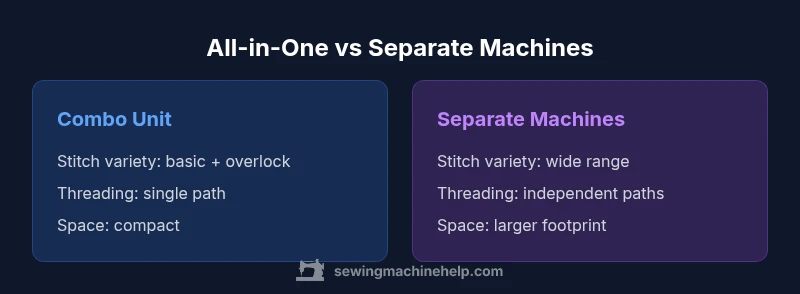
| Feature | Combo unit (sewing machine with serger) | Separate sewing machine + serger |
|---|---|---|
| Stitch variety | Combined straight/zigzag plus built-in overlock options | Dedicated sewing stitches + standalone serger overlock stitches |
| Threading complexity | Single threading path with dual-function capability | Two independent threading systems (one for sewing, one for serging) |
| Speed and throughput | Moderate speed designed for home use | Higher max speeds on both devices for heavy workloads |
| Space footprint | Smaller footprint; one footprint replaces two machines | Larger footprint due to two machines and more accessories |
| Maintenance & repair | One unit to service; risk of shared failure | Two separate devices; easier to isolate issues but more parts to maintain |
| Price range | Lower upfront cost overall, but features vary by model | Two-machine configuration with broader price range |
| Best for | Small spaces, beginners, casual projects | Experienced sewists, heavy fabrics, high-volume work |
Strengths
- Space-saving, compact footprint
- Lower upfront cost than two machines for many setups
- Simplified setup and portability for small studios
- Fewer cords and clutter on the work surface
- All-in-one workflow can be efficient for simple projects
Negatives
- Potential compromise on stitch quality and speed for heavy fabrics
- Threading can still be tricky when switching modes
- Limited expandability versus dedicated machines
- If a component fails, both functions may be affected
All-in-one is best for space-conscious hobbyists; separate machines are better for heavy or high-volume work.
If your projects are light-to-moderate and space is tight, an all-in-one unit delivers value. For serious garment construction or frequent heavy-duty sewing, two dedicated machines offer superior performance and long-term reliability.
Your Questions Answered
What is the difference between a combo sewing machine and a dedicated serger?
A combo sewing machine offers regular stitching plus basic edge finishing in one unit, while a dedicated serger provides advanced overlock capabilities with separate threading and blade systems. The combo is space-saving but may lag behind a true serger in speed and finishing quality for heavy fabrics.
A combo has sewing plus basic edge finishing all in one, while a dedicated serger is a separate machine focused on high-speed overlock finishing.
Can I rely on an all-in-one for heavy fabrics?
All-in-one units often handle light to moderate fabrics well, but heavy or thick materials can challenge speed and edge finishing. If your workload includes denim, canvas, or multiple layers, consider a separate serger or a plan to upgrade later.
For heavy fabrics, you might want separate machines for better performance, or plan a staged upgrade.
Do all-in-one machines have adjustable differential feed?
Many all-in-one units include differential feed, which helps control fabric stretch on knits and wovens. Availability varies by model, so check the product specs and test on your typical fabrics.
Check if the model offers differential feed and test it with your knit fabrics.
Is maintenance easier or harder on an all-in-one?
Maintenance can be simpler with one device, but if a component fails, both functions may be affected. Separate machines allow easier isolation of issues but require more parts and upkeep.
Maintenance is a trade-off: one machine is simpler to service, but a fault can hit both functions.
What should I test before buying?
Test stitch quality on representative fabrics, verify threading paths, switch between sewing and serging modes, and review warranty terms and service options. Also check noise level and vibration for long sessions.
Test on your fabrics, check mode switching, and review warranty terms.
Are there size or weight considerations for a home studio?
Yes. Measure your workspace and consider the unit’s weight and transportability. A lighter all-in-one may be easier to relocate, while heavier two-machine setups demand more space and sturdier furniture.
Yes—space availability and portability matter for your setup.
The Essentials
- Assess space and budget to decide if an all-in-one fits your workflow.
- Test both stitch quality and threading ease on target fabrics.
- Consider future projects requiring higher-speed serging and edge finishes.
- Factor maintenance needs; a single fault can affect both functions.