What is a Serger vs Sewing Machine? A Practical Buying Guide
Explore the key differences between sergers and sewing machines, when to use each, and practical buying guidance for home sewists and beginners seeking versatile finishing and joining options.


Sergers and sewing machines serve different purposes: a serger finishes fabric edges with overlock stitches, while a sewing machine assembles fabric with straight or decorative stitches. For most hobbyists, start with a reliable sewing machine for daily sewing tasks, then consider a serger to speed edge finishing on knits and woven fabrics. The right combo depends on your projects.
What is a serger vs sewing machine and why it matters
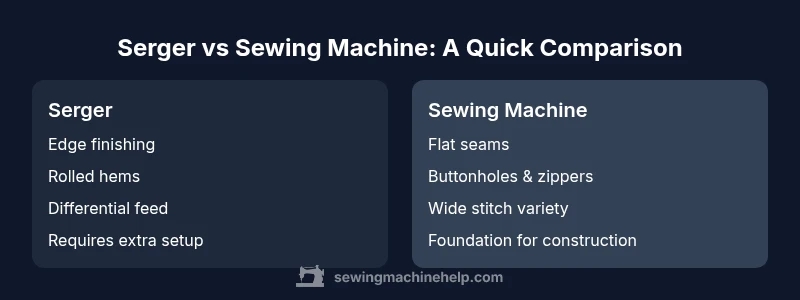
Understanding what is a serger vs sewing machine helps home sewists decide how to finish edges and assemble garments. A serger (overlock machine) trims away excess fabric and encloses the edge with looped thread, producing a clean, professional finish quickly. A traditional sewing machine uses a needle and bobbin to join pieces with straight, zigzag, or decorative stitches. Rather than viewing them as competing devices, consider them complementary tools: a sewing machine handles most construction tasks, while a serger excels at edge finishing and seam stabilization. For many projects, you’ll use both in sequence—serger first for edge finishing, then sewing machine for assembly and topstitching. In this guide, we unpack the core differences, common workflows, and practical buying guidance, so you can choose tools that fit your budget and projects. According to Sewing Machine Help, recognizing the distinct roles of each machine helps beginners plan a practical, scalable sewing setup.
-headlineOk-
Comparison
| Feature | Serger | Sewing Machine |
|---|---|---|
| Primary function | Edge finishing/overlocking | Fabric joining with stitches (straight, zigzag) |
| Stitch options | Overlock stitches, rolled hems, edge finishing | Straight, zigzag, decorative, buttonholes |
| Needle/loopers | Looper-based, multiple threads (often 2-3) | Needle-based, uses top and bobbin threads |
| Adjustability | Differential feed, tension for fabrics | Stitch length/width, presser foot options |
| Best fabrics | Knit-heavy edges, lightweight wovens | Most woven and some lightweight knits |
| Maintenance | Blade, thread nests, regular oiling | Belt drive, bobbin case, lint removal |
| Cost/Upfront | Typically higher upfront; accessories add value | Broad range; affordable entry-level options exist |
| Learning curve | Moderate to high depending on model | Generally easier to start with basic stitches |
Strengths
- Faster edge finishing and professional-looking seams
- Good fabric stabilization for knits and woven edges
- Compact options fit smaller spaces
- Expands your finishing repertoire for garments
Negatives
- Higher upfront cost and ongoing maintenance
- Steeper learning curve for beginners
- Does not replace a full range of stitches on every project
- Requires a complementary sewing machine for complete construction
For most hobby sewers, a sewing machine is the workhorse and a serger is a powerful finishing tool.
A sewing machine covers the core building tasks, while a serger excels at edge finishing and speed on specific fabrics. If your budget and space allow, owning both offers the most versatile setup for a beginner-to-intermediate sewist.
Your Questions Answered
What is a serger used for?
A serger specializes in finishing raw fabric edges with overlock stitches, trimming excess fabric as it sews. It creates durable, professional edges on knits and woven fabrics, reducing raveling and bulk at seam allowances.
A serger is your go-to for neat edges and fast finishing, especially on knits.
Can a serger replace a sewing machine?
No, a serger cannot replace a standard sewing machine for most construction tasks. It lacks built-in straight stitches, buttonholes, and many decorative options. Use it alongside a sewing machine for a complete setup.
A serger complements a sewing machine, not replaces it.
Is a serger easy for beginners?
Sergers have a steeper learning curve due to threading, tension, and knife settings. Start with basic threading and practice on scraps before using it on garments.
It takes patience, but with a bit of practice you’ll master threading and stitch control.
What fabrics work best with a serger?
Sergers handle knits and woven fabrics where edge finish is important. Lightweight to medium-weight fabrics are ideal; extremely bulky materials may challenge the differential feed and blades.
Knits and light to medium-weight wovens are the sweet spot for sergers.
How much does a basic serger cost?
Serger prices vary by features and brand. Expect a range that reflects entry-level to professional capabilities, but balance cost against features you will actually use.
Prices can vary a lot, so set expectations around features you’ll use most.
What maintenance does a serger require?
Regular cleaning, occasional oiling of moving parts, and blade alignment checks keep a serger performing well. You’ll also need to re-thread when changing stitch types or fabrics.
Keep it clean, oiled, and properly threaded for best results.
The Essentials
- Pair a sewing machine with a serger for best versatility
- Use a serger for seam finishing on knits and woven edges
- Choose a user-friendly model if you are new to sewing machines
- Plan for maintenance, especially blade and thread usage in sergers
- Test-drive both tools to confirm how they fit your projects