Which Sewing Machine Review: Budget vs Computerized
A thorough which sewing machine review comparing budget mechanical models with computerized machines. Learn criteria, compare features, weigh pros and cons, and get a clear buying verdict for home sewers.


Two broad options form the core of this which sewing machine review: budget mechanical machines and computerized, feature-rich models. Both meet different needs, with price and ease-of-use guiding early decisions. For home sewers prioritizing reliable basics, budget models shine; for versatility and automation, computerized machines deliver more options. This TL;DR helps you decide quickly.
What this which sewing machine review covers
In this which sewing machine review, we compare two core categories that color most consumer decisions: budget mechanical machines and computerized, feature-rich models. The aim is to give home sewers—beginners, hobbyists, and intermediates—a practical framework for choosing the right tool without getting lost in specs. According to Sewing Machine Help, the analysis considers real-world performance, maintenance needs, and long-term ownership beyond headline prices. We avoid hype and focus on how machines behave when you thread fabric, adjust tension, and complete common projects such as hemming, mending, and light quilting. The goal is clarity: which option delivers reliable stitches, works well with your fabric of choice, and fits your planned budget. Throughout this guide, you’ll see how two distinct paths can meet different projects and skill levels. The broader takeaway is that no single machine suits every user, and your decision should reflect your typical projects and willingness to learn new features.
Key criteria for evaluating sewing machines
A thoughtful comparison starts with criteria that matter in daily sewing. First, stitch options and fabric handling: look for a machine that handles straight, zigzag, and a few utility stitches, plus adjustable presser foot pressure for different fabrics. Second, build quality and durability: metal frames tend to last longer than plastic shells in budget ranges, while reliability comes down to the quality of the feed dogs and gear trains. Third, ease of use and ergonomics: intuitive controls, clear manual, and comfortable bobbin winding reduce fatigue on longer sessions. Fourth, maintenance and service: availability of parts, ease of cleaning, and the ability to swap feet or belts matter for long-term ownership. Fifth, warranty and support: a reasonable warranty and responsive customer service protect your investment. Finally, noise and speed: a steadier motor that runs quietly at typical speeds reduces fatigue. This section frames how to score machines against real-world needs rather than marketing hype.
Budget mechanical vs computerized models: overview
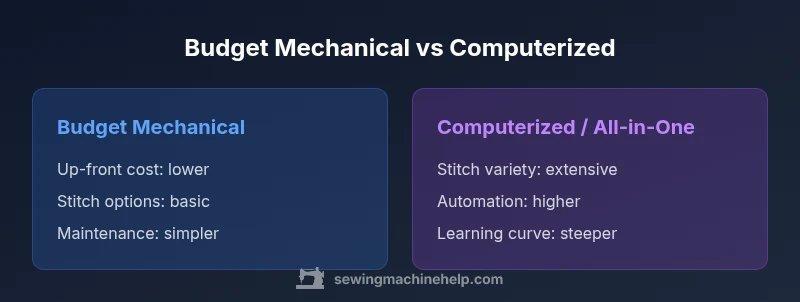
Budget mechanical machines offer the essentials: reliable straight stitching, simple tension adjustment, and straightforward maintenance. They typically have fewer moving parts, making repairs more approachable for beginners and hobbyists who enjoy tinkering. Computerized models, by contrast, bring a broader stitch library, automatic needle threaders, speed control, memory functions, and computer-assisted tension management. For many users, the trade-off is cost versus convenience: lower upfront cost and easier DIY repairs with mechanicals, or a higher price that yields more versatility and automation. The key question a reader of which sewing machine review must answer is whether their projects justify the extra features. If you sew regularly across a range of fabrics or enjoy decorative stitches and edits on garment patterns, a computerized machine can save time and expand creative options. If your tasks are basic repairs, crafts, and streaming-friendly learning, a budget model may suffice.
Stitch quality and tension behavior
Stitch quality depends on consistent feed-dog action, accurate thread tension, and balanced stitch formation. In a side-by-side test, mechanical machines tend to produce reliable straight stitches with minimal adjustment, while computerized models can maintain steadier tension across a wider range of stitches with less manual fiddling. The important tests are fabric feed consistency, seam allowance accuracy, and the machine's response when starting and stopping. Look for smooth fabric feeding, no skipped stitches, and minimal bird-nesting at the bobbin area. Real-world indicators include how well the machine handles layered fabrics (like denim or canvas) and delicate layers (like silk). In this which sewing machine review, remember that tension is a relationship between upper and bobbin threads, presser foot pressure, and stitch selection. A good machine keeps both threads balanced at typical sewing speeds.
Ease of use for beginners
Ease of use is not just about whether a machine stitches; it’s about how quickly a new user can start producing usable results. Mechanical machines often shine here, with simple dial-based controls and a shorter learning curve. Computerized machines introduce features that can feel overwhelming at first—multiple stitch menus, pattern selection knobs, and screen prompts. For a beginner, a model with a friendly manual, easy threading guides, and a reliable automatic needle threader can dramatically shorten the ramp-up period. This block also emphasizes error recovery: how forgiving the machine is when you make tension mistakes, or when you skip a step—like winding a bobbin incorrectly. The best option, in a practical sense, is the one that encourages ongoing experimentation without constant fiddling. The reader should test both styles to see which feels natural for their workflow and fabric choices.
Versatility: stitch options and accessories
Versatility is often the deciding factor in a 'which sewing machine review' because it translates directly into project breadth. Computerized models generally offer extended stitch libraries, utility stitches, and decorative options, plus automatic buttonhole functions and presser foot lifters. Budget machines usually provide a core set of straight and zigzag stitches, a handful of decorative stitches, and compatibility with a basic range of presser feet. Accessories matter: a walking foot, buttonhole foot, zipper foot, and blind-hem foot expand capabilities. Compatibility with quilting or embroidery extensions also influences value. The takeaway is to map your typical projects—garments, crafts, or light quilting—and ensure the chosen machine delivers the essential foot attachments, as appropriate. This alignment matters more than the sheer number of stitches, particularly for home sewers.
Reliability, maintenance, and service
Reliability is built from quality components, consistent manufacturing, and accessible service. Mechanical machines have fewer complex electronics, which can translate to easier maintenance and simpler repairs for DIY enthusiasts. Computerized machines depend on firmware, sensors, and digital interfaces, which can slow service if authorized technicians aren’t nearby. In this portion of the which sewing machine review, it’s essential to consider parts availability, lead times for service, and how easy it is to source feet and belts. Routine care—cleaning lint from the bobbin area, oiling moving parts if the model calls for it, and using the correct needle type—keeps machines performing longer. Long-term ownership is not only about stitch quality but also about repair accessibility and how quickly you can obtain replacement parts. Sewing Machine Help’s experience shows that a robust warranty coupled with broad retailer support reduces downtime.
Noise, speed, and user experience
Many shoppers underestimate how noise and vibration affect daily use. Mechanical machines often deliver predictable operation with modest noise, while computerized models can run smoother or produce more consistent results at higher speeds due to better motor control. Speed control features—such as a variable foot pedal and adjustable maximum speed—directly impact user comfort, especially for beginners who may be learning to handle thread tension and fabric feed at the same time. In real life, a quiet, stable machine reduces fatigue during long projects like alterations or curtains. Check how the machine feels when starting, stopping, and reversing direction, and note any unusual squeaks or shudders. The right balance between speed and control matters more than raw horsepower when you’re sewing at home.
Long-term ownership: cost of ownership and warranties
Beyond sticker price, long-term ownership includes accessories, thread, needles, and potential repair costs. Budget mechanical machines tend to require less expensive parts; computerized models may incur higher service costs if electronics wear out or firmware updates require service. Look for a warranty that covers electronics, motor, and mechanical components for a reasonable period, plus retailer return policies that allow testing at home. This section highlights that value is not solely about price but about how a model holds up over years of use, including how easy it is to replace feet, belts, or small gears. Sewing Machine Help’s researchers emphasize assessing total ownership—parts availability, service network, and upgrade paths—when counting the true cost.
How to test a sewing machine in-store or at home
Testing in-store or at-home is the most reliable way to gauge fit for your hands and projects. Start with a fabric sample similar to your typical work (cotton, denim, jersey). Check stitch consistency on a scarf or sample panel, and observe how the machine handles multiple fabric thickness. Evaluate ease of threading and bobbin winding, and test the auto-needle threader if included. Also test reverse stitching and stitch strength along a seam. Bring a few simple projects to see how the machine handles real tasks, such as hemming a skirt or constructing a tote. If you’re shopping online, request a friendly demo from the seller or a test drive if possible. This practical in-person testing aligns with the Buying Guide approach and helps you decide which sewing machine review yields the best long-term satisfaction.
Putting it together: which sewing machine review outcomes
After hands-on testing and evaluating the criteria above, the core insight is that there is no one-size-fits-all machine. The best choice depends on your project mix, budget, and willingness to engage with learning curves. For many home sewers, starting with a budget mechanical model provides dependable basics and a stress-free learning path. If you anticipate varied tasks, frequent stitching options, and time-saving automation, a computerized machine offers greater versatility and faster results. The key decision factors are project variety, maintenance willingness, and available support. The practical approach is to create a priorities list (stitches, maintenance, price, and warranty) and test accordingly.
A practical decision framework for home sewers
Use a simple framework to choose: (1) list your top 3 projects; (2) compare models against willingness to DIY maintenance; (3) evaluate ease of use in your space; (4) verify parts and warranty; (5) schedule a test run. This framework keeps you anchored to your real-world needs rather than spec sheets. Throughout this which sewing machine review, keep your budget in check, but don’t sacrifice essential features that enable your projects. Remember to factor in ongoing costs such as bobbins, needles, and presser feet. The end result is a choice that feels natural in your workflow, not forced by marketing claims.
Comparison
| Feature | Budget Mechanical | Computerized/All-in-One |
|---|---|---|
| Price up-front | lower upfront cost | higher upfront cost |
| Ease of learning | easier for beginners | more features, steeper learning curve |
| Stitch options | basic stitches | extensive stitches and automation |
| Maintenance & repair | simpler maintenance | electronics may require specialist service |
| Best for | basic projects, repairs, crafts | varied projects, quilting, garment making |
| Warranty & support | standard warranty | broader support options |
Strengths
- Clear differentiation helps buyers match needs to price
- Highlights long-term maintenance and repair considerations
- Addresses common home sewing tasks with real-world relevance
- Encourages hands-on testing before purchase
Negatives
- May underplay niche uses like embroidery-specific work
- Not all brands fit neatly into mechanical vs computerized
- Warranty terms vary by retailer and region
Budget mechanical models suit beginners; computerized models win on versatility.
For casual projects, budget mechanicals deliver reliable basics with a short learning curve. If you expect varied tasks and automation, computerized machines offer greater flexibility. The Sewing Machine Help team recommends hands-on testing to confirm stitch quality and reliability before buying.
Your Questions Answered
What is the primary difference between mechanical and computerized sewing machines?
Mechanical machines rely on manual controls and have fewer automated features. Computerized machines include digital controls, wider stitch libraries, and automatic functions. The choice depends on your project needs and comfort with technology.
Mechanicals are simple and easy to learn; computers add options and automation you may or may not need.
Is a budget mechanical machine suitable for beginners?
Yes, for basic sewing tasks like hems and simple garments. It offers reliable performance with fewer electronic components, which can simplify maintenance.
Yes, great for getting started and learning the basics without a big upfront investment.
Do computerized machines require more maintenance?
They can require service for electronics or firmware, and parts can be pricier. Regular cleaning and proper use help minimize issues.
They can be a bit more finicky, but with good care they perform very well.
What features should I prioritize in a buying guide?
Prioritize stitch options, feed dog reliability, tension control, presser foot compatibility, auto-threading, and warranty coverage.
Look for what you’ll actually use, plus a solid warranty.
Should I buy a serger separately?
Only if you plan professional edge finishing. A few combo machines include serger capabilities; otherwise, a separate serger is common for serious finishing.
Only if you’ll do lots of edging; otherwise, a standard machine usually suffices.
How do I test a sewing machine before buying?
Test with fabrics similar to your projects, check stitch quality, tension, noise, and ease of threading. Ask for a demo if shopping online.
Test it with your fabrics to see how it handles real projects.
The Essentials
- Identify your top 3 sewing projects before choosing
- Test both mechanical and computerized styles in-store or at home
- Prioritize essential feet and accessories over stitch count
- Check warranty coverage and parts availability
- Factor long-term maintenance into total cost of ownership