What Size Sewing Machine Needle for Quilting: A Practical Guide
Discover the right sewing machine needle size for quilting across fabrics, stitches, and projects. Learn common sizes (80/12–100/16), when to switch, and expert tips to improve your quilting results.


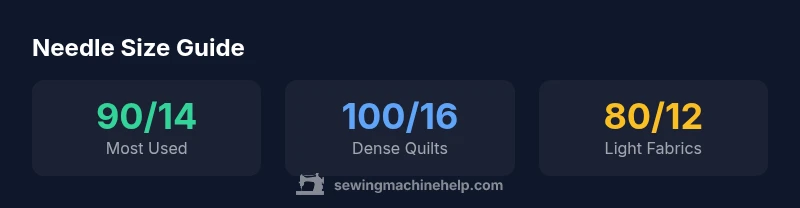
For quilting on most home machines, the go-to needle size is 90/14. If you work with dense fabrics or multiple layers, upgrade to 100/16; for lightweight cottons, try 80/12. When in doubt, start with 90/14 and test on a fabric scrap before stitching. Also consider thread type and stitch length.
Understanding Needle Size and Quilting Fabric
When you ask what size sewing machine needle for quilting, you are really asking about how to match a slender steel tip to your fabric and stitches. Needle size is a gauge that helps the machine pierce multiple layers without skipping stitches or breaking thread. For most home quilters working with standard quilting cottons, a size 90/14 is the common starting point. The 90/14 designation indicates a mid-range needle with a medium diameter and a sharp tip, suitable for mid-weight fabrics and a range of thread types. According to Sewing Machine Help, the selection process becomes easier when you view needle size as a tool for managing fabric layering and stitch density rather than a rigid rule. If your quilt uses several fabric layers or dense batting, stepping up to a 100/16 can improve penetration and reduce fabric fraying. For lighter fabrics or very delicate prints, an 80/12 can help prevent fabric puckering. Throughout any quilting project, also consider the thread type and stitch length, since those factors interact with needle size in real-world sewing.
How Needle Size Affects Stitch Quality on Quilts
Needle size directly influences the way stitches form and how the fabric responds during sewing. A larger needle (toward 100/16) creates a wider entry hole which is helpful when you are passing thick batting or multiple fabric layers, but it can leave larger holes in light-weight fabrics if the stitch length is too long. A smaller needle (like 80/12) produces finer penetration, which helps avoid visible fabric distortion on delicate prints but may struggle with heavy seams or heavy thread. Quilting also depends on the needle point: a sharp needle slices cleanly through tight weave fabrics, while a ballpoint or a universal needle can be gentler on knit materials. For most quilting cottons and blends, a sharp universal 90/14 balances thread tension, stitch formation, and fabric integrity. The key is experimentation: run a few short test stitches on scrap fabric that mimics your quilt and adjust needle size, tension, and stitch length until the results look consistent on both front and back sides.
The Most Common Needle Sizes in Quilting and When to Use Them
Most quilters start with 90/14 for standard quilts on cotton fabrics. If you are piecing multiple layers with batting and a dense top, 100/16 provides the extra needle thickness needed to push through without skipping stitches. For very lightweight fabrics such as cotton lawn or chiffon, 80/12 helps prevent perforation and puckering while preserving clean seam lines. A few seasoned quilters reach for 70/12 or 60/8 in free-motion contexts or when working with extremely delicate fabrics; these sizes reduce drag across the feed dogs during fluid movement. Remember that the same fabric can respond differently depending on the thread you choose and the machine’s tension. Always keep a small assortment of sizes—80/12, 90/14, and 100/16—on hand so you can adapt quickly as you test new blocks.
Fabric Weight and Thread Type: Tailoring Needle Choices
Your quilt’s fabric weight and the thread you intend to use should drive your needle choice. Heavier fabrics like denim or double-layer canvases respond better to 100/16 or 110/18, especially when using thicker threads such as polyester topstitch or wooly threads. Mid-weight fabrics like quilting cottons and blends typically respond well to 90/14, while very light fabrics—batiste, voile—often benefit from 80/12. If you are sewing with metallics or nylon threads, a sharp needle in the mid to upper range helps prevent thread shredding. The choice also interacts with the needle point: sharp needles excel at crisp seams on tightly woven fabrics; ballpoint or microtex points may be preferred for delicate knits or slippery materials. A practical rule of thumb is to test a small sample with your chosen fabrics and thread to verify that the stitches are even and the fabric doesn’t pucker.
Free-Motion Quilting and Special Cases
For free-motion quilting or quilting on thick batting, many quilters begin with a smaller needle such as 60/8 to 70/10 to reduce drag and improve feed control. As you gain confidence, you may move to 80/12 or 90/14 for a balance between needle robustness and fabric damage risk. When you’re stitching dense or high-pile quilts (lots of batting or plush fabrics), a 100/16 can be advantageous to prevent thread breaks and maintain smooth movement. Some sewists also use specialized needles like microtex or sharp points for precise micro-stitching on compact fabrics. The bottom line is to test on a sample block with the batting and fabric you plan to use and adjust needle size, tension, and stitch length together to achieve consistent results across the top and bottom layers.
Testing and Tuning: A Practical Workflow
Before you commit to a quilt block, perform a small, repeatable test. Set up a scrap sandwich that imitates your planned top, batting, and backing. Start with a mid-range needle size (90/14) and a standard stitch length. Sew a short row, then inspect the back for skipped stitches, broken threads, or fabric distortion. If the back looks clean, try a longer stitch and a heavier needle (100/16) to simulate dense quilting; evaluate both sides carefully. Adjust thread tension if you notice looped top threads or bottom thread show-through. Keep notes on the fabric type, batting, needle size, thread, tension, and stitch length that produced the best result. This method—test, evaluate, tune—reduces risk and gives you a reliable baseline for future blocks.
Mistakes to Avoid When Changing Needle Sizes
One common mistake is not re-threading after changing needles; even a slight tension mismatch can cause skipped stitches. Another pitfall is forcing a large needle into a very light fabric; this can create visible holes and puckers. Conversely, using a tiny needle on a thick batik or dense fabric can bend the needle and snap thread. Never reuse a bent or dull needle; discarded needles should be replaced promptly. Finally, ignoring needle-point type for the fabric can sabotage stitch quality: sharp points on woven fabrics, ballpoint or universal for knits. The best practice is to clearly map your fabric and thread choice to needle size and always perform a scrap test when you try a new combination.
Step-By-Step Quick Start Guide for Quilting Needle Size
- Identify fabric weight and batting. 2) Start with 90/14 for typical quilt blocks. 3) If fabric is light, try 80/12; if dense, switch to 100/16. 4) Thread choice should align with needle type; test. 5) Sew a small sample and adjust tension if you see looping. 6) Once satisfied, proceed to your full project. Keep spare needles in sizes 80/12, 90/14, and 100/16 for quick changes.
Maintaining Needle Quality for Quilting
Regularly inspect your needle for burrs or bending after long sessions. Replace bent or dull needles promptly to prevent snagging threads or damaging fabric. Store needles with protective caps to prevent dulling from contact and ensure the right size is used on the right project. Clean the bobbin area after finishing, and don’t reuse needles that have threaded or broken tips. Proper maintenance helps preserve fabric integrity and improves stitch consistency across your quilts.
Needle size and fabric compatibility for quilting
| Needle Size | Recommended Fabrics | Common Uses |
|---|---|---|
| "80/12" | "Lightweight fabrics" | "Piecing and delicate quilting" |
| "90/14" | "Cotton fabrics, blends" | "General quilting and mid-weight quilts" |
| "100/16" | "Dense fabrics" | "Dense quilts and multiple layers" |
| "110/18" | "Heavy fabrics" | "Heavy-duty or multi-layer quilts" |
Your Questions Answered
What size needle should I use for quilting on cotton fabrics?
For cotton quilting projects, start with a 90/14. If the fabric is very light, consider 80/12; for dense batting, use 100/16. Always test on a scrap to confirm stitch quality and tension.
For cotton quilts, start with 90/14. If it’s light, try 80/12; for dense batting, 100/16. Test on scrap first.
Can I use a universal needle for quilting?
Yes, a universal needle can work for many quilting projects, especially with mid-weight fabrics. For best results on denser quilts or specialty threads, a sharp or microtex needle (like 90/14 or 100/16) often performs better.
You can, but you’ll typically get better results with a sharp needle for dense fabrics.
What's the difference between 90/14 and 100/16 for quilting?
90/14 is a mid-range size suitable for standard quilts on cotton. 100/16 is thicker and penetrates dense layers more easily, reducing skipped stitches in multi-layer projects.
90/14 is for standard quilts; 100/16 helps with dense layers.
Should I change needle size when switching fabrics?
Yes. Heavier fabrics or thicker threads may require larger needles (like 100/16), while light fabrics benefit from smaller needles (80/12). Always test on scrap first.
Yes—change based on fabric weight and thread, and test first.
Is there a special needle for free-motion quilting?
For free-motion quilting, many quilters choose a smaller needle (60/8 to 70/10) to reduce drag, though 80/12 or 90/14 can work well for adjusted tension.
Free-motion usually uses a smaller needle to reduce drag, like 60/8 to 70/10.
How often should I replace quilting needles?
Replace dull or bent needles promptly to prevent fabric damage and thread breaks. Always use a fresh needle when starting a new project or changing fabrics.
Replace dull or bent needles as soon as you notice issues, and start fresh with new projects.
“Selecting the right needle size isn't just about fabric; it affects thread tension, stitch quality, and fabric integrity.”
The Essentials
- Start with 90/14 for most cotton quilts.
- Increase to 100/16 for dense batting or multiple layers.
- Use 80/12 for lightweight fabrics and delicate prints.
- Always test on a fabric scrap before quilting the project.
- Change needles regularly to maintain stitch quality and fabric integrity.