What Sewing Machine Needle for Knits
Learn which sewing machine needle to use for knit fabrics, how to choose sizes, test methods, and pro tips for smooth, puckering-free stitches. Ballpoint vs stretch needles, stitch settings, and maintenance for home sewers.


For knits, use a ballpoint or jersey needle, sized to fabric weight (commonly 70/10 to 90/14). Test on a scrap first, as knits stretch and curl. Avoid sharp points that can snag; opt for a longer stitch length and a stretch stitch or zigzag to let the fabric recover. This setup minimizes skipped stitches and puckering.
Understanding Knits and Needles
Knits differ from woven fabrics because they are made of loops that stretch and relax. This structure means a regular sharp-pointed needle can cut through the loops, causing skipped stitches or runs. The first question many home sewists ask is, what sewing machine needle for knits? The practical answer is a ballpoint or jersey needle, positioned toward the lower end of the weight spectrum for lightweight jerseys and adjusted upward for heavier knits. Start with a frequent test on a fabric scrap to observe how the needle interacts with yarns. If the fabric puckers or the machine seems to push, adjust either the stitch length or the needle size. Keeping a dedicated case with knit-friendly needles will speed up changes during a project and improve consistency across seams.
Ballpoint vs Stretch Needles: When to Use
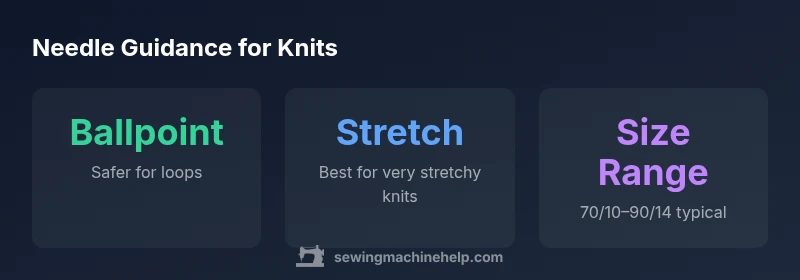
Ballpoint needles have a rounded tip that slides between yarns, reducing snags and skipped stitches on most knits. They are the default choice for everyday knit fabrics like jersey and interlock. Stretch needles, while similar, include a sturdier shaft and sometimes a slightly sharper edge designed for very stretchy, thick knits and performance fabrics (like ponte or scuba). If your stitching starts to skip or the fabric refuses to lay flat, consider swapping from a ballpoint to a stretch needle or vice versa. For lighter weight knits, ballpoints are usually sufficient; for multiple layers or very stretchy fabrics, a stretch needle can provide better stability.
Needle Sizes and Knit Weight: Quick Guide
Knits vary from lightweight jersey to heavy ponte; needle sizes should correspond to fabric weight rather than a single rule. A common starting range is 70/10 to 90/14, with lighter fabrics taking the smaller end and heavier fabrics the larger end. Always align needle size with your stitch type—stretch stitches tolerate slightly larger needles, while regular zigzag stitches can perform well with mid-range needles. If you are unsure, perform a test seam on a swatch the same way you would finish a garment. Your goal is to achieve smooth feeding without creating holes or fabric distortion.
How to Test Before You Sew
Before committing to a full seam, test on a scrap that mirrors your knit. Step 1: mount your chosen needle and set a stitch length appropriate for knits (usually longer than for woven fabrics). Step 2: sew a short sample on the same weight fabric, using the selected stitch (stretch or zigzag). Step 3: inspect the back for loose loops or skipped stitches and the front for puckering. If issues appear, adjust either needle size, tension, or stitch width. This method helps you determine the best combination for your specific knit and project.
Tips for Seams, Hems, and Finishes on Knits
Hems on knits benefit from a touch more stretch and controlled feeding. A walking foot can help advance the fabric evenly, especially with slippery or finer knits. For visible seams, a wide zigzag or a small stretch stitch can accommodate fabric stretch without puckering. When finishing hems, avoid clipping too close to the edge as it can cause curl. A twin needle may be used for decorative hems on lightweight knits, but ensure your machine supports twin-needle operation and that your needle type is compatible with twin-needle fabrics.
Common Mistakes When Sewing Knits
Poor needle selection is a frequent culprit. Using a sharp point needle on knits can cut the loops and lead to runs. Sewing too fast without testing often leads to skipped stitches; knits require a slightly gentler feed and a longer stitch. Forgetting to adjust tension can cause seams to pucker on the inside or look loose on the outside. Finally, using a standard straight stitch on a heavily stretched knit can create a wavy seam because the fabric pulls away from the needle’s path.
Specialty Knits and Needle Options
Specialty knits like ponte, scuba, or lace knits may demand different needle choices. Heavier, thicker knits generally benefit from a larger ballpoint or a stretch needle to handle extra bulk. Delicate lace knits might require a finer ballpoint needle and a shorter stitch length to prevent tearing. Always tailor your needle choice to the specific knit, test on a scrap, and consider stabilizers or walking feet to maintain fabric integrity during assembly.
Maintenance, Tools, and Storage for Knit Sewing
Keep your knit needles organized and labeled so you can switch quickly during a project. Clean your machine’s throat plate to prevent lint buildup and check tension after changing fabrics. Store needles in a dry, padded case to prevent bending. If you encounter sticky fabric or residue buildup due to synthetic fibers, a light application of sewing machine oil on moving parts (not on the needle eye) can help maintain smooth operation.
Quick Setup Checklist for Knits
- Identify knit weight and choose a ballpoint or jersey needle accordingly.
- Select needle size between 70/10 and 90/14, adjust for fabric thickness.
- Use a stretch stitch or zigzag with a slightly longer stitch length.
- Engage walking foot if fabric is slippery or prone to shifting.
- Test on a scrap, adjust tension, and re-test until stitches are balanced.
Needle types by knit weight
| Knit Weight | Recommended Needle | Notes |
|---|---|---|
| Lightweight jersey | Ballpoint 70/10 | Basic seams, light stretch |
| Medium knit (interlock/ ponte) | Ballpoint 80/12 | Common dress knits, stable seams |
| Heavy knit (scuba/ ponte ponte) | Stretch 90/14 | Thicker fabrics with more stretch |
| Delicate lace knit | Ballpoint 60/8 | Gentle handling, minimal perforation |
Your Questions Answered
What needle should I use for lightweight knits?
For lightweight knits, start with a ballpoint or jersey needle in the 70/10 range. Test on scraps to confirm that the stitch lies flat without creating tears or runs.
For light knits, use a ballpoint needle and test on scraps to ensure smooth stitching.
Can I sew knits with a universal needle?
Universal needles can work for some knit fabrics, but they are more prone to snagging on loops. If you notice skipped stitches or snagging, switch to a ballpoint or stretch needle and test again.
Universal needles can work sometimes, but ballpoint or stretch needles usually give better results for knits.
Do I need a special needle for serger knits?
A serger uses different needles; for a domestic machine, stick with ballpoint or stretch needles and a compatible stitch setting. For heavy serger knits, consider a dedicated serger needle.
Serger knits need specialized needles, but household sewing with ballpoint or stretch needles generally works well.
Does stitch length matter when sewing knits?
Yes. Knits benefit from slightly longer stitch lengths to allow fabric to recover and avoid crowding the loops. Start around 2.5–3.0 mm and adjust as needed.
Yes—use a longer stitch length for knits to prevent puckering.
What is the difference between ballpoint and jersey needles?
Ballpoint needles are rounded and glide between yarns; jersey needles are a common variation for stretch fabrics. Both are suitable for knits, with ballpoint being the safer default choice for many fabrics.
Ballpoint needles glide between yarns; jersey needles are another option for stretch fabrics.
“The right knit needle transforms a challenging fabric into a smooth, predictable sewing experience.”
The Essentials
- Choose ballpoint or jersey needles for most knits.
- Match needle size to knit weight, not fabric type alone.
- Test on scrap before sewing to prevent puckering.
- Use stretch stitches or zigzag for better recovery.
- Consider walking feet for slippery or bulky knits.