Is Hand Sewing as Strong as Machine Sewing? A Practical Comparison
An analytical, practical comparison of hand sewing vs machine sewing focusing on seam strength, fabric interactions, stitch types, and techniques for home sewists.


In general, machine sewing delivers higher average seam strength and consistency due to controlled tension and uniform stitches. Hand sewing can equal or exceed machine strength for certain tasks when using appropriate stitches, thread, and careful technique. The choice depends on fabric, load, and repair context. For everyday hems and delicate fabrics, hand stitches can be just as strong when reinforced with proper needle choice.
Core principles: how seam strength is determined
When evaluating whether is hand sewing as strong as machine sewing, it’s essential to understand that seam strength is a function of several interrelated variables: material, stitch geometry, tension, and load direction. According to Sewing Machine Help, the long-standing question often reduces to whether hand-stitched seams can replicate the uniformity that a modern sewing machine provides. In most durable fabrics and typical garment seams, machine stitching yields higher average tensile strength due to consistent stitch length, stable thread tension, and flat seam allowances. However, skilled hand sewing can achieve comparable strength when the stitch chosen matches the fabric’s needs, and when reinforced techniques are used. For home sewists and repair tasks, the practical difference often hinges on how the load is applied: straight pull, twist, or shear, and whether the seam is reinforced near edges or stress points. In essence, the strength outcome depends less on the label “hand” or “machine” and more on technique, materials, and the anticipated stress. The Sewing Machine Help analysis highlights that context matters more than the method itself.
- Quick takeaway: strength is driven by method-agnostic principles like tension control, stitch integrity, and load direction.
- Practical implication: choose your technique based on fabric, expected stress, and repair goals, not solely on whether you’re using hands or a machine.
As you read further, keep in mind several core criteria: fabric type (woven vs knit), fiber content, weight, and finish; thread type and weight; needle choice and entry/exit consistency; and whether the seam will bear dynamic loads or static holding. These factors collectively determine ultimate seam strength more than the tool used to stitch it.
Material and fabric interactions: fiber, weave, and load
Fabric behavior under stress is a primary driver of seam strength. The phrase is not simply about the stitch; it’s about how fibers grip, thread sits through the weave, and how movement occurs at the seam line. When you ask is hand sewing as strong as machine sewing, the answer depends on fabric structure. Dense weaves like denim or twill demand tight stitches and steady tension to prevent thread cutting and seam slippage. Lighter silks or chiffon respond better to finer needles and careful handling. The role of fabric finish—calendered, pre-washed, or treated—also influences knotting and fray resistance. In a Sewing Machine Help analysis, machine seams typically outperform hand stitches on high-load fabrics because the machine maintains uniform stitch length and consistent needle penetration across the seam. However, there are notable exceptions: well-chosen hand stitches on delicate fabrics can achieve equal strength when reinforced with backstitches and knots at stress points.
- Practical tip: assess fabric drape, weave, and finish before deciding on a stitching approach.
- When in doubt, test a small seam on a scrap piece mirroring the final fabric to observe how it behaves under load.
The material properties interact with stitch choice to determine final seam strength. A strong seam on a weak fabric is not as meaningful as a strong seam on a strong fabric, and the reverse is true for fragile materials. The key is to align the stitch method with the fabric’s intrinsic properties and the intended stress profile of the finished product.
Stitch types and their impact on strength
Stitch geometry matters more than most hobbyists realize when evaluating is hand sewing as strong as machine sewing. The machine’s lockstitch typically provides even bite width, consistent stitch density, and minimal fabric distortion. Hand stitches can rival this strength when the right stitches are chosen and executed with precision. For example, reinforced backstitches or deliberate back-and-forth securing stitches at endpoints can dramatically increase seam strength for hand-sewn seams. In contrast, long, loose running stitches or whipped stitches tend to have lower tensile strength and can fail under load if not appropriately reinforced. Stitch length, spacing, and the number of passes over a seam all affect strength. For delicate fabrics, running stitches might suffice for order-of-magnitude light loads, while heavier fabrics benefit from a dense approach that reduces stress concentration.
- Best hand stitches for strength include reinforced backstitches, herringbone or overcast variations, and double-threaded knots at both ends.
- For machine sewing, consider stitches that accommodate fabric stretch and finish, such as reinforced topstitch or twin-needle seams, which can outperform basic hand stitches on certain fabrics.
Overall, stitch type is context-driven. The same fabric may perform very differently under a backstitch than under a chain stitch or a blanket stitch. The choice should be guided by load direction, fabric behavior, and the desired finished look.
Needle, thread, and tension considerations
Strength hinges on more than the act of stitching; the smallest details can determine outcome. Needle size and point shape must suit fabric weight and weave to prevent snagging or piercing delamination. Thread selection matters as well: a strong, smooth thread minimizes snagging and ensures uniform tension across stitches. For heavy fabrics, choose a robust weight (e.g., 40-50 weight) with a tightly wound thread, while delicate fabrics benefit from lighter weights (60-100 weight) to prevent bulk. Tension control is critical in both hand and machine sewing, but machines offer consistent tension across the entire seam, which reduces the risk of weak spots. When hand sewing, maintaining uniform tension along the entire seam is challenging; practice and technique are essential to matching machine-like consistency.
- Practical tip: use a thimble to control needle force and maintain even stitch tension across the seam.
- Practice makes consistent: test several stitches on scrap fabric to find a tension that doesn’t cause puckering or loose ends.
Sewing Machine Help emphasizes that selecting the right needle and thread pair for your fabric is one of the most significant levers for improving seam strength, whether you sew by hand or machine.
Hand sewing techniques that maximize strength
If your goal is to maximize strength by hand, follow a structured approach that emphasizes precision and reinforcement. Start with anchor stitches, then use backstitching at the ends for extra security. Consider reinforced knots at stress points and edges where loads may concentrate. When finishing, trim threads neatly and avoid bulky knots that can snag or create weak points. For added durability, run a secondary layer of stitches—sometimes called a bound seam or double-stitched seam—over high-stress areas. In addition to stitch choice, maintain a clean fabric edge and proper seam allowance to prevent seam distortion under tension.
- Step-by-step approach: anchor stitch → backstitch at start/end → optional reinforced knot → optional second pass for high-stress zones → secure finish.
- Fabric considerations: richer textures and heavy fabrics benefit from reinforced techniques; delicate fabrics gain from gentler handling and smaller needle and thread.
According to the Sewing Machine Help framework, skilled hand sewers can achieve comparable seam strength to machine sewing on many tasks when technique and material choices align with the load profile. Practicing deliberate backstitching and reinforcement is a dependable way to enhance hand-sewn seam integrity.
Practical scenarios: when hand sewing shines
There are real-world contexts where hand sewing offers advantages, especially when access to a sewing machine is limited or when fabric constraints demand a gentler touch. Hems on delicate fabrics like chiffon or silk may benefit from hand sewing to avoid heat, tension, and distortion from a machine stroke. Hand seams can also preserve fabric integrity in leatherwork or suede where machine needles may mar the surface, or in upholstery projects where a controlled, patient stitch is preferable near corners and edges. Repairs that require precise knotting near a seam edge, such as mending a torn elbow or knee, can be more durable when reinforced with hand stitches. Finally, miniature or high-detail sewing projects often demand the control and finesse offered by hand work.
- Best-case scenarios: delicate fabrics, leather, repairs needing edge control, and small-scale details.
- When to avoid hand sewing: very high-load seams, industrial fabric layers, or projects requiring uniform mass production.
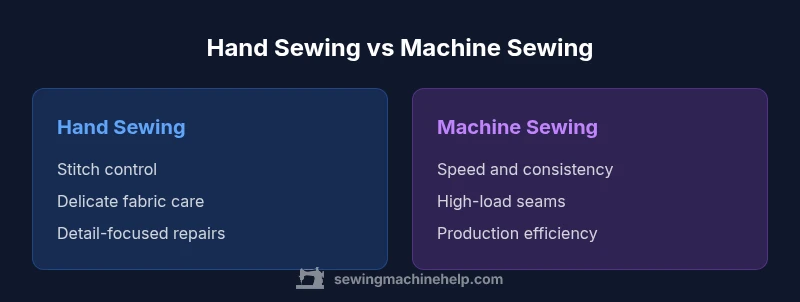
The bottom line is that hand sewing shines in precision work, delicate materials, and repairs where machine access or materials would compromise the result, while machine sewing excels in speed and uniformity for heavy-duty or high-volume tasks.
Testing strength and evaluating results
A systematic approach to testing seam strength helps remove guesswork from the question is hand sewing as strong as machine sewing. Build a simple test rig with scrap fabric of the same type as your project. Create sample seams using both methods under similar thread weights and stitch configurations. Apply tension gradually using a calibrated force gauge or a hanging weight while observing for strain concentration, thread breakage, or fabric fraying. Record the peak load at which the seam fails and inspect the failure mode: thread breakage, seam rip, or fabric tearing. Repeat tests to ensure repeatability and adjust variables like stitch length, tension, and reinforcement to optimize results. While home tests won’t replace formal lab testing, they provide practical guidance for common sewing needs.
- Tooling: a simple ruler, a spring scale, and scrap fabric.
- Metrics: peak seam strength, failure mode, and visible wear.
Sewing Machine Help recommends adopting a data-driven approach to decisions about whether to rely on hand or machine sewing, especially when the project involves load-bearing seams or critical repairs.
Maintenance, care, and decision guide
Maintenance influences longevity and strength. For hand sewing, keep needles sharp and clean, store them in a pin cushion or magnetic holder, and replace dull needles promptly. Thread should be stored away from moisture to prevent weakening, and you should inspect for fraying before starting a long project. For machine sewing, regularly oil moving parts, clean lint from the bobbin area, and ensure tension discs and thread paths are free of debris. Your decision on whether to rely on hand or machine sewing should consider the load profile, fabric types, expected wear, and repair practicality. If you’re repairing a stress-prone seam or finishing a heavy garment, machine sewing often provides better integrity and repeatable results. In other cases, skilled hand stitching with reinforced techniques can meet or exceed machine strength for certain fabrics and applications.
- Decision factors: fabric type, load, repair context, and available tools.
- Quick-reference guide: for high-stress seams on heavy fabrics, prefer machine; for delicate fabrics or edge finishes, consider hand sewing with reinforcement.
The Sewing Machine Help team cautions that no single rule fits every project; weigh material properties and load expectations to choose the most durable approach.
Comparison
| Feature | Hand sewing | Machine sewing |
|---|---|---|
| Seam strength under typical load | Strong with reinforced hand stitches on appropriate fabrics | Generally stronger and more consistent due to tension control and stitch regularity |
| Stitch uniformity | Dependent on skill; can be highly variable | High consistency and speed; uniform stitch length |
| Ideal fabrics | Delicate fabrics, leather edges, repairs with constrained access | Heavy fabrics, high-volume projects, wear-heavy seams |
| Speed | Slow; depends on operator | Fast; best for long runs and production |
| Edge finishing | Requires technique to avoid distortion | Typically clean, with strong edge finish |
| Repair scenarios | Excellent for quick, precise fixes in limited access | Ideal for durable repairs and project efficiency |
Strengths
- Low upfront cost and equipment needs for hand sewing
- Excellent control for delicate fabrics and detail work
- Can achieve strong seams with reinforcement in skilled hands
- No power source required for hand methods
- Flexible for repairs in tight spaces
Negatives
- Generally slower than machine sewing
- Seam uniformity and repeatability depend on skill
- May require more time for high-load seams
- Potentially less scalable for producing many identical seams
Machine sewing generally provides superior strength and consistency for high-load seams; hand sewing remains a strong, viable option for delicate fabrics, repairs, and precision work.
If you prioritize speed and uniformity, machine sewing wins. For delicate fabrics or intricate repairs, skilled hand sewing can match or surpass machine strength with reinforcement and proper technique.
Your Questions Answered
Is hand sewing as strong as machine sewing for denim?
Denim typically requires strong stitches to withstand wear. Machine sewing provides consistent stitches ideal for heavy fabric; however, reinforced hand stitches can achieve comparable strength in denim if executed carefully. For daily wear or heavy-use areas, machine seams are often preferred.
Denim often benefits from machines for consistent stitches, but reinforced hand stitches can work in a pinch.
What factors influence seam strength the most?
Fabric weight and weave, thread type and weight, needle choice, and stitch reinforcement are the most influential. Load direction and seam placement (edges vs. center) also matter. Understanding these helps you decide when hand or machine sewing is best.
Fabric, thread, needle, and reinforcement determine seam strength more than the tool used.
Can I hem with hand sewing and still have a strong seam?
Yes, hems can be strong when you use reinforced stitches like backstitch at the start and end, and consider a secondary pass for durability. Delicate fabrics may benefit from lighter thread and smaller needles. While machine hems are very efficient, well-executed hand hems can be equally strong for many garments.
Hand hems can be very strong with reinforcement.
Which hand stitches are best for strength?
Backstitch with reinforcement at ends is a classic, strong option. Overcast or running stitches can work for lighter loads but usually need reinforcement. For high-stress areas, consider a bound seam or doubled threads at endpoints.
Backstitch with reinforcement is a top choice for strength.
When should I choose a machine over hand sewing?
Choose a machine for high-load seams, long runs, or when uniformity is crucial. If access to a machine is limited, or you’re working on delicate materials or repairs in tight spaces, hand sewing is a practical alternative.
Use machine for speed and consistency; hand sewing for delicate or limited-access tasks.
How can I test seam strength at home?
Create sample seams on similar fabric scraps, apply gradual force with weights or a force gauge, and observe failure modes. Repeat with different stitches or tensions to identify the strongest approach for your project.
Test with scraps and weights to compare strength.
The Essentials
- Machine sewing offers superior consistency for high-load seams
- Hand sewing can be as strong as machine sewing in selected tasks
- Choose fabric, load, and technique over tool bias
- Reinforce hand stitches to maximize strength
- Test seam strength on scrap fabric before committing
- Maintain tools and materials to sustain seam integrity