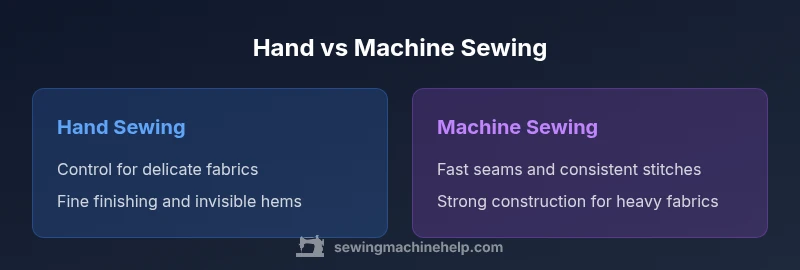
Hand vs Machine Sewing: A Practical Comparison for Home Sewists
Explore when hand sewing or machine sewing is the smarter choice for common sewing projects. This analytical guide weighs speed, control, fabric handling, and finishing to help home sewists decide the best method for each task.


Is it better to sew by hand or machine? For most home projects, machine sewing provides speed, consistency, and strong seams for base construction. Hand sewing shines on delicate fabrics, tiny details, and near-finish work where control matters most. This guide compares strengths, weaknesses, and ideal use cases to help you choose the right approach for each task.
Why this comparison matters
Is it better to sew by hand or machine? For home sewists, the choice influences project speed, fabric behavior, and finish quality. According to Sewing Machine Help, understanding where each method excels helps you conserve time, reduce frustration, and achieve professional-looking results without over-investing in tools. This section lays groundwork for evaluating base construction versus finishing work and sets expectations for what you’ll gain when you blend techniques across projects. The central question—hand vs machine—is not a single answer; it shifts with fabric, pattern, and the finish you desire. The goal is a practical framework you can apply to almost any sewing task, from hems to heavy-duty seams, without getting overwhelmed by options.
Historical context and present-day practice
Sewing has always combined human dexterity with mechanical assistance. Early sewers relied almost entirely on hand stitching for durability and personal control. Modern machines expanded speed and consistency, enabling bulk production and complex stitch options. For home sewists, the current landscape is a blend: machines handle repetitive, sturdy seams; hands excel where precision, adaptability, and fine finishing are paramount. This balance matters for projects ranging from repair work to garments and crafts. The choice becomes a matter of task, fabric, and tolerance for time vs. finesse.
Hand sewing strengths: when it shines
Hand sewing excels when your project requires precision, discretion, or fabric sensitivity. It’s ideal for tiny hemming work, invisible closures, and tailoring adjustments where machine access is limited. For delicate fabrics such as silk or chiffon, hand stitches distribute tension more evenly and reduce risk of fabric distortion. Hand finishing also allows you to perfect seam allowances and curvature around corners where machine feed can cause pulling. In addition, hand stitches can be adjusted mid-way with ease, which is valuable for complex, custom-fit alterations. For decorative detailing, a hand-stitched finish offers a level of control that can surpass what a machine delivers.
Hand sewing limitations
Despite its strengths, hand sewing is time-consuming and physically demanding for large projects. It requires steady concentration and can be inconsistent if stitches vary by hand fatigue. For bulky fabrics or long seams, hand work may be impractical or imprudent due to endurance and time. Hand sewing also requires skill to avoid visible stitch marks and to manage thread tension across different fibers. Finally, the lack of automation means fewer options for repeatable stitch patterns, which can limit project efficiency when a uniform look is essential.
Machine sewing strengths: when it shines
Machine sewing is a powerhouse for base construction and repetitive seams. It delivers speed, uniform stitch length, and consistent tension across kilograms of fabric. For woven fabrics, sturdy seams and precise topstitching are achievable with a well-tuned machine. Zippers, buttonholes, and other standard hardware tasks become efficient with the appropriate presser foot and settings. In addition, machine sewing supports heavy fabrics such as denim or canvas when paired with the right needle type, thread, and stitch choice. For beginners, a sewing machine accelerates learning by providing immediate feedback on stitch quality and fabric handling, reinforcing correct technique over time.
Machine sewing limitations
Machines can struggle with extremely delicate fabrics or projects requiring near-invisible finishes. Tension management and fabric feed can cause puckering if settings aren’t right, and machines may damage very slippery fibers without careful adjustment. Some tasks demand frequent thread changes or thread path monitoring that slows progress. The initial setup and maintenance—oil, needle changes, and foot selection—also add friction for new users. Finally, the machine has limits on micro-adjustments that skilled hand sewing can finesse in tricky curves and fine details.
Practical decision framework: how to choose
When deciding between hand and machine, start with three questions: What fabric are you using? What is the seam requirement (finish and strength)? How much time do you want to invest? Use the following framework to guide your choice:
- Fabric assessment: delicate or stretch fabrics often favor hand finishing; rigid fabrics support machine seams well.
- Task mapping: base assembly and repetitive seams = machine; finishing, hems on curved edges, or invisible repairs = hand.
- Skill and comfort: if you’re new, start with machine-based projects and gradually incorporate hand finishing as confidence grows.
- Hybrid workflow: begin with machine assembly and switch to hand finishing for tight corners and fine details.
- Tools and setup: ensure you have appropriate needles, threads, and feet, then adapt as projects demand. This framework helps you avoid rigid rules and instead tailor your approach to each project’s needs.
Project-specific guidance: sample scenarios
Scenario A: A cotton blouse with a lined collar
- Build the main seams on the machine for speed, then switch to hand finishing for inset collars and fine topstitching along the neck edge to ensure a clean, invisible finish. This hybrid approach saves time while achieving a high-quality look. Scenario B: A silk scarf with delicate edges
- Use hand stitching for the hem and edge finishing, because controlled tension minimizes fabric creep and prevents puckering. If a machine is used, keep stitch length very short and employ a walking foot to stabilize the fabric.
Techniques and tips to combine both
- Start with machine construction for sturdy seams, then switch to hand finishing for hems and refinements.
- Choose stitch types appropriate to fabric; for delicate fabrics, rely on small, nearly invisible hand stitches for final touches.
- Use a lightweight needle and fine thread for hand finishing on delicate fabrics to minimize visible stitch lines.
- For visible topstitching on heavy fabrics, machine topstitching with a longer stitch length can reduce bulk and improve accuracy.
- Practice a slow, deliberate rhythm when hand-stitching to maintain consistent tension and even stitches.
Getting started: starter kit and setup
A practical starter kit includes a versatile sewing machine with adjustable stitch options, a basic set of hand-sewing needles, a selection of hand stitches (backstitch, running stitch, catch stitch), and a small assortment of compatible threads. Organize a dedicated workspace with good lighting and a comfortable chair. For hand sewing, invest in a thimble, thread snips, and thread conditioner for smoother stitch travel. For machine sewing, stock up on essential presser feet (for seams, zippers, and topstitching) and keep a light oil, along with spare needles of varying sizes to accommodate different fabrics. This foundation supports quick toggling between hand and machine tasks as projects demand.
Common myths debunked
Myth: Hand sewing is outdated and slower than machines. Reality: Hand finishing can be quicker for tiny details and delicate fabrics, while machines accelerate bulk construction. Myth: Machines can replace careful hand finishing entirely. Reality: Certain finishes look better when done by hand due to control of tension and fabric behavior. Myth: If you own a machine, you don’t need hand sewing skills. Reality: Hand skills complement machine work and enable superior results on fabrics that machines struggle with.
Practical next steps and practice plan
To build confidence, plan a weekly practice routine that alternates between machine-based projects and hand-finishing tasks. Start with simple seams on stable fabrics to establish rhythm, then progress to more challenging materials like knits or satin with careful stitch choices. Track your progress by noting which tasks you completed by hand vs. machine, the fabric type, and the finish result. Over time, you’ll build an instinct for when to switch methods. The key is consistent practice and deliberate experimentation with different fabrics, foot options, and stitch settings.
Comparison
| Feature | Hand sewing | Machine sewing |
|---|---|---|
| Speed | Slow for long tasks and small projects | Fast for bulk seams and standard construction |
| Control/precision | High control on fine details and tricky curves | Consistent stitches but less micro-control on delicate fabrics |
| Finishing quality | Excellent invisibility for hems and edges when done by hand | Strong finishes for most fabrics with proper settings |
| Fabric handling | Excellent for extremely delicate or slippery fabrics | Good across a wide range of fabrics with correct needle/foot |
| Equipment cost | Minimal tools required; cost scales with quality of thread and needles | Machine plus accessories cost varies by model and features |
| Learning curve | Low initial barrier but requires practice for consistency | Steeper at first but scalable with more patterns and techniques |
| Best for | Tiny details, invisible repairs, tailoring adjustments | Base construction, repetitive seams, and faster production |
Strengths
- Low upfront cost for hand sewing when starting with basic tools
- Finer fabric control and flexibility for delicate materials
- Increases precision in finishing and invisible hems
- Delivers a quiet, portable option for on-the-go repairs
- Develops coordination and patience as a craft skill
Negatives
- Time-intensive for larger projects or multiple seams
- Consistency depends on skill and fatigue
- Limited speed and repeatability on heavy fabrics
- Hand finishing may require more practice to look flawless
Machine sewing is generally the more versatile choice for most home projects, while hand sewing excels for finishing and delicate details.
Choose machine sewing for speed and consistent construction on most fabrics. Opt for hand sewing when finishing touches, precision around curves, or delicate fibers demand careful control. A hybrid approach often yields the best results.
Your Questions Answered
What is the main difference between hand sewing and machine sewing?
Hand sewing relies on manual stitch formation, offering maximum control for delicate tasks and finishing. Machine sewing uses a motorized needle and feed system to produce fast, uniform seams, ideal for base construction and bulk work. Both methods have unique strengths that complement each other on many projects.
Hand sewing gives you control for delicate tasks, while machine sewing speeds up base construction and bulk seams. Both are useful, and many projects benefit from a mix.
When should I use hand sewing for hems?
Hand sewing is often preferred for hems on lightweight or sheer fabrics where a visible machine stitch would be undesirable. It’s also ideal when the fabric is prone to distortion and you need precise control of fold and tension.
Use hand sewing for hems on delicate or sheer fabrics to keep the finish invisible and precise.
Can I finish most projects with a sewing machine?
Yes, most home projects can be efficiently completed with a sewing machine for the main seams and topstitching. Plan to reserve hand finishing for edges, closures, and details where the look matters most.
Most projects are finished on the machine, with hand finishing used for details.
What skills transfer between hand and machine sewing?
Fundamental skills like seam allowance, fabric handling, and thread control transfer between methods. Understanding fabric behavior and stitch types improves outcomes whether you sew by hand or machine.
Core sewing skills help with both methods; learn fabric behavior and stitch choices for better results.
Is hand sewing slower than machine sewing?
Hand sewing is typically slower for large tasks but faster for finishing small, precise details. The overall time depends on fabric, project scope, and your comfort level with each method.
Hand sewing often takes longer for big tasks, but can be quicker for small finishing touches.
What equipment upgrades most improve results?
Upgrade basic tools: a reliable needle set, appropriate thread types, and a versatile presser foot kit for the machine. For hand sewing, quality needles, thimbles, and good lighting make a big difference in control and comfort.
Good needles, thread, and lighting improve both methods noticeably.
The Essentials
- Assess fabric type before choosing a method
- Prioritize base construction with a machine, finishing by hand
- Build a small hybrid workflow for efficiency
- Invest in essential tools for both methods
- Practice deliberately to improve both skills